































By 12s: Compare Strategies - Complete Guide

Paste this activity's link or code into your existing LMS (Google Classroom, Canvas, Teams, Schoology, Moodle, etc.).
Students can open and work on the activity right away, with no student login required.
You'll still be able to track student progress and results from your teacher account.
This Grade 3 math worksheet helps students analyze and compare distinct multiplication strategies for facts of 12. Learners evaluate the distributive property alongside skip counting, identify procedural errors, and articulate why breaking numbers apart simplifies calculations, building flexible computational fluency and conceptual reasoning across 22 structured tasks.
At a Glance
- Grade: 3 · Subject: Math
- Standard:
3.OA.B.5— Apply properties of operations, such as distributive property, to multiply and divide.- Skill Focus: Comparing multiplication strategy efficiency, representations, and reasoning for facts of 12
- Format: 2 pages · 22 problems · Answer key included · PDF
- Best For: Guided math instruction and partner discourse
- Time: 25–35 minutes
What's Inside
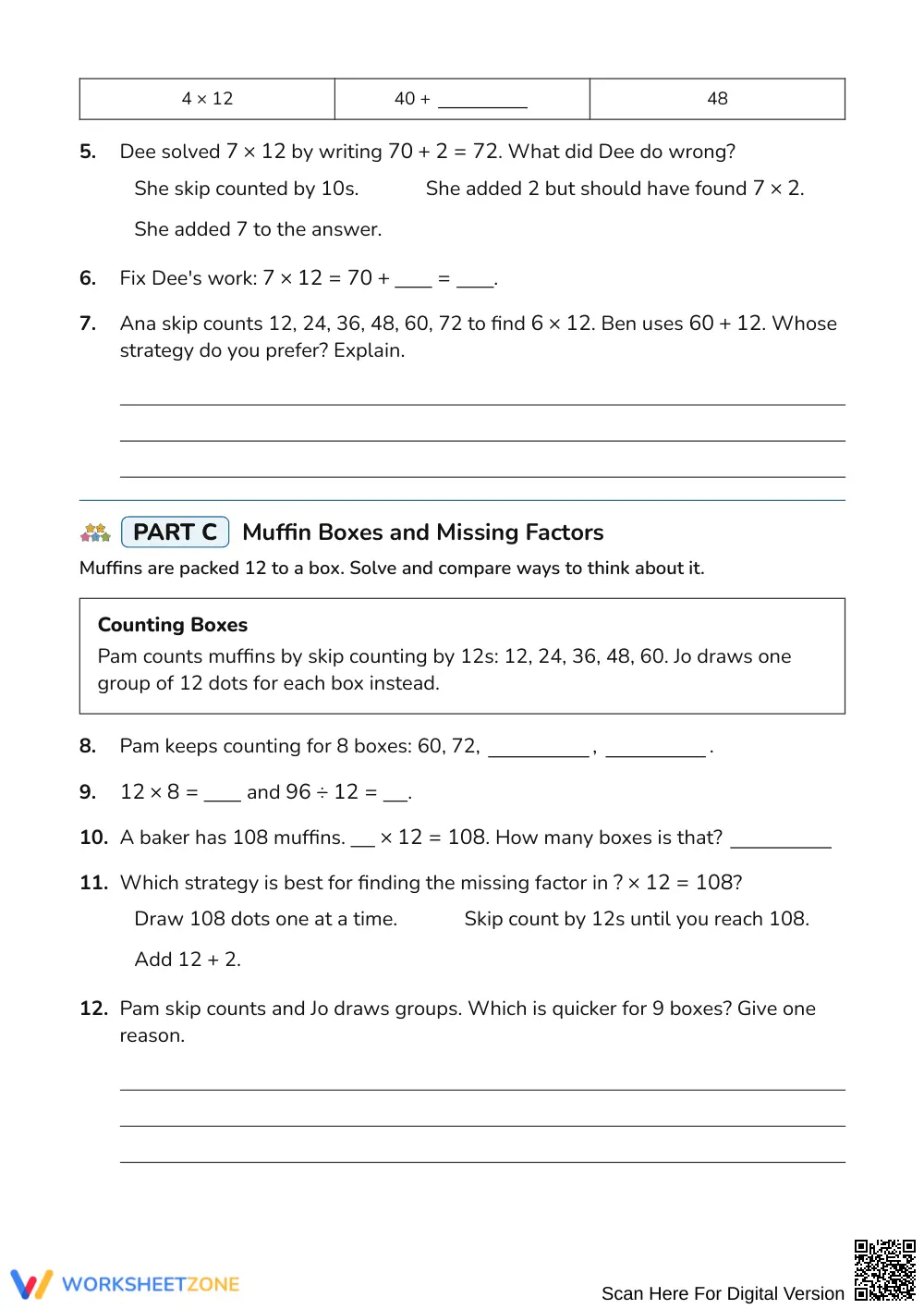
This 2-page printable provides 22 problems organized into three progressive sections. Students examine partitioned array models, complete a breakdown table converting factors into tens and twos, correct student errors, and evaluate word problems. A complete 2-page answer key provides solutions and written explanation models.
Skill Progression
- Guided practice (Part A, 6 problems): Students compare partitioned arrays with skip-counting lines, verifying why breaking 12 into 10 and 2 aids computation.
- Supported practice (Part B, 8 problems): Learners examine a distributive property table, identify an error in peer work, and evaluate method efficiency.
- Independent practice (Part C, 8 problems): Students solve equal-group word problems, finding missing factors and justifying why skip counting outpaces drawing groups.
This gradual-release structure guides students from visual comparison to independent justification of procedural efficiency.
Standards Alignment
This worksheet directly targets primary standard `3.OA.B.5`, emphasizing the application of the distributive property to decompose factors of 12. Supporting standard `3.OA.A.3` connects these strategies to solving contextual word problems involving equal groups. Both standard codes can be copied directly into lesson plans, IEP goals, or district curriculum mapping tools.
How to Use It
Use Part A during direct instruction to launch a discussion comparing arrays and number lines. Then assign Parts B and C after instruction for partner analysis and error correction. For formative assessment, verify whether students can explain Dee's specific error. Total completion time is 25 to 35 minutes.
Who It's For
This resource serves Grade 3 students mastering multi-digit facts and Grade 4 students requiring intervention with decomposition. Visual arrays and organized tables support English learners, while comparison questions challenge advanced learners. Pair this worksheet with a distributive property anchor chart.
Mastering multiplication strategies requires students to move beyond rote memorization toward flexible operational reasoning. This resource targets standard 3.OA.B.5 by engaging third-grade learners in comparing multiplication representations, decomposing factors, and analyzing procedural efficiency when multiplying by 12. According to Fisher & Frey (2014), structured instructional sequences that guide students through peer model comparison, error analysis, and written justification promote deeper metacognitive awareness than repetitive calculation drills alone. When students evaluate why decomposing 12 into 10 and 2 simplifies multi-digit multiplication, they internalize the distributive property as an active problem-solving tool rather than an isolated formula. Providing clear visual models alongside contrasting solution methods allows learners to articulate their mathematical thinking, bridge concrete arrays with abstract multiplication, and choose efficient pathways when solving complex equations. Consequently, this worksheet builds rigorous conceptual understanding and enduring computational fluency across elementary mathematics curricula.


