































By 11s: Real-World Modeling Printable Worksheet

Paste this activity's link or code into your existing LMS (Google Classroom, Canvas, Teams, Schoology, Moodle, etc.).
Students can open and work on the activity right away, with no student login required.
You'll still be able to track student progress and results from your teacher account.
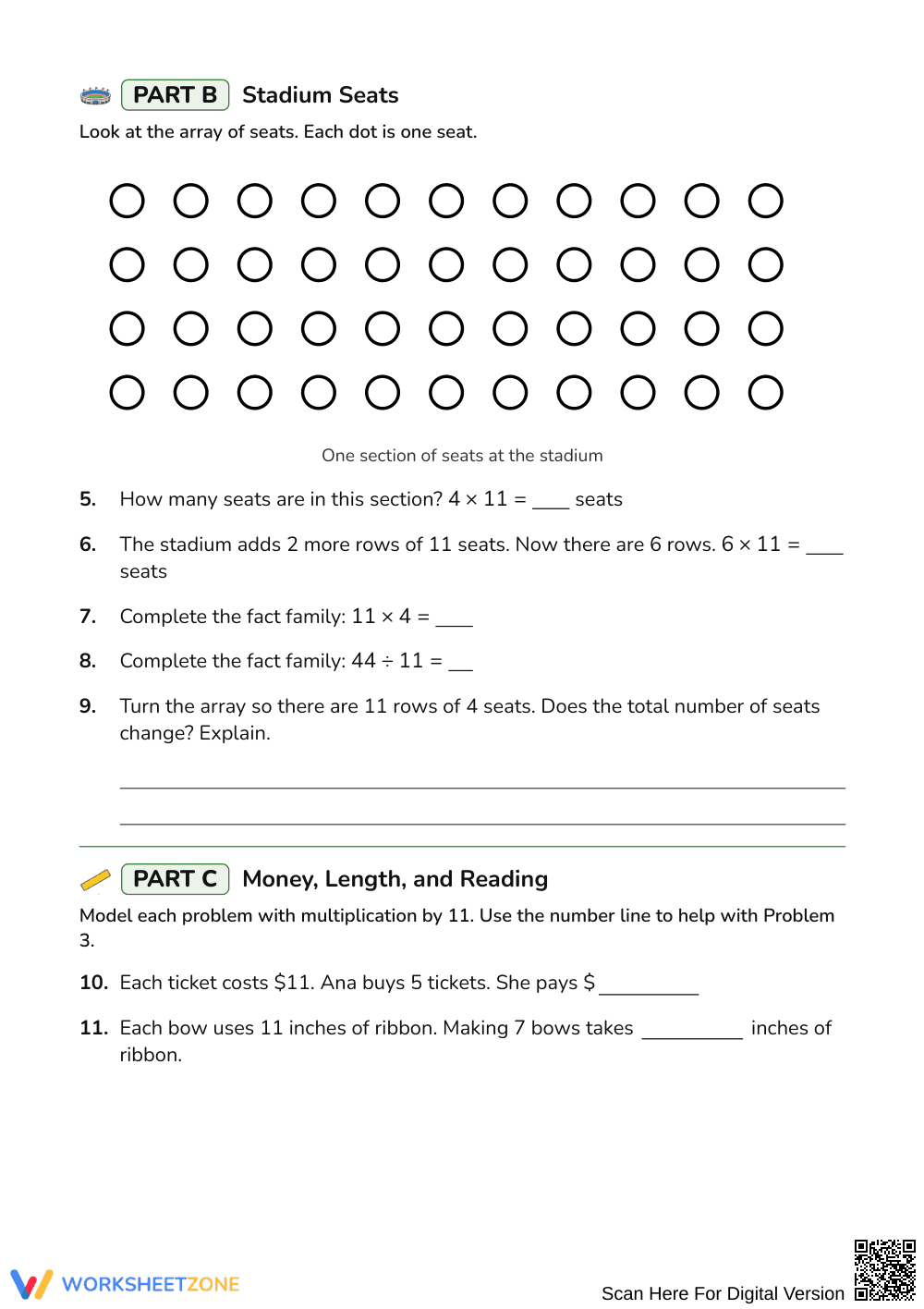
This Grade 3 math worksheet strengthens multiplication fluency by modeling equal groups of 11 in practical, real-world situations. Students interpret equal groups, examine stadium seating arrays, and solve authentic word problems involving money and measurement. By connecting multiplication sentences to concrete scenarios, learners build conceptual understanding and verifiable calculation accuracy across all 18 structured tasks.
At a Glance
- Grade: 3 · Subject: Math
- Standard:
3.OA.A.3— Solve word problems using multiplication and division within 100 in equal groups and arrays- Skill Focus: Real-World Modeling and Problem Solving with Factors of 11
- Format: 3 printable pages · 18 structured problems · Complete answer key included · PDF
- Best For: Post-lesson independent practice after direct instruction
- Time: 30–45 instructional minutes
What's Inside
This 3-page printable resource contains 18 carefully constructed mathematical tasks distributed across three dedicated real-world sections. Students encounter structured tables, visual dot arrays, open response word problems, and a number line model. The resource integrates sentence frames, fact family relationships, and error analysis tasks where students disprove misconceptions. A full 3-page answer key provides complete numerical solutions, arithmetic equations, and written explanations for efficient grading.
Skill Progression
- Guided practice (Problems 1–5): Students examine soccer team rosters using a completed ratio table of 11s, calculating team and player counts before explaining skip-counting patterns.
- Supported practice (Problems 6–10): Learners analyze stadium seat arrays, applying the commutative property and generating complete multiplication and division fact families with visual models.
- Independent practice (Problems 11–18): Students apply factors of 11 across varied financial, measurement, and reading contexts, using number lines and evaluating mathematical misconceptions without visual scaffolds.
This progression mirrors the gradual-release instructional model, moving students smoothly from structured observation to self-directed mathematical problem-solving.
Standards Alignment
This worksheet directly targets 3.OA.A.3: Use multiplication and division within 100 to solve word problems in situations involving equal groups, arrays, and measurement quantities. It also supports 3.OA.B.5 by prompting learners to verify that rotating an array preserves total quantity through the commutative property. Both standard codes can be copied directly into lesson plans, IEP goals, or district curriculum mapping tools.
How to Use It
Deploy this resource immediately after direct instruction on the 11s multiplication facts or during a targeted small-group intervention station. During classwork, circulate to observe how students justify Problem 18; students who confuse place value often write 707 instead of 77. The complete activity takes between 30 and 45 minutes to finish.
Who It's For
This worksheet serves general education third-grade classrooms, math intervention groups, and special education settings addressing foundational multiplication IEP goals. Teachers can pair this printout with a physical base-ten block manipulative lesson or an interactive skip-counting anchor chart before students begin independent problem sets.
According to Fisher & Frey (2014), structured cognitive scaffolding enables elementary students to transfer conceptual arithmetic understanding into flexible problem-solving competencies. This 3-page Grade 3 mathematics resource addresses standard 3.OA.A.3 by systematically engaging learners in solving multiplication word problems within 100 involving equal groups, arrays, and measurement quantities. By anchoring operations in relatable scenarios such as athletic rosters, stadium seat configurations, currency transactions, and daily reading rates, the 18 problems bridge visual modeling and abstract calculation. Students actively demonstrate relational thinking through fact families and skip-counting verification, directly confronting common place-value misconceptions in multi-digit notation. Educational research consistently shows that guided gradual-release structures reduce procedural anxiety while accelerating operational automaticity in foundational mathematics. This curriculum-aligned worksheet provides educators with rigorous diagnostic evidence of operational mastery, supporting standards-based reporting, IEP goal tracking, and targeted Tier 2 instructional interventions across elementary learning environments.


