































By 11s: Printable Multiple Representations

Paste this activity's link or code into your existing LMS (Google Classroom, Canvas, Teams, Schoology, Moodle, etc.).
Students can open and work on the activity right away, with no student login required.
You'll still be able to track student progress and results from your teacher account.
This Grade 3 math worksheet builds multiplication fluency for the eleven times tables through multiple representations. Students translate between arrays, number lines, function tables, and equations across 24 structured tasks. By connecting visual models to abstract number sentences, learners master multiplying by 11 with conceptual understanding.
At a Glance
- Grade: 3 · Subject: Math
- Standard:
3.OA.A.1— Interpret products of whole numbers using equal groups, arrays, and visual models.- Skill Focus: Multiplying by 11 using multiple representations
- Format: 2 pages · 24 problems · Answer key included · PDF
- Best For: Guided math and fluency practice
- Time: 25–35 minutes
What's Inside
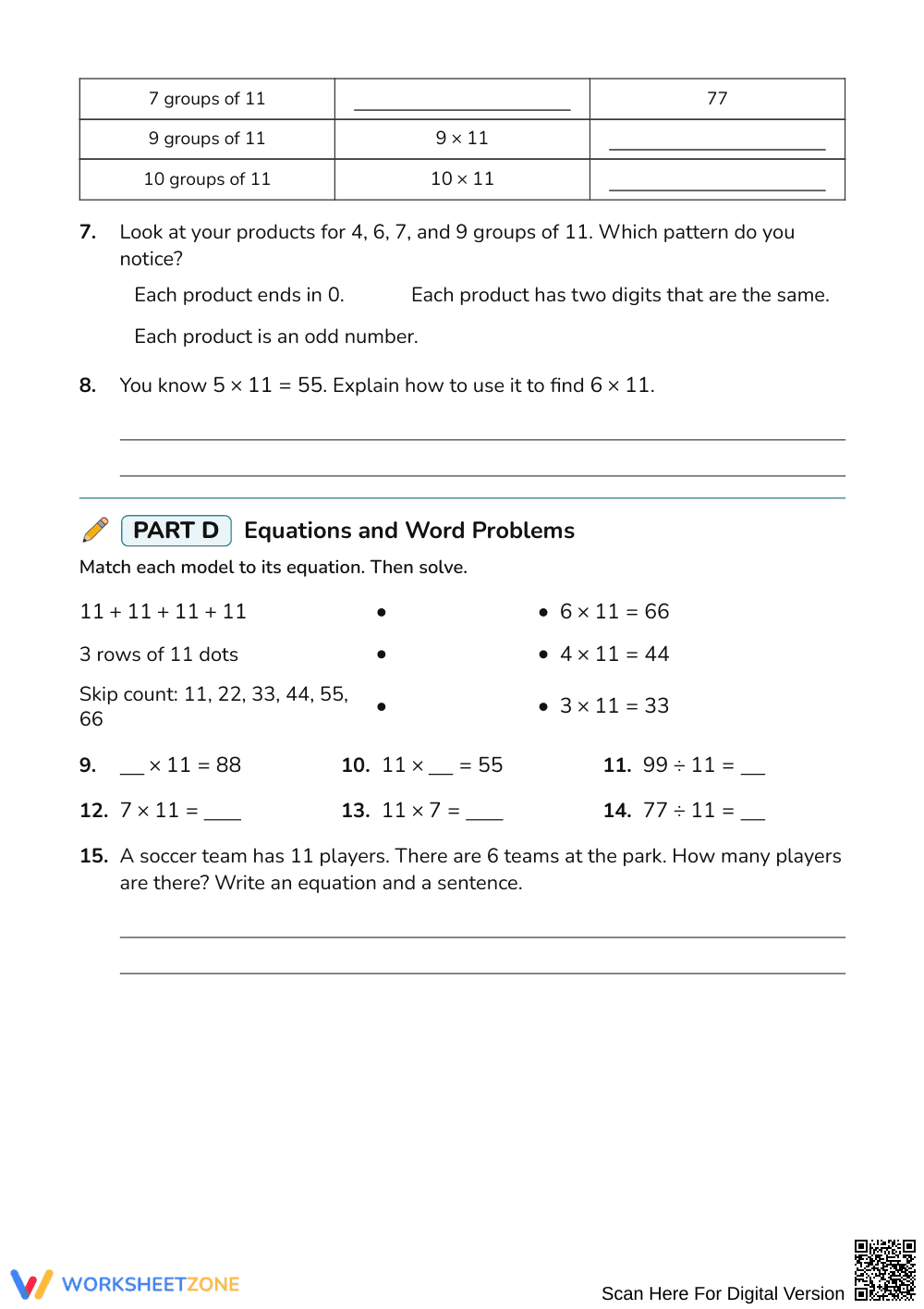
The 2-page printable activity features 24 problems distributed across four parts. Students examine dot arrays in Part A, track skip-counting on a number line in Part B, analyze tables and digit patterns in Part C, and connect models to equations and word problems in Part D. A complete 2-page answer key provides solutions for efficient grading.
Skill Progression
- Guided practice (Tasks 1–6): Visual arrays and number line jumps provide concrete scaffolding, prompting students to write repeated addition and basic multiplication equations.
- Supported practice (Tasks 7–14): Function tables and reflection questions prompt learners to identify two-digit patterns and apply additive reasoning.
- Independent practice (Tasks 15–24): Students independently match representations, solve isolated fact equations, and write complete sentences for contextual word problems.
This sequence follows the gradual-release model of I Do, We Do, You Do to build symbolic fluency from concrete models.
Standards Alignment
The primary focus aligns with `3.OA.A.1`: Interpret products of whole numbers, such as interpreting 3 × 11 as the total objects in 3 groups of 11. Supporting standard `3.OA.D.9` is addressed as students identify arithmetic patterns within the products. Both standard codes can be copied directly into lesson plans, IEP goals, or district curriculum mapping tools.
How to Use It
Deploy this worksheet during the active practice phase of direct instruction after introducing equal groups of 11. It also functions well during small-group intervention. While circulating, observe whether students count individual dots or recognize 11 as a composite unit. Expected completion time is 25 to 35 minutes.
Who It's For
This resource serves third-grade general education students, math intervention groups, and special education learners working on multiplication fluency. Pair this worksheet with base-ten blocks or a times-table anchor chart for additional visual support.
Multiplication fact mastery in elementary mathematics requires translating fluently across visual, numerical, and verbal representations rather than depending solely on rote memorization. Aligned to standard 3.OA.A.1, this instructional resource builds conceptual multiplication fluency for the eleven times table by systematically linking dot arrays, number line intervals, tables, and symbolic equations. Grounded in the instructional architecture described by Fisher & Frey (2014), the gradual-release design moves learners methodically from heavily scaffolded concrete representations to autonomous problem solving. Research demonstrates that multi-representational practice deepens place-value awareness and enhances arithmetic reasoning, enabling students to recognize consistent numerical patterns in two-digit products. By pairing contextual word problems with dual operations and explicit pattern analysis, this curriculum tool ensures third-grade students establish durable conceptual frameworks for multiplication facts that support subsequent multi-digit computation, algebraic thinking, and standardized assessment expectations across diverse elementary learning environments.


