































By 11s: Compare Strategies: Complete Guide

Paste this activity's link or code into your existing LMS (Google Classroom, Canvas, Teams, Schoology, Moodle, etc.).
Students can open and work on the activity right away, with no student login required.
You'll still be able to track student progress and results from your teacher account.
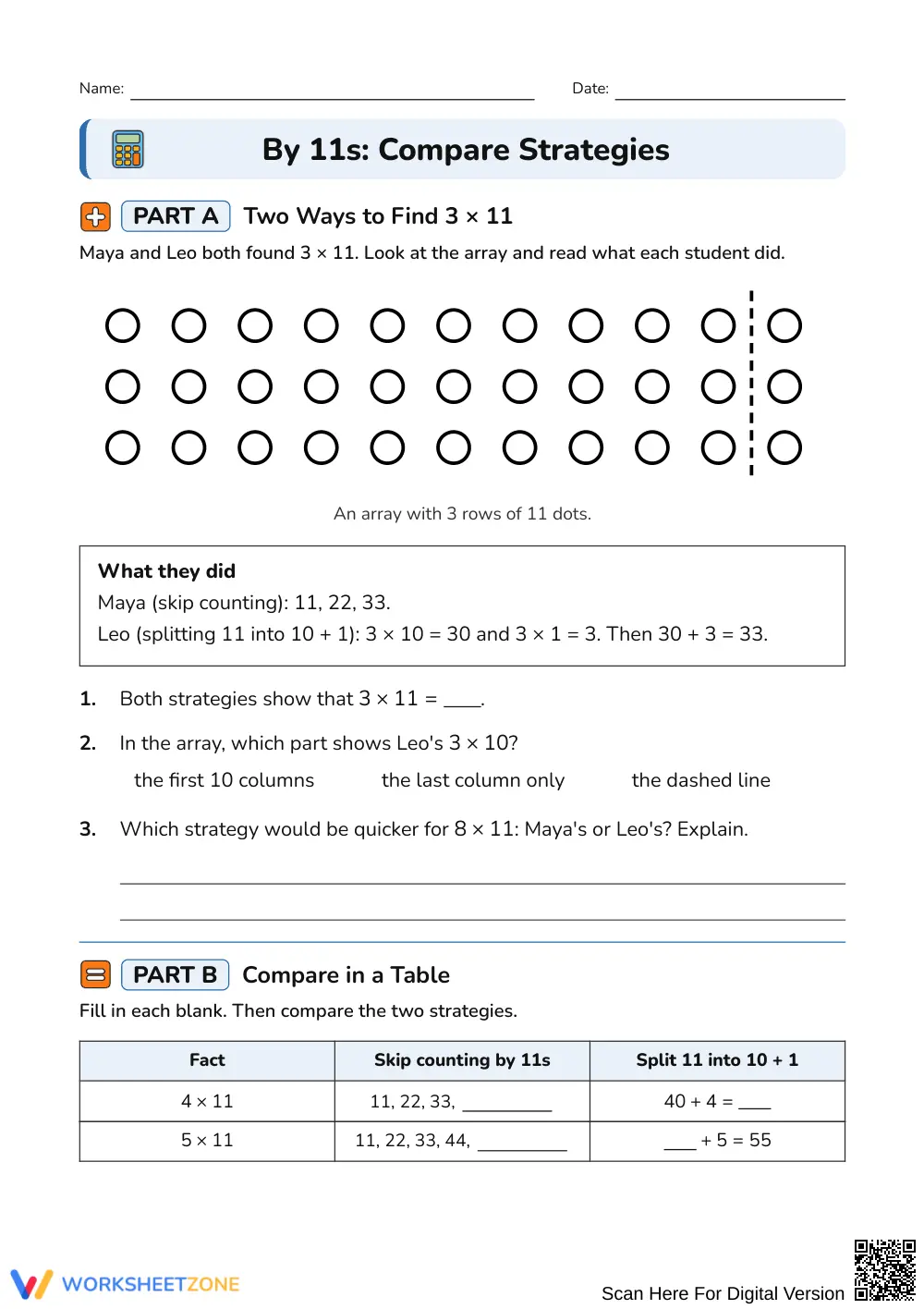
This Grade 3 math worksheet develops conceptual understanding and procedural fluency by having students compare skip counting with distributive splitting when multiplying by 11. Students evaluate visual arrays, analyze tabular patterns, identify calculation errors, and justify the efficiency of their chosen computation strategy across two engaging practice pages.
At a Glance
- Grade: 3 · Subject: Math
- Standard:
3.OA.B.5— Apply properties of operations to solve multiplication problems efficiently- Skill Focus: Comparing multiplication strategies for 11s
- Format: 2 pages · 15 problems · Answer key included · PDF
- Best For: Small-group or independent math practice
- Time: 20–30 minutes
What's Inside
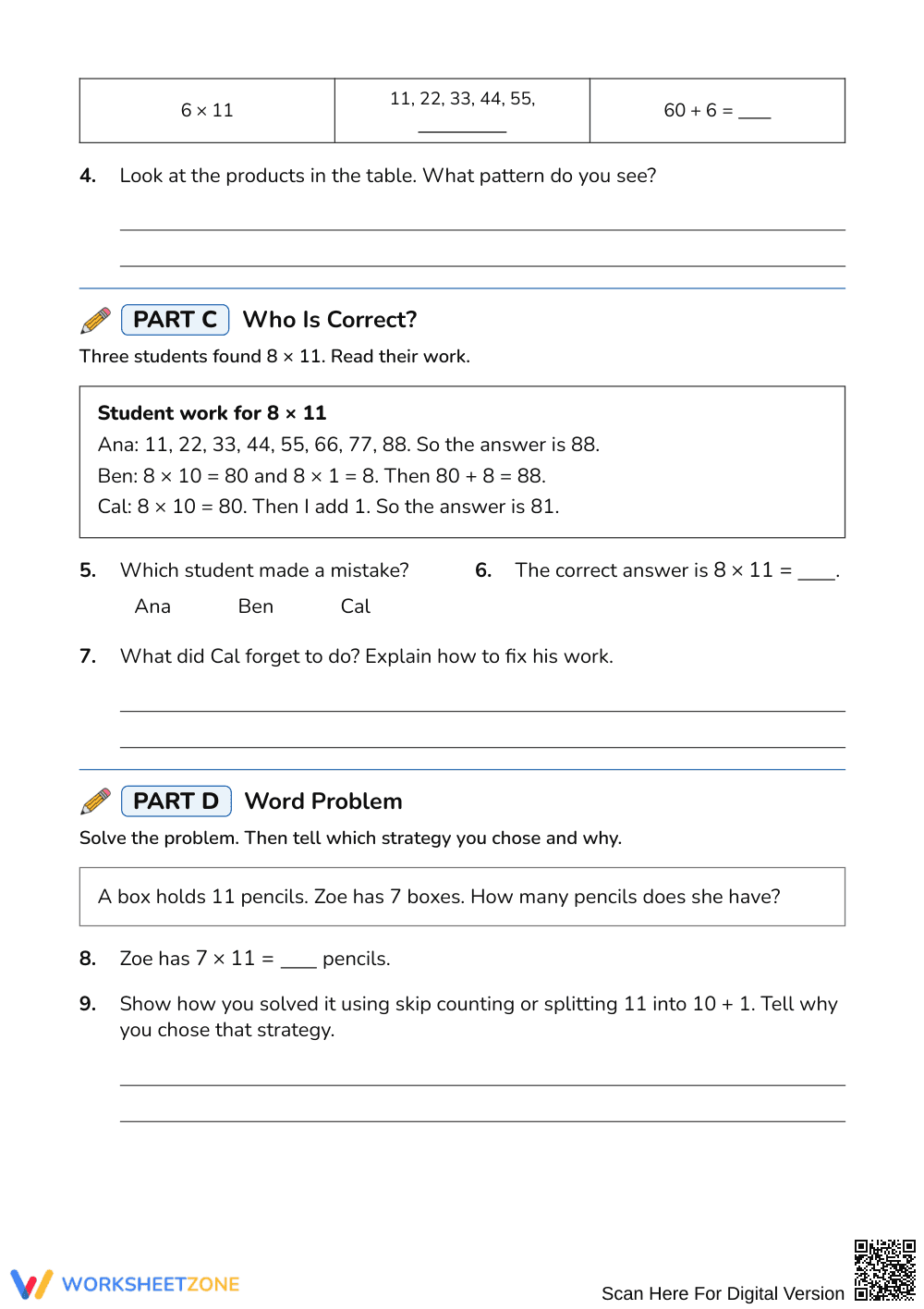
Across 2 structured pages, this resource presents 15 targeted problems organized into four distinct parts. Students examine an array model, complete a side-by-side comparison table, diagnose an error in student work, and solve a contextual word problem. A complete 2-page answer key provides worked-out solutions and sample student explanations for immediate feedback.
Skill Progression
- Guided practice (Part A, 4 problems): Examines a visual dot array split into 10 and 1, prompting learners to identify the partial products and evaluate strategy speed.
- Supported practice (Part B, 6 problems): Uses a structured comparison table where students generate skip-counting sequences alongside decomposed sums, identifying repetition patterns in products.
- Independent practice (Parts C and D, 5 problems): Requires students to detect a misconception in peer work and justify their own computation method in an applied word problem.
This sequence follows the gradual-release framework, moving learners smoothly from teacher-facilitated visual analysis to self-directed mathematical reasoning and written justification.
Standards Alignment
This worksheet directly aligns with 3.OA.B.5: Apply properties of operations as strategies to multiply and divide. In addition, the pattern analysis reinforces supporting standard 3.OA.D.9 by prompting students to identify arithmetic patterns in multiplication tables. Both standard codes can be copied directly into lesson plans, IEP goals, or district curriculum mapping tools.
How to Use It
Deploy this worksheet after direct instruction on the distributive property. During independent seatwork, observe whether students calculate 8 × 11 by counting jumps of 11 or immediately decompose the factor into 80 plus 8, which indicates operational fluency. Alternatively, use Part C as a mid-lesson formative checkpoint. Expect completion within 20 to 30 minutes.
Who It's For
Designed for general Grade 3 math classrooms, this resource supports students transitioning from additive skip counting to multiplicative reasoning. Teachers can pair this sheet with a physical base-ten block demonstration or an anchor chart displaying the distributive property for targeted tier-2 intervention.
Instruction aligned to 3.OA.B.5 encourages third-grade students to apply properties of operations, such as the distributive property, rather than relying exclusively on rote memorization or repetitive skip counting. Research highlighted by Fisher & Frey (2014) emphasizes that prompting learners to compare contrasting solution strategies deepens conceptual understanding and strengthens mathematical discourse. When students evaluate two valid or partially valid methods—such as decomposing a two-digit factor versus counting equal groups—they actively construct cognitive connections between visual models and abstract number relationships. This comparative analysis moves students past basic computation into metacognitive justification, reinforcing why breaking factors into friendly benchmark numbers like ten and one is more efficient for larger multipliers. Incorporating error analysis tasks further solidifies operational reasoning by challenging learners to identify and correct procedural misconceptions. Consequently, structured strategy comparison builds lasting multiplicative fluency and strategic competence across elementary mathematics curricula.


