


























Views
Downloads
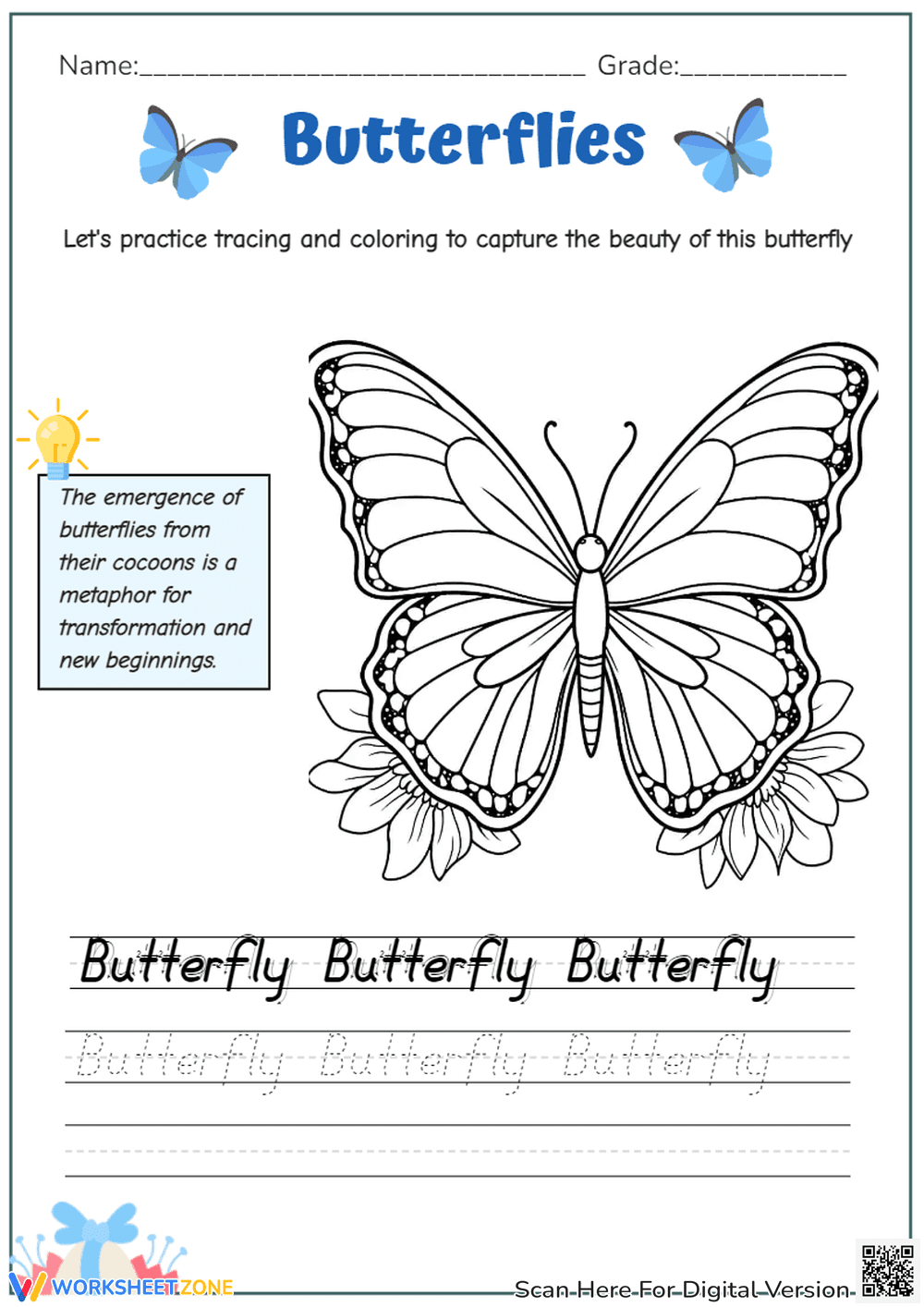

Butterfly Tracing Worksheet | Grade K-1 Printable
Paste this activity's link or code into your existing LMS (Google Classroom, Canvas, Teams, Schoology, Moodle, etc.).
Students can open and work on the activity right away, with no student login required.
You'll still be able to track student progress and results from your teacher account.
This Grade K-1 butterfly tracing and coloring worksheet helps young learners develop essential fine motor control and letter formation skills. By combining artistic expression with structured handwriting practice, students remain engaged while mastering the word Butterfly. It provides a multi-sensory approach to early literacy and science-themed vocabulary development.
At a Glance
- Grade: K-1 · Subject: Handwriting
- Standard:
CCSS.ELA-LITERACY.L.K.1.A— Print many upper- and lowercase letters with proper form- Skill Focus: Fine motor and letter formation
- Format: 1 page · 7 tasks · No answer key needed · PDF
- Best For: Morning work or spring science centers
- Time: 15–20 minutes
Inside this resource, you will find a high-quality illustration of a butterfly designed for detailed coloring. Below the image, a dedicated handwriting section features the word Butterfly in a clear model font, followed by a dashed tracing line and two empty primary ruled lines for independent practice. A small informational box provides a nature fact to spark curiosity.
The zero-prep workflow is designed for busy educators. First, print the single-page PDF in approximately 30 seconds. Next, distribute the sheets along with crayons and pencils to your students. Finally, review student letter height and line placement as they work. Total teacher preparation time is under 2 minutes, making it an ideal sub plan or transition activity.
This worksheet aligns with `CCSS.ELA-LITERACY.L.K.1.A`, which requires students to print many upper- and lowercase letters. It also supports `CCSS.ELA-LITERACY.L.1.1.A` by reinforcing proper spacing and legibility. Both standard codes can be copied directly into lesson plans, IEP goals, or district curriculum mapping tools to ensure compliance with state and national frameworks.
Use this worksheet during a spring-themed science unit or as a quiet morning work activity. It serves as an excellent formative assessment tool; observe how students grip their pencils and whether they follow the correct stroke order for the letter B. Expect completion within 15 to 20 minutes depending on the level of coloring detail chosen by the student.
This resource is perfect for Kindergarten and First Grade students, including those requiring occupational therapy support for grip strength. It pairs naturally with a read-aloud about life cycles or a classroom anchor chart showing the parts of an insect. The combination of art and writing makes it accessible for diverse learners.
Research from Fisher & Frey (2014) emphasizes the importance of integrated literacy tasks where students connect visual representation with written language. This worksheet applies these principles by linking the biological concept of a butterfly with the orthographic practice of writing the word. According to the NAEP, early mastery of fine motor skills is a significant predictor of later academic success in writing. By providing 7 distinct opportunities for engagement—ranging from artistic coloring to disciplined letter tracing—this resource ensures that students develop the muscle memory required for fluent handwriting. The inclusion of a nature fact further supports vocabulary acquisition within a meaningful context. This 1-page printable is a practical application of the gradual release of responsibility model, moving from a visual model to guided tracing and finally to independent production of text, meeting the rigorous demands of `CCSS.ELA-LITERACY.L.K.1.A`.


