


























Views
Downloads

Letter A Beginning Sounds Worksheet | Essential Kindergarten
Paste this activity's link or code into your existing LMS (Google Classroom, Canvas, Teams, Schoology, Moodle, etc.).
Students can open and work on the activity right away, with no student login required.
You'll still be able to track student progress and results from your teacher account.
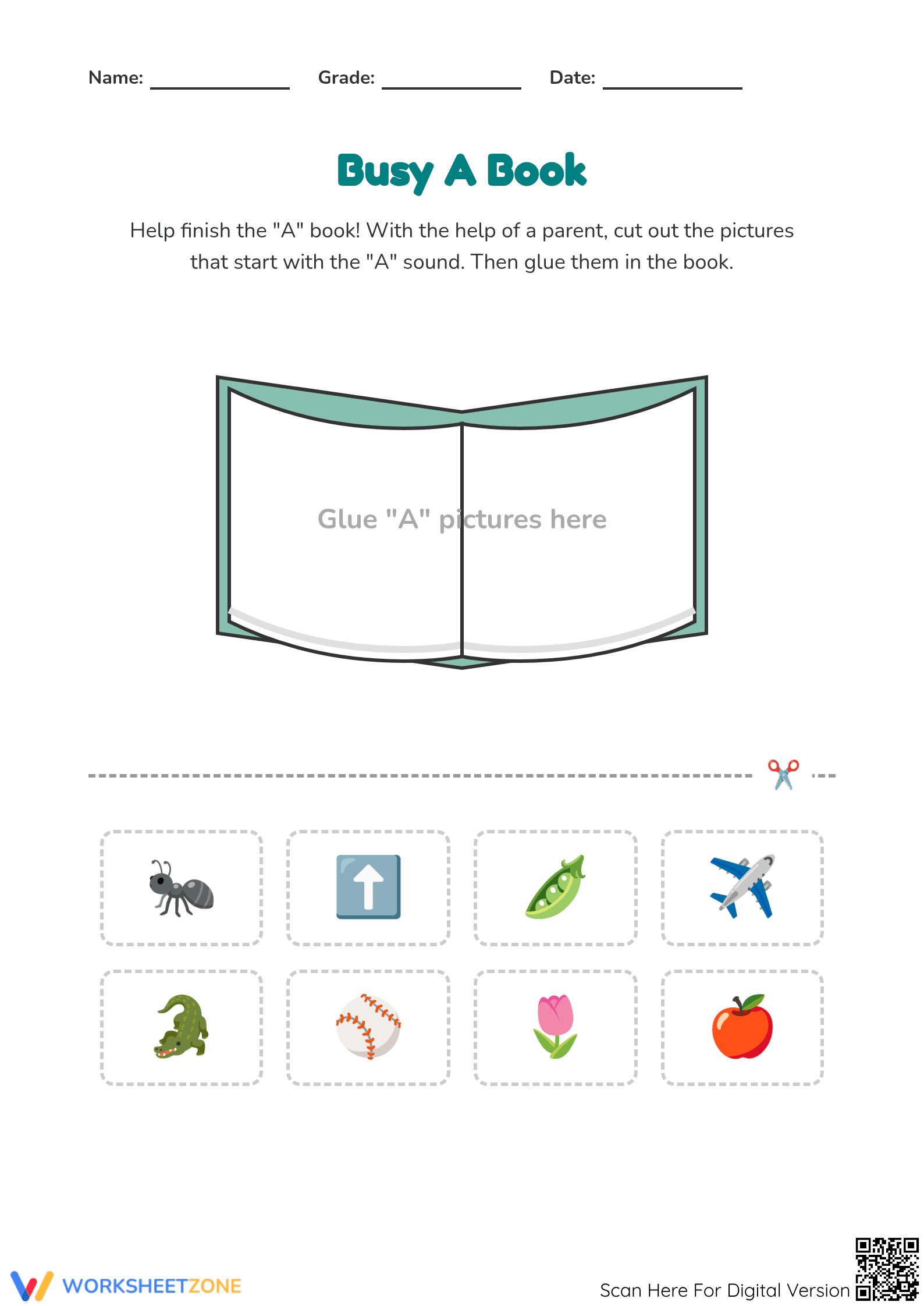
This Letter A phonics worksheet helps early learners master initial sound identification through an interactive cut-and-paste activity. Students develop phonemic awareness by distinguishing between words that start with the "A" sound and those that do not. This foundational exercise prepares children for decoding and successful early reading outcomes.
At a Glance
- Grade: Kindergarten · Subject: ELA Phonics
- Standard:
CCSS.ELA-LITERACY.RF.K.3.A— Demonstrate basic knowledge of one-to-one letter-sound correspondences- Skill Focus: Initial letter sound /a/
- Format: 1 page · 8 problems · Answer key included · PDF
- Best For: Morning work or literacy centers
- Time: 15–20 minutes
What's Inside: This 1-page PDF features a "Busy A Book" graphic and a collection of 8 sorting tiles. Students must evaluate images including an ant, apple, airplane, and alligator to determine which belong in their personalized book. The layout includes clear cutting lines and a dedicated gluing area, making it easy for small hands to manage independently.
Zero-Prep Workflow
- Print (1 min): Simply print the single-page PDF for your entire class or small group.
- Distribute (1 min): Provide students with scissors and glue sticks; no additional teacher setup is required.
- Review (2 mins): Use the included answer key for a quick visual check as students complete their books.
This resource is an ideal sub-plan addition because it is self-explanatory and requires no prior instructional context to complete.
Standards Alignment
The primary standard addressed is `CCSS.ELA-LITERACY.RF.K.3.A`: Demonstrate basic knowledge of one-to-one letter-sound correspondences by producing the primary sound or many of the most frequent sounds for each consonant. This worksheet specifically targets the short /a/ vowel sound in the initial position. Both standard codes can be copied directly into lesson plans, IEP goals, or district curriculum mapping tools.
How to Use It
Use this worksheet during the "You Do" phase of a phonics lesson after introducing the letter A. It works exceptionally well as a formative assessment; observe students as they sort to see who can distinguish the /a/ sound from distractors like the /p/ in peas or /t/ in tulip. Expected completion time is 15 to 20 minutes depending on fine motor speed.
Who It's For
This activity is designed for Preschool and Kindergarten students who are beginning their journey with the alphabetic principle. It is particularly helpful for students needing fine motor practice alongside academic content. Pair this with a Letter A anchor chart or a read-aloud book featuring alliterative "A" sentences for a comprehensive literacy experience.
According to Fisher & Frey (2014), the gradual release of responsibility in phonics instruction begins with clear, isolated sound identification. This worksheet aligns with CCSS.ELA-LITERACY.RF.K.3.A by requiring students to demonstrate basic knowledge of one-to-one letter-sound correspondences. By isolating the "A" sound across 8 distinct visual prompts, the activity provides the repetition necessary for neural mapping of phonemes. Research from the NAEP suggests that early mastery of beginning sounds is a significant predictor of third-grade reading proficiency. This resource bridges the gap between auditory recognition and physical manipulation, reinforcing the alphabetic principle through tactile engagement. Educators can use this tool to identify students who may require additional intervention in phonological processing. The inclusion of non-examples, such as peas and tulips, ensures that students are actively discriminating sounds rather than simply completing a rote task. This evidence-based approach supports long-term literacy development in early childhood settings.


