




























Views
Downloads



Building a Dichotomous Key | Grade 3-5 Printable Worksheet

Paste this activity's link or code into your existing LMS (Google Classroom, Canvas, Teams, Schoology, Moodle, etc.).
Students can open and work on the activity right away, with no student login required.
You'll still be able to track student progress and results from your teacher account.
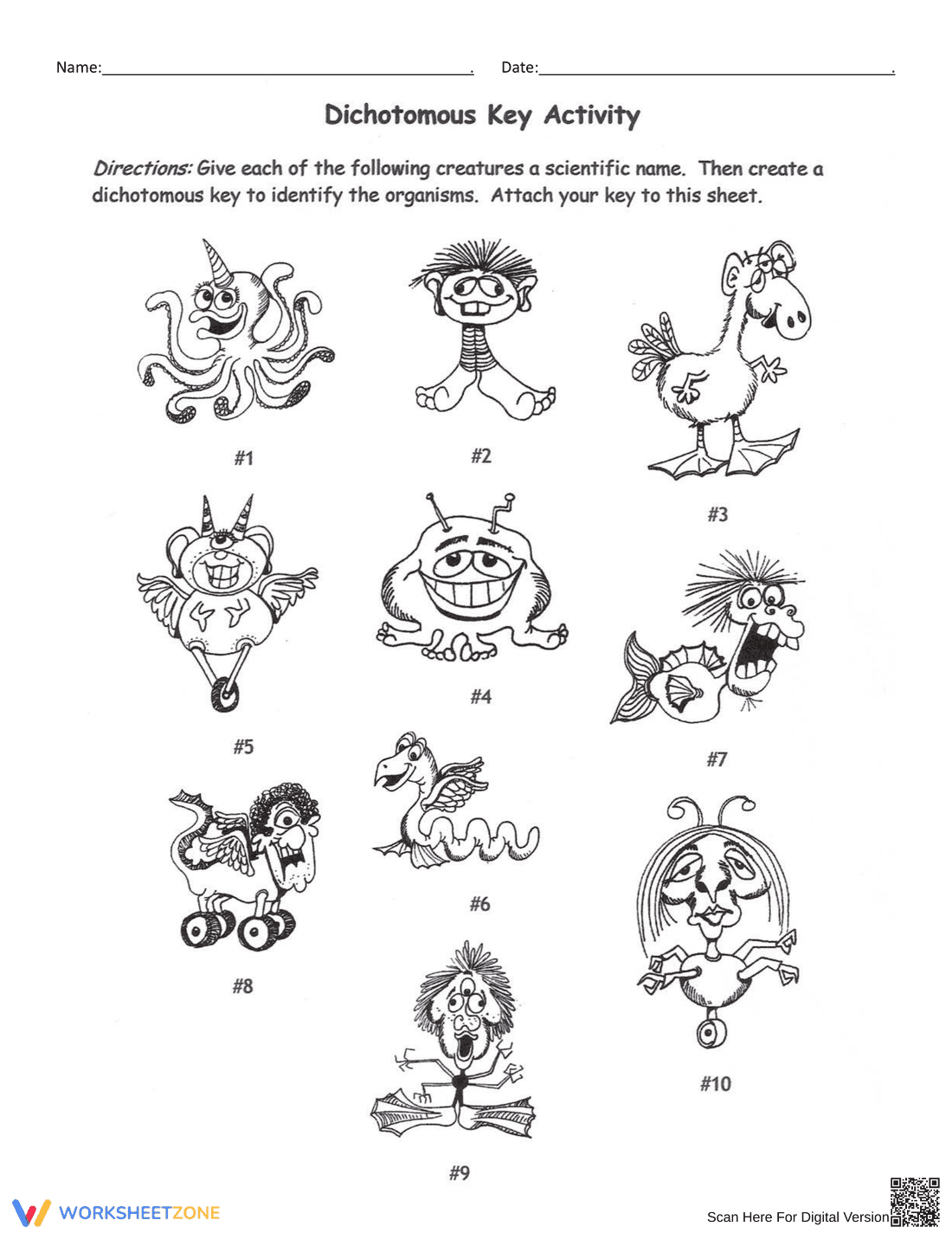
This comprehensive science worksheet introduces students to the fundamentals of biological classification by teaching them how to build and use a dichotomous key. Students will analyze the physical traits of whimsical alien creatures, categorize them based on observable characteristics, and answer analytical questions to solidify their understanding of taxonomy.
At a Glance
- Grade: 3–5 · Subject: Science
- Standard:
3-LS3-1— Analyze physical traits to categorize organisms- Skill Focus: Building a Dichotomous Key
- Format: 5 pages · 15 problems · PDF
- Best For: Independent practice or homework
- Time: 30–45 minutes
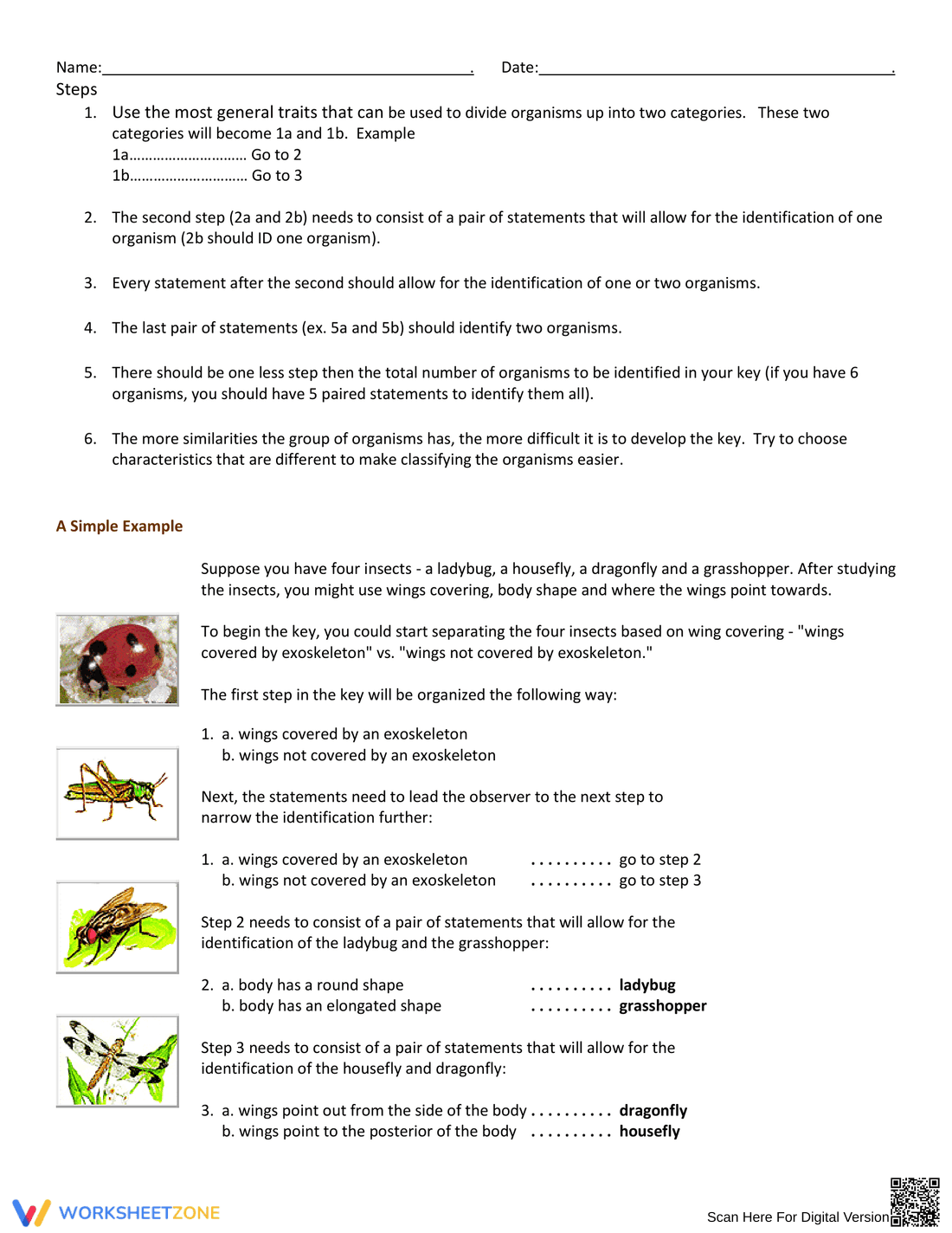
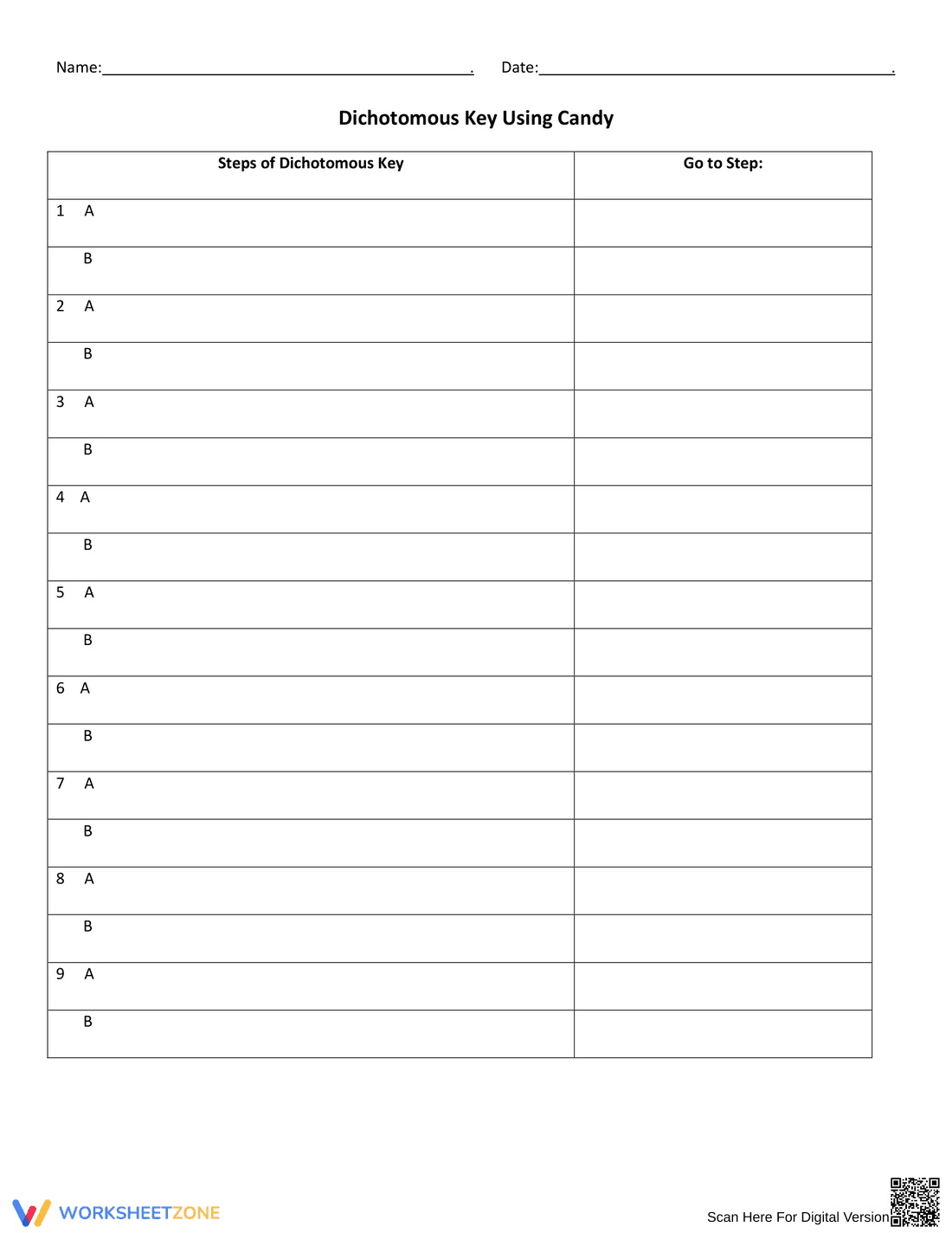
This five-page packet provides a complete, self-guided lesson on dichotomous keys. It begins with a clear introduction and step-by-step instructions, followed by a worked example using common insects. The core activity challenges students to name and classify 10 unique alien illustrations by creating their own contrasting statements. Finally, a dedicated analysis page features five short-answer questions that prompt students to reflect on the purpose and importance of scientific classification.
- Print (1 minute): Simply print the five-page PDF packet. The built-in instructions and examples mean no additional presentation materials are required.
- Distribute (1 minute): Hand out the packets to students for independent work, science centers, or as a structured homework assignment.
- Review (5 minutes): Discuss the analysis questions as a class to ensure students grasp why taxonomy is essential in the scientific community.
With under two minutes of total teacher prep time, this resource is an excellent zero-prep solution for busy educators or an ideal emergency sub plan.
Aligned to 3-LS3-1, this activity requires students to analyze and interpret data to provide evidence that variation of traits exists in a group of similar organisms. By focusing on the specific physical characteristics of the alien creatures, students practice the foundational observation skills necessary for advanced biological sciences. Both standard codes can be copied directly into lesson plans, IEP goals, or district curriculum mapping tools.
This worksheet is highly effective when used after a brief direct instruction session on animal adaptations or taxonomy. Teachers can assign the reading and insect example as guided practice, then let students tackle the alien classification independently. As a formative assessment tip, observe how students formulate their contrasting statements (e.g., "has horns" vs. "does not have horns"); this reveals their ability to isolate binary traits. Expected completion time is 30 to 45 minutes.
This resource is designed for upper elementary students in grades 3 through 5 who are exploring life science and taxonomy. The whimsical alien illustrations make the complex concept of dichotomous keys accessible and engaging for diverse learners. It pairs perfectly with an introductory lesson on the animal kingdom or a hands-on sorting activity using physical manipulatives.
Mastering the use of a dichotomous key is a critical stepping stone for students developing scientific literacy and observational skills. Aligned with 3-LS3-1, this activity requires learners to analyze physical traits to categorize organisms, reinforcing their ability to identify variations within a population. According to a ScienceDirect TpT Analysis (2024), structured classification activities that utilize visual models significantly improve students' capacity to process complex biological data and apply logical reasoning. By breaking down the categorization process into binary choices, students learn to systematically organize information—a skill that translates across multiple STEM disciplines. This foundational practice not only demystifies taxonomy but also encourages analytical thinking, ensuring students are well-prepared for more advanced life science curricula in middle and high school.


