


























Views
Downloads
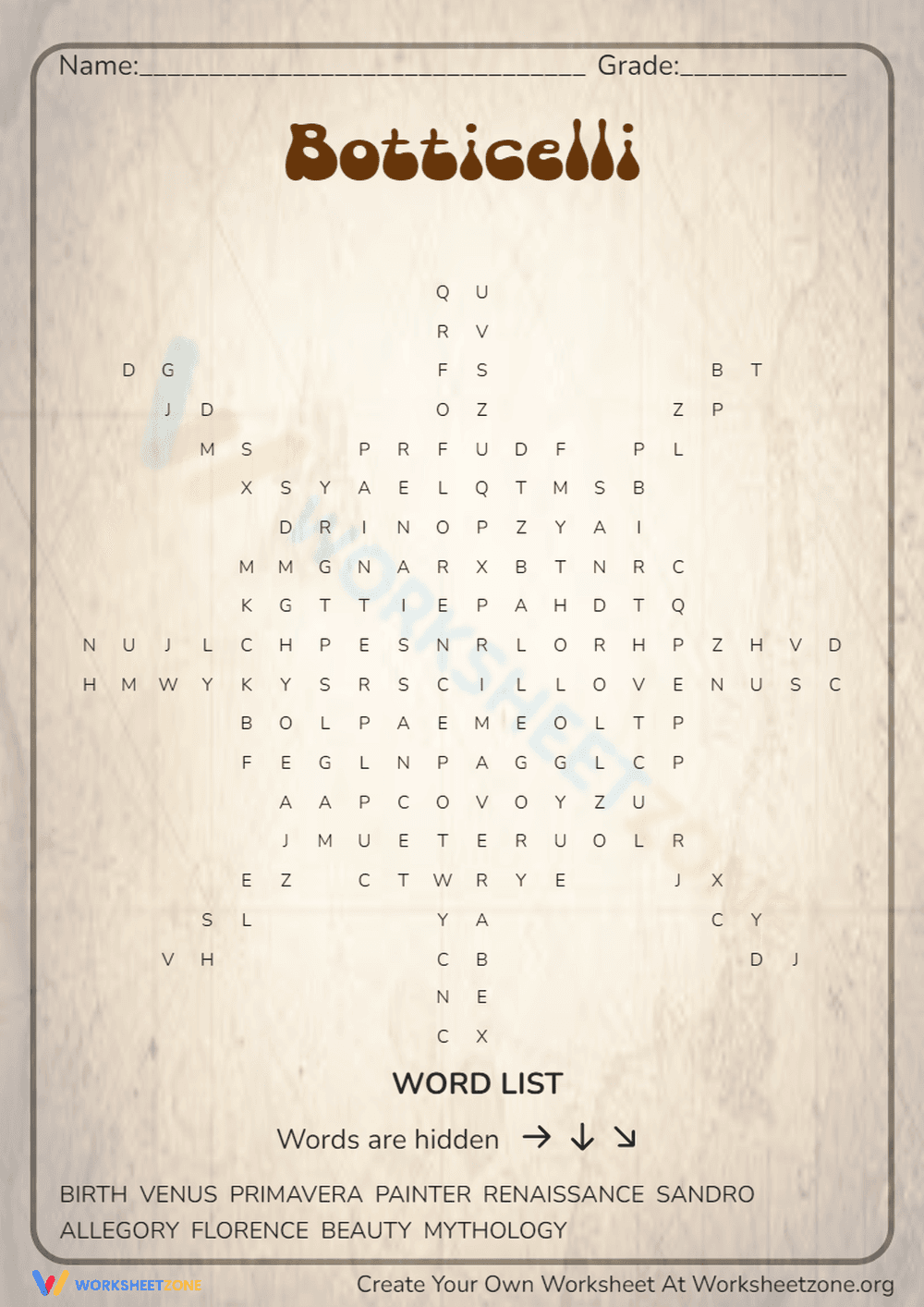

Botticelli Word Search | Printable Grade 3 Art Worksheet
Paste this activity's link or code into your existing LMS (Google Classroom, Canvas, Teams, Schoology, Moodle, etc.).
Students can open and work on the activity right away, with no student login required.
You'll still be able to track student progress and results from your teacher account.
This Botticelli word search introduces students to essential Renaissance vocabulary while reinforcing spelling and pattern recognition. By locating ten domain-specific terms hidden within the puzzle grid, learners build familiarity with art history concepts in an engaging, low-stakes format that supports broader cultural literacy and historical awareness.
At a Glance
- Grade: 3 · Subject: ELA / Art History
- Standard:
CCSS.ELA-LITERACY.L.3.6— Acquire and use domain-specific words- Skill Focus: Vocabulary Recognition
- Format: 1 page · 10 problems · Answer key included · PDF
- Best For: Independent practice or early finishers
- Time: 10–15 minutes
This single-page resource features a custom-shaped letter grid containing ten hidden words related to the Italian painter Sandro Botticelli. The provided word bank includes significant terms such as "Renaissance," "Primavera," "Florence," and "Allegory." Words are oriented horizontally, vertically, and diagonally, offering a moderate visual challenge. A complete answer key is provided to allow for quick verification of found words.
Zero-Prep Workflow
- Print (1 minute): Generate the PDF and print a class set immediately. No special formatting or cutting is required.
- Distribute (1 minute): Hand out the puzzle alongside highlighters or pencils. The instructions are entirely self-explanatory.
- Review (1 minute): Display the answer key on the board for rapid self-correction.
Total teacher preparation time is under two minutes. This makes the activity an excellent, reliable option for emergency sub plans or unexpected schedule changes.
This activity aligns with CCSS.ELA-LITERACY.L.3.6: Acquire and use accurately grade-appropriate conversational, general academic, and domain-specific words and phrases. By exposing students to specialized art history terminology, the puzzle reinforces visual memory of complex spellings. Both standard codes can be copied directly into lesson plans, IEP goals, or district curriculum mapping tools.
Deploy this word search as an engaging hook before a direct instruction lesson on the Italian Renaissance. Students can familiarize themselves with the vocabulary before encountering the terms in a historical text. Alternatively, use it as a quiet, independent activity for early finishers during a broader social studies or art block. While students work, teachers can observe their scanning strategies and phonetic decoding skills as a quick formative assessment. Expected completion time ranges from ten to fifteen minutes.
This worksheet is primarily designed for third-grade students, though it remains highly accessible for grades one through five depending on reading levels. The visual nature of the puzzle provides natural differentiation for visual learners and English Language Learners who benefit from repeated exposure to new vocabulary in a stress-free context. It pairs perfectly with a short reading passage about Botticelli's life or a visual presentation of his famous paintings.
Integrating domain-specific vocabulary practice through structured visual activities significantly enhances long-term retention and reading comprehension. According to Fisher & Frey (2014), repeated exposure to specialized terminology in varied, low-anxiety formats builds the cognitive frameworks necessary for students to tackle complex informational texts. This Botticelli word search directly supports CCSS.ELA-LITERACY.L.3.6 by requiring students to acquire and use domain-specific words. As learners scan the grid for terms like "Mythology" and "Florence," they actively process orthographic patterns, which strengthens their overall spelling proficiency and academic vocabulary acquisition. Providing these targeted, content-rich puzzles ensures that students are not merely memorizing definitions, but are visually interacting with the language of art history. This foundational exposure prepares them for more rigorous analytical tasks in subsequent grades, bridging the gap between basic word recognition and advanced disciplinary literacy.


