


























Views
Downloads

Printable Blood Types Worksheet | Grade 9 Biology
Paste this activity's link or code into your existing LMS (Google Classroom, Canvas, Teams, Schoology, Moodle, etc.).
Students can open and work on the activity right away, with no student login required.
You'll still be able to track student progress and results from your teacher account.
This biology worksheet helps students master the mechanics of blood types, antigens, and antibodies to determine transfusion compatibility. By working through targeted scenarios, learners will build a strong foundation in codominance and human body systems.
At a Glance
- Grade: 9 · Subject: Biology
- Standard:
HS-LS3-3— Explain the variation and distribution of expressed traits- Skill Focus: Blood type compatibility and genetics
- Format: 2 pages · 14 problems · PDF
- Best For: Independent practice or review
- Time: 20–30 minutes
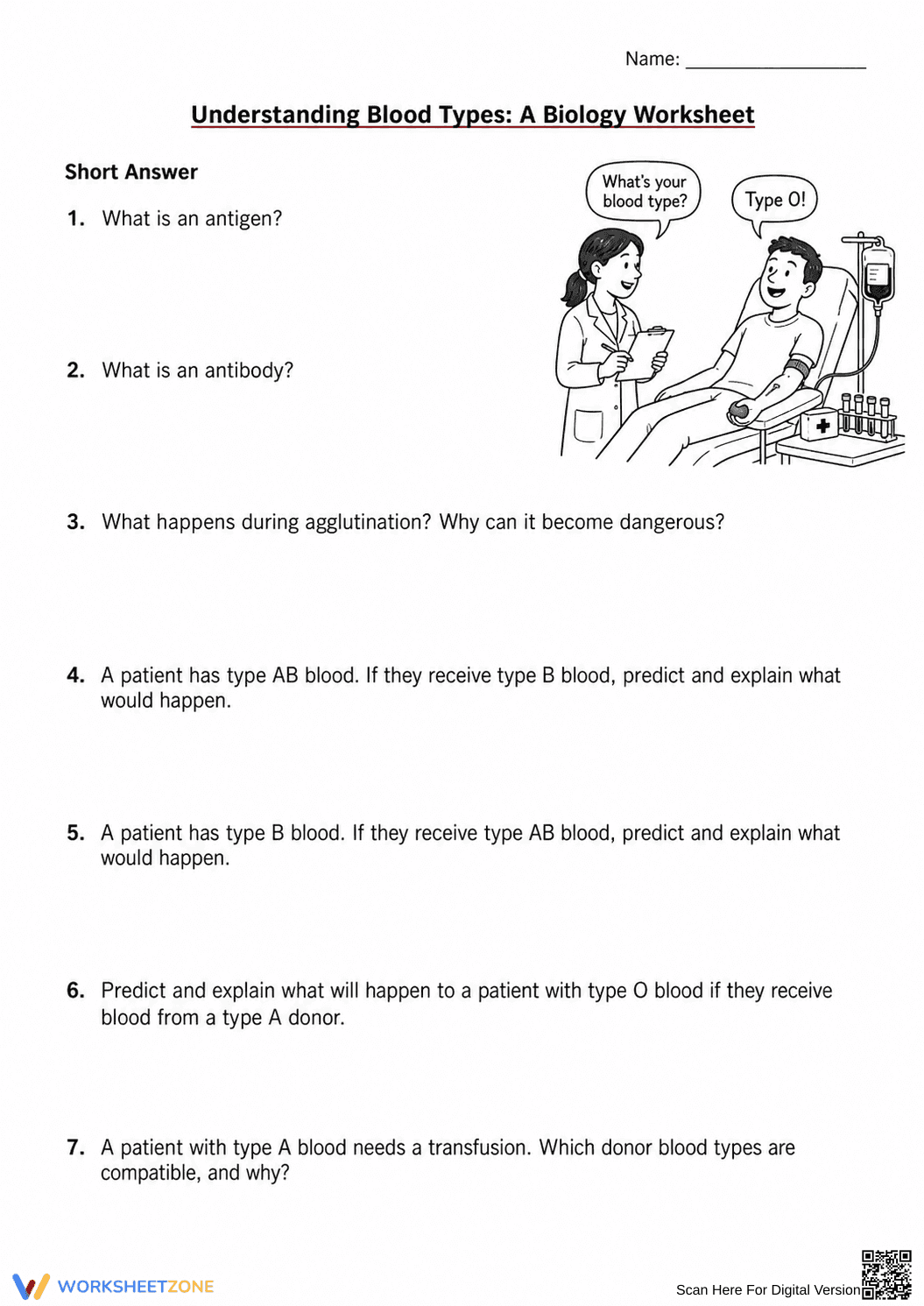
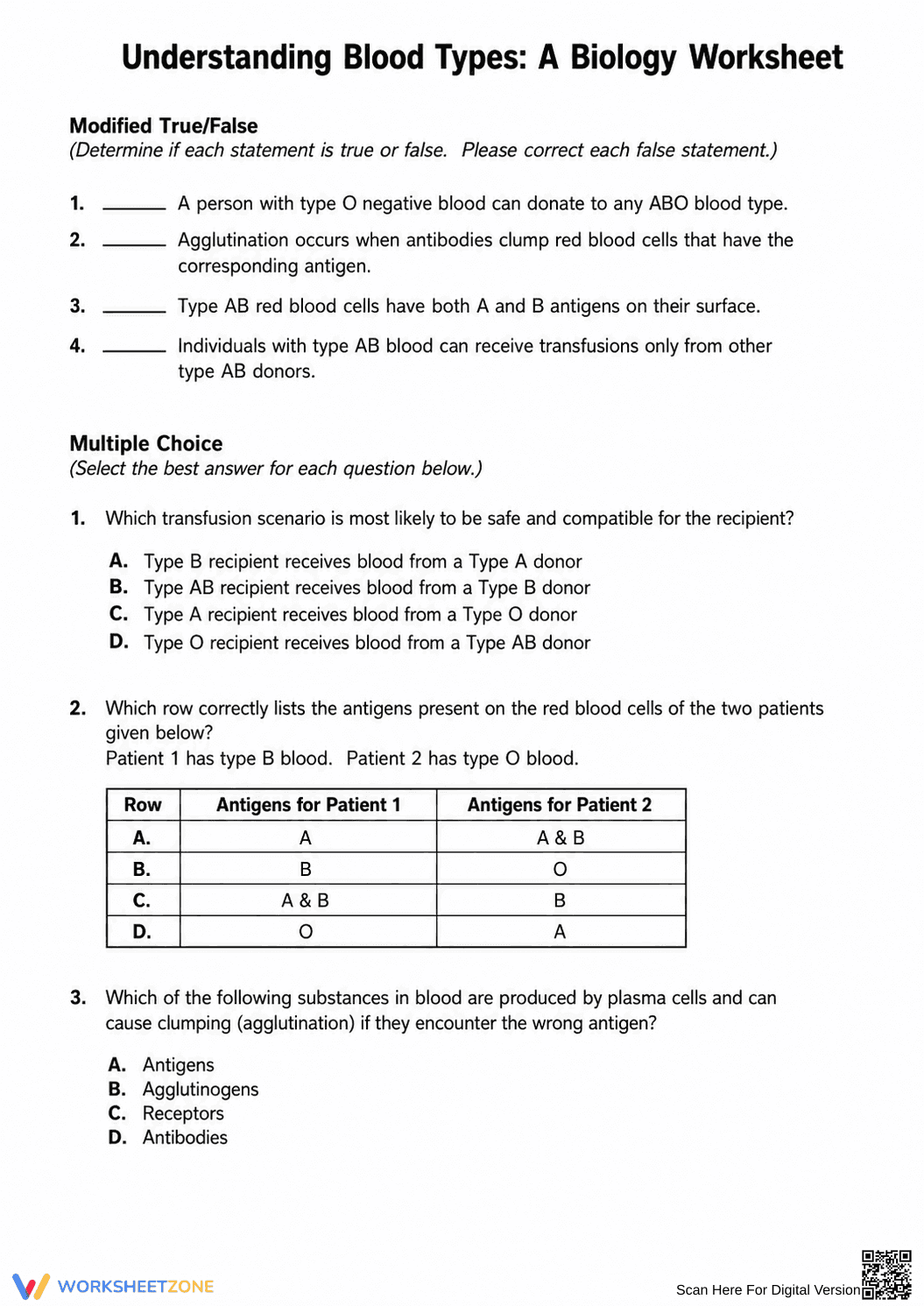
This two-page resource features 14 varied tasks, including seven short-answer questions requiring students to predict transfusion outcomes, four modified true/false statements, and three multiple-choice questions. The structured format includes a helpful cartoon illustration and clear, organized sections to guide student thinking.
- Guided practice: Initial short-answer questions define foundational terms like antigens, antibodies, and agglutination.
- Supported practice: Scenario-based questions ask students to predict and explain the outcomes of specific mismatched transfusions.
- Independent practice: Multiple-choice and modified true/false questions test comprehensive understanding of donor compatibility and blood group systems.
This gradual-release approach ensures students confidently transition from basic definitions to complex application.
Aligned to primary standard HS-LS3-3: Apply concepts of statistics and probability to explain the variation and distribution of expressed traits in a population. It also supports general life science standards regarding human body systems and immune responses. Both standard codes can be copied directly into lesson plans, IEP goals, or district curriculum mapping tools.
Use this worksheet as an independent homework assignment after direct instruction on codominance and multiple alleles. Alternatively, it serves as an excellent formative assessment during a human body systems unit. Teachers can quickly gauge student comprehension by reviewing their explanations for the transfusion prediction scenarios. Expected completion time is 20 to 30 minutes.
Designed for high school biology and middle school life science students. It is easily differentiated by allowing students to use a blood type compatibility chart as a scaffold. Pairs perfectly with introductory lessons on genetics or a laboratory activity on simulated blood typing.
Understanding the biological mechanisms behind blood type compatibility is essential for mastering complex genetic traits and human physiology. Aligned with HS-LS3-3, this resource helps students explain the variation and distribution of expressed traits within a population. According to a ScienceDirect TpT Analysis, structured scenario-based questioning significantly improves student retention of abstract biological concepts like antigen-antibody interactions and the mechanics of agglutination. By applying these principles to real-world transfusion scenarios, learners develop the critical thinking skills necessary for advanced scientific literacy and medical understanding. This instructional approach bridges the gap between theoretical genetics and practical application, ensuring that students can articulate why certain blood groups are compatible while others trigger immune responses. Furthermore, integrating these evidence-based strategies into the classroom environment fosters a deeper engagement with the curriculum, allowing educators to meet diverse learning needs while maintaining high academic standards for all biology students. This comprehensive resource provides the necessary scaffolding to achieve these goals effectively.


