Understanding sentence structure begins with recognizing the subject, the part of a clause that identifies who or what the clause is about. In traditional school grammar, the terms “simple subject” and “complete subject” describe different amounts of that subject information.
This article explains the complete subject, how it differs from the simple subject, which modifiers belong to it, and how its position can change in questions and inverted sentences. The examples and activities provide a practical method for analyzing complete subjects accurately.
What is a Complete Subject?
To understand a complete subject, it’s essential to first understand the basics of a sentence’s structure: subject and predicate.
- Subject: This is the part of the sentence that tells us who or what the sentence is about.
- Predicate: This is the part that says something about the subject and contains the verb, along with any objects, complements, or modifiers that belong to it.
A complete subject includes the simple subject, usually a noun or pronoun, together with every determiner and modifier that belongs to it. A compound subject contains two or more coordinated simple subjects, while the complete subject includes the entire coordinated structure and its modifiers.

Components of a Complete Subject
A complete subject comprises the simple subject and its modifiers. Let’s break down the components with examples:
1. Simple Subject (Main Noun)
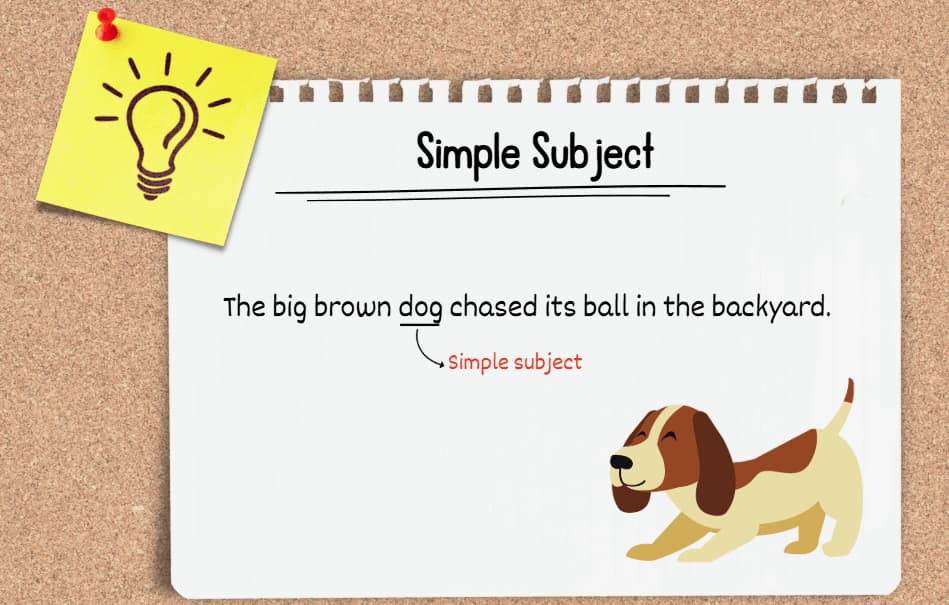
The simple subject is the core noun or pronoun within the complete subject. A compound subject contains more than one coordinated simple subject.
Examples:
- “dog” (in “The big brown dog”)
- “teacher” (in “Our favorite math teacher”)
- “book” (in “The interesting book about dinosaurs”)
2. Modifiers
Modifiers and determiners add information to the simple subject. The following structures commonly occur inside a complete subject:
Articles (a, an, the)
Articles “a,” “an,” and “the” function as determiners before nouns. The indefinite articles introduce a nonspecific singular count noun, while “the” marks a noun phrase as definite in context.
Example: “The fluffy cat slept by the fire.”
- Determiner and modifier: “The fluffy” includes the definite article and an adjective describing the cat.
- Complete subject: “The fluffy cat”
Adjectives (Descriptive words)
Adjectives describe or classify nouns by adding information such as size, color, quality, or number.
Example: “The large brown bear roamed the forest.”
- Determiner and modifiers: “The large brown” includes the article and two adjectives describing the bear.
- Complete subject: “The large brown bear”
Possessive Pronouns
Although school materials sometimes group these forms with possessive pronouns, “my,” “your,” “his,” “her,” “our,” and “their” function as possessive determiners when they appear before nouns. Independent possessive pronouns such as “mine,” “hers,” and “theirs” stand without a following noun.
Example: “Her favorite book was on the shelf.”
- Possessive determiner: “Her” indicates possession or association and appears before “book.”
- Complete subject: “Her favorite book”
Prepositional Phrases
A prepositional phrase can modify the simple subject by identifying, classifying, or describing it. In school grammar, the phrase begins with a preposition such as “of,” “in,” “on,” or “with” and includes its complement.
Example: “The basket of fresh apples sat on the counter.”
- Modifier: “of fresh apples” (describes what is in the basket).
- Complete subject: “The basket of fresh apples”
Participle Phrases
Participial phrases are headed by participles and function adjectivally to modify a noun or pronoun. When such a phrase modifies the simple subject, it belongs to the complete subject.
Example: “The car speeding down the highway caught everyone’s attention.”
- Modifier: “speeding down the highway” (describes the car).
- Complete subject: “The car speeding down the highway”
Simple vs. Complete Subject
The simple subject identifies the core noun or pronoun, while the complete subject includes that core and every word or phrase that belongs with it.

- Simple Subject: The main noun or pronoun that the sentence is about, without any modifiers.
- Example: In “The students in the science class conducted an experiment,” the simple subject is “students.”
- Complete Subject: The simple subject along with all its modifiers.
- Example: In “The students in the science class conducted an experiment,” the complete subject is “The students in the science class.”
Recognizing this distinction also helps writers identify which noun controls subject-verb agreement. In the example, the verb agrees with “students,” not with “class.”
Complete Subject and Predicate
In traditional analysis, a declarative clause can be divided into a complete subject and a complete predicate. Questions and inverted constructions may place part of the predicate before the subject, and commands normally have an understood subject.
- Complete Subject: Includes the simple subject and its modifiers.
- Complete Predicate: Includes the verb or verb phrase and every object, complement, and modifier that belongs to the predicate.

For example, in “The quick brown fox jumps over the lazy dog.”
- Complete Subject: “The quick brown fox”
- Complete Predicate: “jumps over the lazy dog”
Understanding this division helps distinguish modifiers of the subject from objects, complements, and modifiers that belong to the predicate.
How to Identify a Complete Subject in a Sentence
Use the following steps to identify the complete subject while accounting for linking verbs, passive constructions, questions, and inversion:
Step-by-Step Guide
1. Identify the Verb and Predicate First
Start by finding the finite verb or verb phrase. Then identify the complete predicate, which includes that verb and any objects, complements, or modifiers belonging to it.
Example: “The small puppy barked loudly.”
- Verb: “barked”; complete predicate: “barked loudly”
2. Determine Who or What the Clause Is About
Ask which noun or pronoun the verb refers to. Avoid relying only on the “doer” test because a subject can be described by a linking verb or receive an action in a passive clause.
Example: “The small puppy barked loudly.”
- Subject: “The small puppy”
3. Include Determiners and Modifiers Belonging to the Subject
Include the words and phrases that determine, describe, or restrict the simple subject. Do not include material that belongs to the predicate.
Example: “The small puppy barked loudly.”
- Simple subject: “puppy”
- Complete subject: “The small puppy”
Examples with Annotations
1. Sentence: “A group of students is presenting its project.”
- Predicate: is presenting its project
- Simple subject: group
- Complete subject: A group of students
2. Sentence: “The old man with a cane walked slowly.”
- Predicate: walked slowly
- Simple subject: man
- Complete subject: The old man with a cane
3. Sentence: “Her brightly colored dress attracted attention.”
- Predicate: attracted attention
- Simple subject: dress
- Complete subject: Her brightly colored dress
These steps work for many common sentence patterns. In a question, account for an auxiliary before the subject; in an inverted sentence, check whether the subject follows the verb.
Complete Subject Worksheets and Activities
Practice helps students distinguish the simple subject from its full noun phrase. Worksheetzone activities can reinforce the process through several formats:

- Identifying Complete Subjects: Students read sentences and identify the complete subject, which includes the main noun and all its modifiers.
- Matching Activities: Match simple subjects with their correct modifiers to form complete subjects.
- Example: Match “dog” with modifiers like “the playful brown” to create “The playful brown dog.“
- Fill-in-the-Blanks: Complete the sentence by adding modifiers to the given simple subjects.
- Sentence Sorting: Provide mixed examples of complete and incomplete subjects for students to sort.
- Rewriting Exercises: Rewrite sentences by expanding the simple subject into a complete subject.
- Creative Writing Prompts: Encourage students to write their own sentences using specified simple subjects and add creative modifiers to form complete subjects.
These activities move from recognition to construction, helping students apply the distinction in complete sentences.
Frequently Asked Questions
1. Can a complete subject come at the end of a sentence?
Yes. In standard declarative order, the complete subject usually comes before the predicate. In questions and certain inverted constructions, it can follow an auxiliary or main verb.
Example: “Through the door walked my older brother with his new backpack.”
2. Is it possible to have more than one complete subject in a sentence?
A single clause can have a compound subject containing two or more coordinated simple subjects. Together, those elements form one complete subject for that clause. A sentence with multiple clauses may contain a separate complete subject in each clause.
Example: “The tall basketball player and his younger sister with the red hair both play sports.”
3. Do questions have complete subjects?
Yes. In many questions, an auxiliary verb appears before the complete subject while the main verb follows it.
Example: “Has the new student with the blue backpack arrived yet?”
4. How can I identify the complete subject in a sentence?
First find the finite verb or verb phrase, then identify the noun or pronoun it refers to. Locate the simple subject and include every determiner and modifier that belongs to it, while excluding words that belong to the predicate.
Wrapping Up!
A complete subject consists of the simple subject, or coordinated simple subjects, plus every determiner and modifier that belongs to it. Identifying this full unit helps explain subject-verb agreement and prevents modifiers of the subject from being confused with material in the predicate.
Begin with the finite verb or verb phrase, locate the noun or pronoun it refers to, and expand outward to include the subject’s modifiers. Remember that questions and inverted sentences may place the subject after part or all of the verb.
Visit Worksheetzone’s collection of grammar worksheets for additional practice with complete subjects, predicates, modifiers, and sentence structure.