




















If you’re searching for meaningful and age-appropriate poems for 6th graders, you’re in the right place. Sixth grade is a turning point where students start exploring deeper themes, richer vocabulary, and more figurative language. Poems at this level should spark curiosity while remaining accessible, allowing students to analyze, infer, and connect literature to their own experiences. The selections below balance classic, modern, humorous, and thought-provoking pieces tailored for middle-school readers.
20 poems for 6th graders
The following poems were chosen to match the interests and developmental stage of 6th graders. Each entry highlights why the poem works well and how to teach it effectively.
1. “Still I Rise” by Maya Angelou

This empowering poem celebrates resilience, confidence, and rising above negativity. Angelou’s strong voice and rhythmic repetition help students feel the emotion behind each line. Its themes of personal strength and dignity resonate strongly with 6th graders beginning to understand identity and empowerment. The poem also encourages discussions about fairness, courage, and facing challenges.
“You may write me down in history
With your bitter, twisted lies,
You may trod me in the very dirt
But still, like dust, I’ll rise.”
Teaching tip: Use this poem to introduce voice and tone, as Angelou’s confident delivery is unmistakable. Have students identify repeated phrases and discuss how repetition enhances meaning. Invite them to write journal reflections about a moment when they “rose above” something difficult. This poem also works well for dramatic reading to build fluency and expression.
2. “Caged Bird” by Maya Angelou
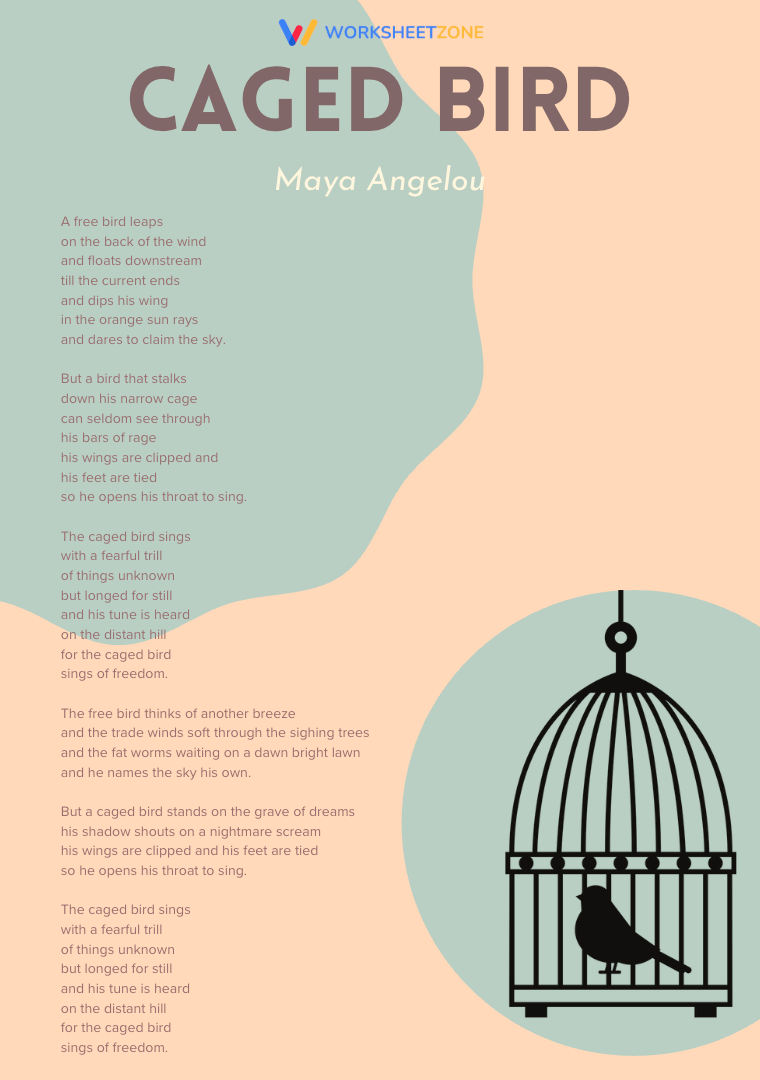
This poem contrasts the lives of a free bird and a caged bird, using vivid imagery to symbolize freedom and oppression. Students appreciate the clear comparison and emotional depth. Its symbolism opens meaningful conversations about independence, justice, and personal limitations. The language is accessible while still rich in metaphor and theme.
“A free bird leaps
on the back of the wind
and float downstream
till the current ends
and dips his wing
in the orange sun rays
and dares to claim the sky.”
Teaching tip: Use the poem to teach symbolism and extended metaphor. Have students annotate contrasting images of freedom versus confinement. Encourage a class discussion about how people experience “cages” in everyday life – fear, rules, insecurities, etc. Students can finish by writing their own metaphorical poem about freedom.
3. “I Am Offering this Poem” by Jimmy Santiago Baca

This heartfelt poem expresses love, care, and emotional generosity through simple, powerful imagery. Students connect with the idea of giving something meaningful that isn’t material. The poem uses repetition to strengthen its message about kindness, support, and the values of emotional connection. Its tone is warm and reassuring, making it highly relatable.
“I am offering this poem to you,
since I have nothing else to give.”
Teaching tip: Introduce theme and figurative language by analyzing the metaphors Baca uses to represent love. Ask students to identify lines showing warmth and emotional protection. Encourage them to write a paragraph about something meaningful they can “offer” someone. Pair this poem with a creative assignment where students design a symbolic gift inspired by the poem.
4. “Hanging Fire” by Audre Lorde
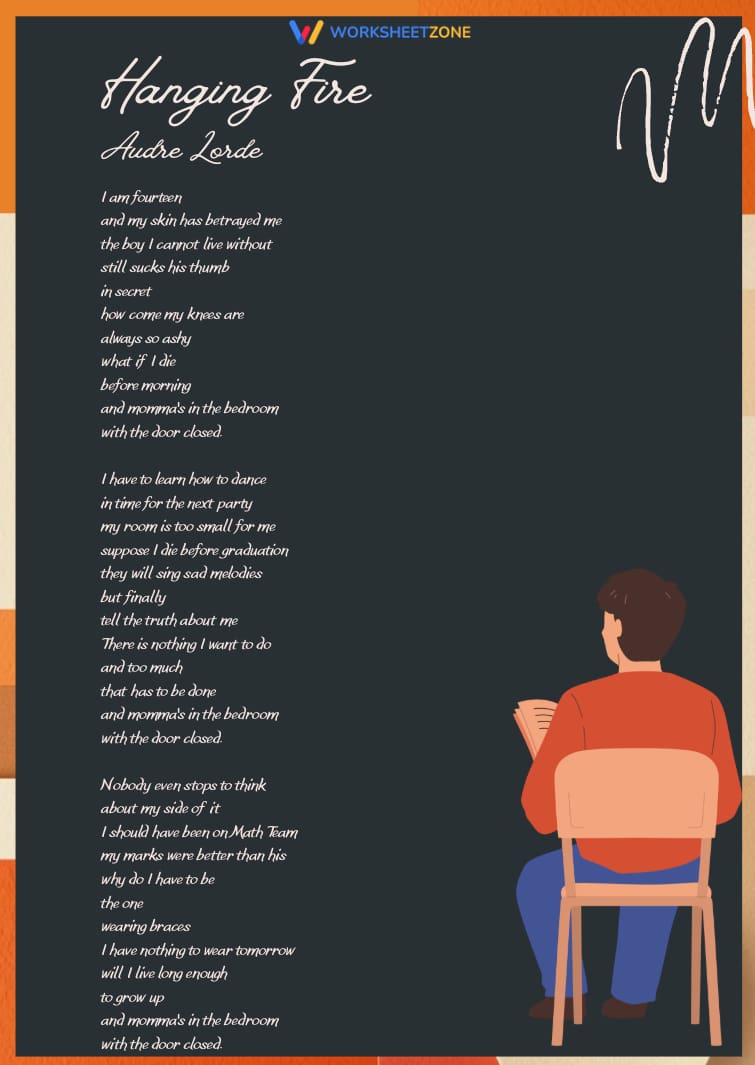
This poem explores the inner thoughts of a 14-year-old dealing with insecurity, growing changes, and feeling unseen. 6th graders strongly identify with the narrator’s worries and emotional landscape. Lorde’s use of repetition and short lines creates a sense of urgency and introspection. The poem provides an honest snapshot of adolescence, making it a powerful classroom discussion starter.
“I am fourteen
and my skin has betrayed me
the boy I cannot live without
still sucks his thumb
in secret”
Teaching tip: Use this poem to teach monologue and emotional voice. Ask students to analyze how repeated phrases reflect the character’s anxiety. Have them write a short reflection about a worry they’ve had and how they dealt with it. This poem also works well in SEL lessons about empathy and emotional awareness.
5. “The Cremation of Sam McGee” by Robert W. Service

This narrative poem blends adventure, mystery, and dark humor in a way that engages middle-school readers. With vivid descriptions of the Arctic landscape and a surprising twist ending, students stay hooked from start to finish. The storytelling style helps students visualize scenes clearly. Its blend of suspense and humor appeals especially to reluctant readers.
“There are strange things done in the midnight sun
By the men who moil for gold;
The Arctic trails have their secret tales
That would make your blood run cold;
The Northern Lights have seen queer sights,
But the queerest they ever did see
Was that night on the marge of Lake Lebarge
I cremated Sam McGee.”
Teaching tip: Use this poem to teach narrative elements in poetry, including setting, conflict, and climax. Students can map the story using a plot diagram. Discuss how rhyme and rhythm build suspense. A dramatic read-aloud helps bring the poem’s humor and tension to life.
6. “Invictus” by William Ernest Henley
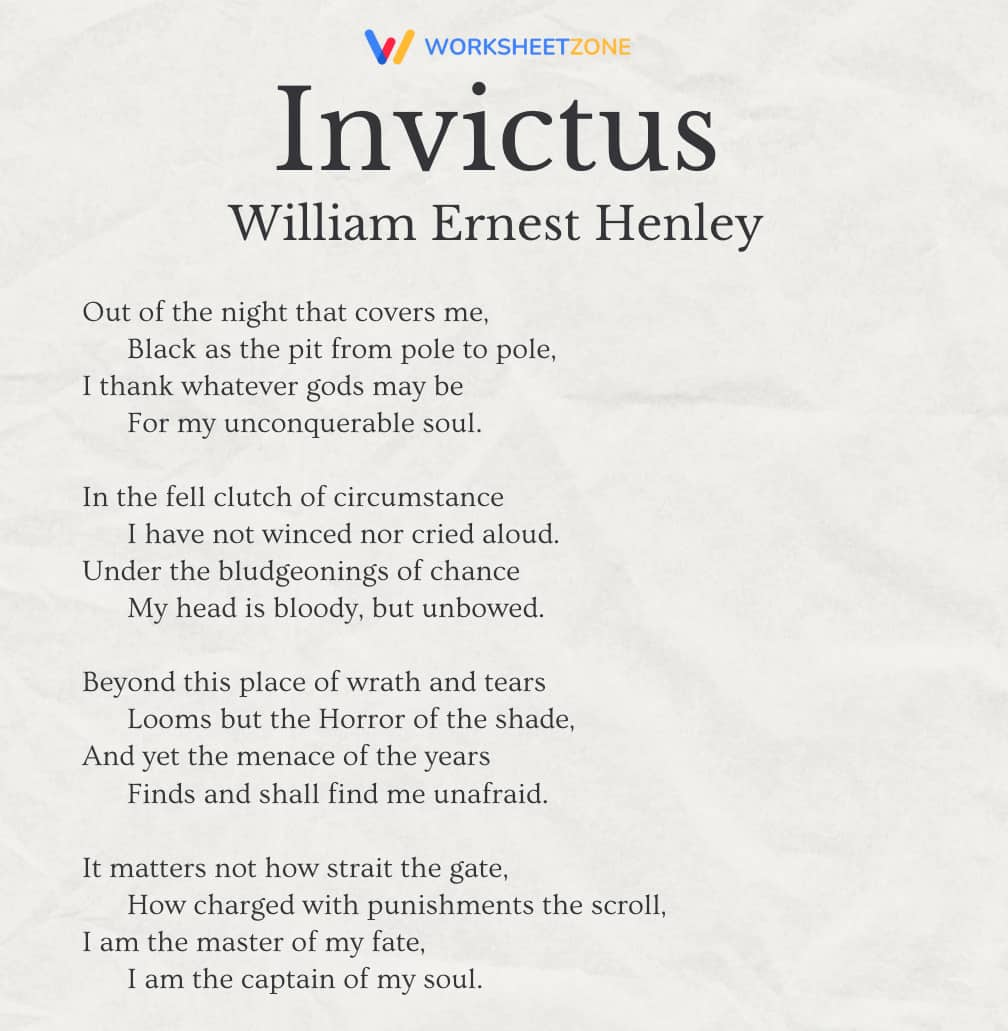
This classic poem embodies courage, inner strength, and determination in the face of hardship. Its famous line, “I am the master of my fate”, empowers young readers as they develop independence. The strong rhythm and bold tone captivate students. Despite the elevated vocabulary, the message resonates deeply with 6th graders.
“Out of the night that covers me,
Black as the pit from pole to pole,
I thank whatever gods may be
For my unconquerable soul.”
Teaching tip: This poem is perfect for teaching strong tone and impactful word choice. Have students annotate powerful phrases and discuss how they contribute to emotional intensity. Use it to spark conversations about perseverance and setting goals. A reflective writing prompt – “What does ‘master of my fate’ mean to you?” – works well.
7. “Harlem” by Langston Hughes
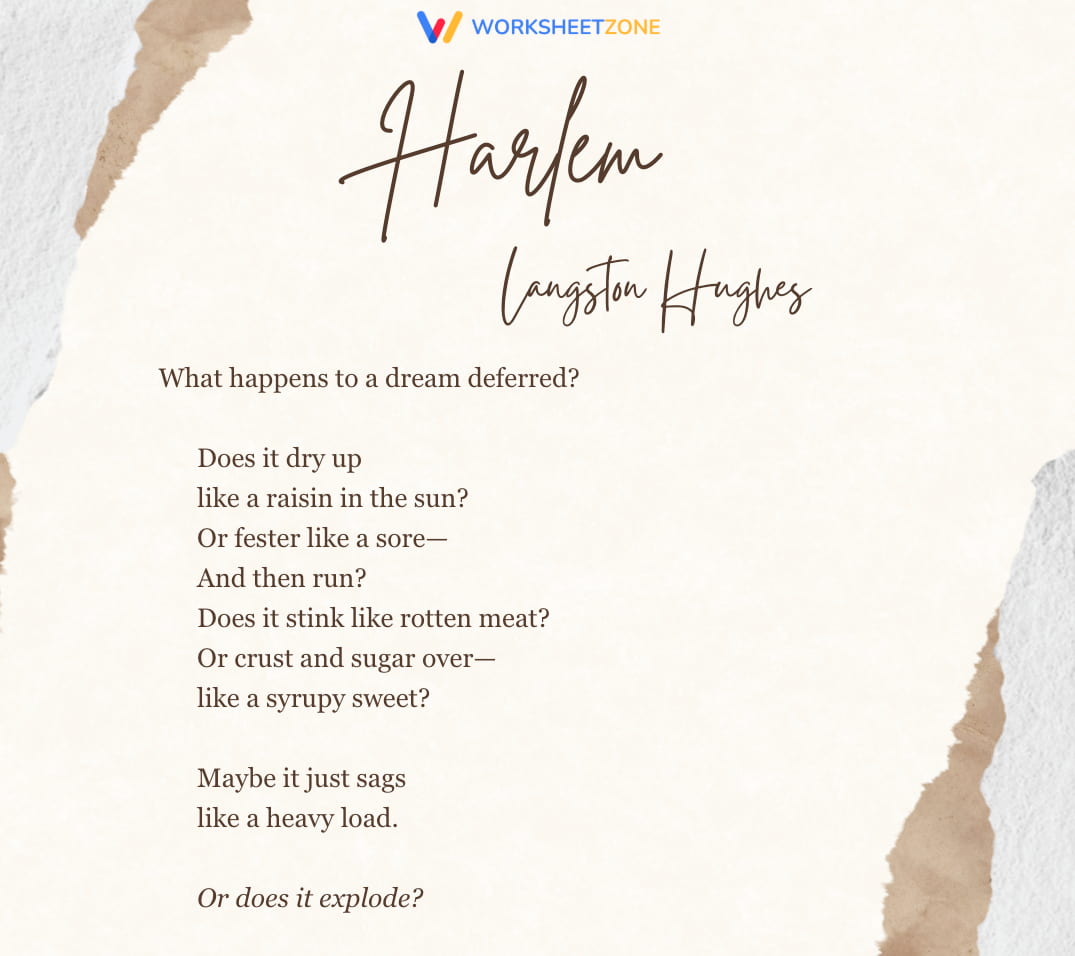
This short yet powerful poem uses vivid similes to explore what happens when dreams are delayed or ignored. Each comparison creates strong images that invite discussion and interpretation. The poem’s structure encourages students to think deeply about choices and consequences. Its ending question sparks curiosity and debate.
“What happens to a dream deferred?”
Teaching tip: Use this poem to teach similes and inference. Have students illustrate each simile and explain what it might symbolize. Hold a class debate on what they believe happens to a “dream deferred.” Encourage students to write their own simile-based poem about a feeling or idea.
8. “The Raven” (excerpt) by Edgar Allan Poe

This Gothic poem draws students into its eerie atmosphere with suspense, rhythm, and repetition. The mysterious raven and the narrator’s growing despair create an unforgettable mood. Middle-schoolers enjoy the dramatic tone and striking imagery. Excerpts work well for this age group due to the poem’s complexity and length.
“Once upon a midnight dreary, while I pondered, weak and weary,
Over many a quaint and curious volume of forgotten lore –
While I nodded, nearly napping, suddenly there came a tapping,
As of some one gently rapping, rapping at my chamber door.”
Teaching tip: Use it to teach mood, symbolism, and repetition. Play an audio recording to highlight tone and pacing. Ask students to annotate words that create a spooky or anxious feeling. Have them rewrite a stanza in modern language to improve comprehension.
9. “Nothing Gold Can Stay” by Robert Frost

This brief but profound poem uses nature imagery to express the fleeting nature of beauty and innocence. Students appreciate how such a short poem can communicate deep meaning. Its emotional tone encourages reflection, especially as sixth graders experience personal change. The poem also supports conversations about growth and loss.
“Nature’s first green is gold,
Her hardest hue to hold.”
Teaching tip: Use the poem to introduce theme, interpretation, and figurative language. Ask students to explain how nature reflects human experiences. Have them relate the poem to a moment in life that “didn’t last.” A creative extension is writing a poem about something precious or temporary.
10. “I Hear America Singing” by Walt Whitman

This celebratory poem highlights pride in work and individuality. Students enjoy how each worker contributes to a larger sense of community and strength. Whitman’s free-verse style introduces students to poetry without strict rhyme or rhythm. The poem is uplifting and a great gateway to American literature.
“I hear America singing, the varied carols I hear,
Those of mechanics, each one singing his as it should be blithe and strong,
The carpenter singing his as he measures his plank or beam,
The mason singing his as he makes ready for work, or leaves off work,”
Teaching tip: Use it to teach free verse and cataloging (lists in poetry). Have students identify the various workers and discuss what they represent. Ask them to write their own version celebrating the “voices” of their school or community. This poem pairs well with SEL activities focused on belonging and identity.
11. “The Listeners” by Walter de la Mare

This mysterious poem tells the story of a traveler who arrives at a lonely house where no one answers his call, yet listeners inside seem to hear him. The eerie atmosphere captures students’ imaginations and invites them to infer what happened before and after the poem’s events. Its blend of suspense, unanswered questions, and vivid imagery keeps sixth graders fully engaged. The poem’s ambiguity makes it ideal for teaching critical thinking and interpretation.
“‘Is there anybody there?’ said the Traveller,
Knocking on the moonlit door;
And his horse in the silence champed the grasses
Of the forest’s fenny floor:
And a bird flew up out of the turret.
Above the Traveller’s head:
And he smote upon the door again a second time;
‘Is there anybody there?’ he said.”
Teaching tip: Use this poem to teach mood, inference, and visualization. Ask students to identify words and phrases that create the poem’s haunting atmosphere. Have them write a short narrative describing what they think happened inside the house. A follow-up creative activity is rewriting the poem from the perspective of one of the “listeners.”
12. “Mother Doesn’t Want a Dog” by Judith Viorst

This humorous poem follows a child who desperately wants a dog, while the mother insists on not having one, but the poem ends with a clever twist. Viorst’s lighthearted tone and witty reasoning make the poem easy for sixth graders to enjoy and analyze. Students relate to the narrator’s playful persistence and the universal experience of wanting something their parents refuse. Its accessible language and fun rhythm make it ideal for middle-grade readers.
“Mother doesn’t want a dog.
Mother says they smell,
And never sit when you say sit,
Or even when you yell.”
Teaching tip: Use this poem to teach tone and point of view. Ask students to identify lines that show the child’s personality and how Viorst uses humor to express frustration. Encourage them to write their own “Mother/Father doesn’t want a…” poem to practice voice and comedic exaggeration. A class discussion can also explore how families negotiate wants, rules, and compromises.
13. “The River Merchant’s Wife: A Letter” (translated by Ezra Pound)

This narrative poem tells a story of love, distance, and longing through a young wife’s perspective. Students enjoy its emotional honesty and descriptive language. The poem’s simple yet powerful presentation of time passing supports rich discussion. It also introduces world literature in translation.
“While my hair was still cut straight across my forehead
I played about the front gate, pulling flowers.
You came by on bamboo stilts, playing horse,
You walked about my seat, playing with blue plums.”
Teaching tip: Use it to teach perspective and emotional tone. Have students identify how the speaker changes over time. Ask them to write a letter-poem from another character’s viewpoint. Discuss how translation can affect meaning and interpretation.
14. “Abuelito Who” by Sandra Cisneros
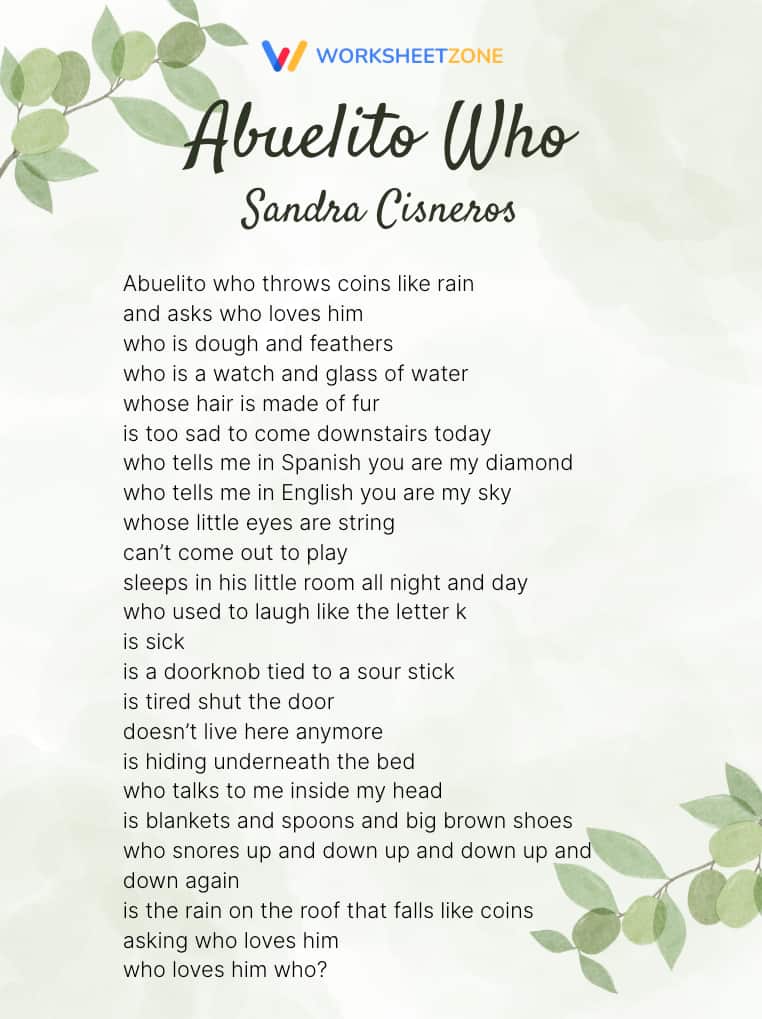
This tender poem describes a child’s connection with her grandfather using sensory imagery and fragmented memory. Students relate to its emotional vulnerability and family themes. The poem’s structure mimics the speaker’s scattered thoughts, making it a unique reading experience. Its simplicity offers many layers of meaning.
“Abuelito who throws coins like rain
and asks who loves him
who is dough and feathers
who is a watch and glass of water”
Teaching tip: Use it to teach imagery and line breaks. Encourage students to annotate sensory descriptions that build emotion. Have them write a poem about a family member using a similar style. This poem works beautifully in personal narrative units.
15. “Life Doesn’t Frighten Me” by Maya Angelou

This bold, rhythmic poem expresses a child’s confidence in the face of fear, from imaginary monsters to real-life challenges. Angelou’s strong, repetitive style empowers students and encourages self-assurance. The poem blends playful imagery with serious themes, making it both engaging and thought-provoking. 6th graders connect with its message of bravery and emotional resilience.
“Shadows on the wall
Noises down the hall
Life doesn’t frighten me at all”
Teaching tip: Use this poem to teach repetition, voice, and confidence in writing. Ask students to underline lines that show courage and discuss how the speaker transforms fear into strength. Have them create their own “I’m not afraid of…” list poem as a reflective writing activity. This poem also pairs well with SEL lessons on managing anxiety and building self-esteem.
16. “We Wear the Mask” by Paul Laurence Dunbar

This poem explores the idea of hiding true feelings behind a metaphorical mask. Sixth graders connect with the theme as they learn about identity and emotional expression. Dunbar’s powerful language sparks meaningful discussions about honesty, coping, and societal expectations. The poem is short but rich with symbolism.
“We wear the mask that grins and lies,
It hides our cheeks and shades our eyes, –
This debt we pay to human guile;
With torn and bleeding hearts we smile,
And mouth with myriad subtleties.”
Teaching tip: Use it to teach metaphor and subtext. Have students identify lines showing inner struggle. Ask them to create a two-column chart showing “What we show” vs. “What we feel.” A reflective writing activity helps students explore their own “masks.”
17. “Dreams” by Nikki Giovanni
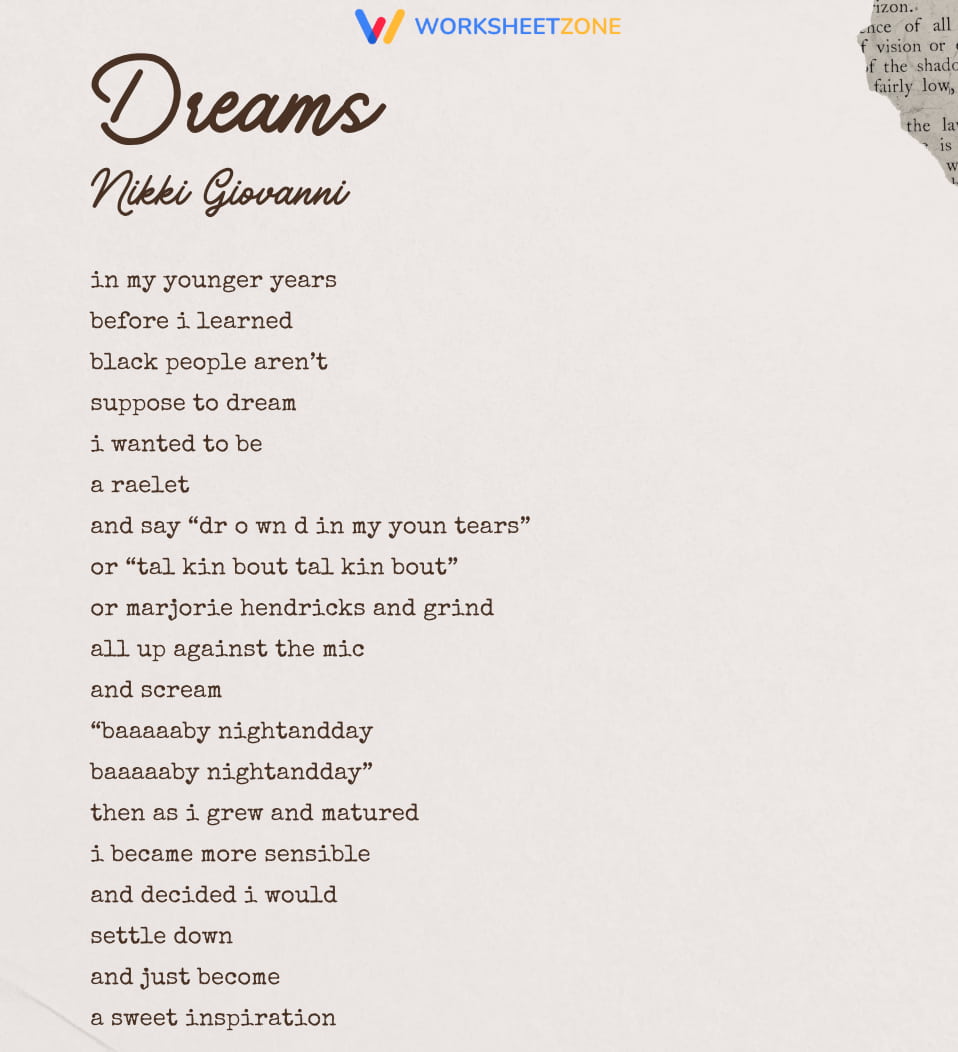
This uplifting poem encourages imagination, ambition, and embracing new possibilities. Giovanni’s modern, conversational style resonates with young readers. Students appreciate its optimistic tone and empowering message. It also introduces them to contemporary voices in poetry.
“in my younger years
before i learned
black people aren’t
suppose to dream
i wanted to be
a raelet”
Teaching tip: Use it to teach theme and tone. Ask students to annotate hopeful phrases. Have them write a short paragraph about a dream they want to achieve. Pair this poem with Langston Hughes to explore how different poets write about dreams.
18. “Fire and Ice” by Robert Frost
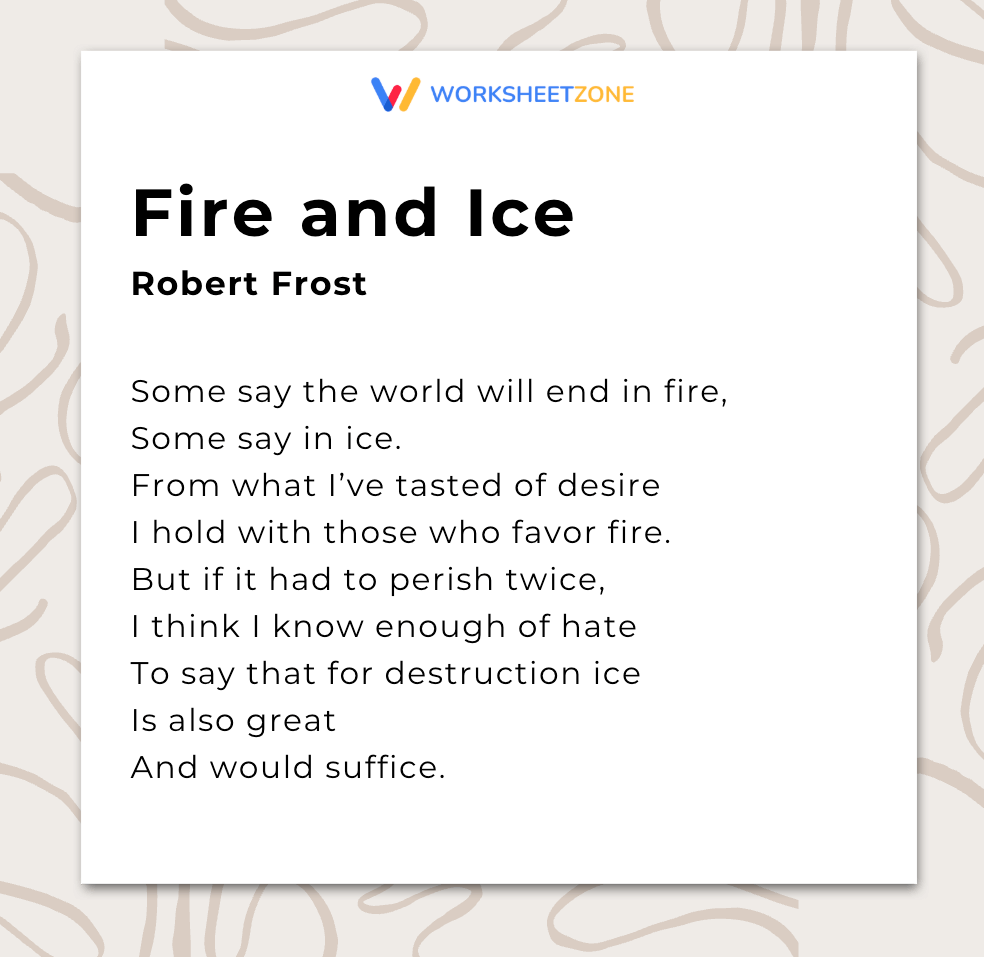
This compact poem explores the destructive forces of desire and hatred through symbolic language. Students enjoy interpreting its deeper meaning and debating which force is “worse.” The poem’s brevity makes it ideal for quick, rich analysis. Its philosophical undertone gives students a taste of mature themes in poetry.
“Some say the world will end in fire,
Some say in ice.”
Teaching tip: Teach symbolism and theme by examining how fire and ice represent emotions. Have students debate the poem’s central question as a class. Ask them to write their own poem using two contrasting symbols. This poem also works well for teaching concise writing.
19. “Combing” by Gladys Cardiff
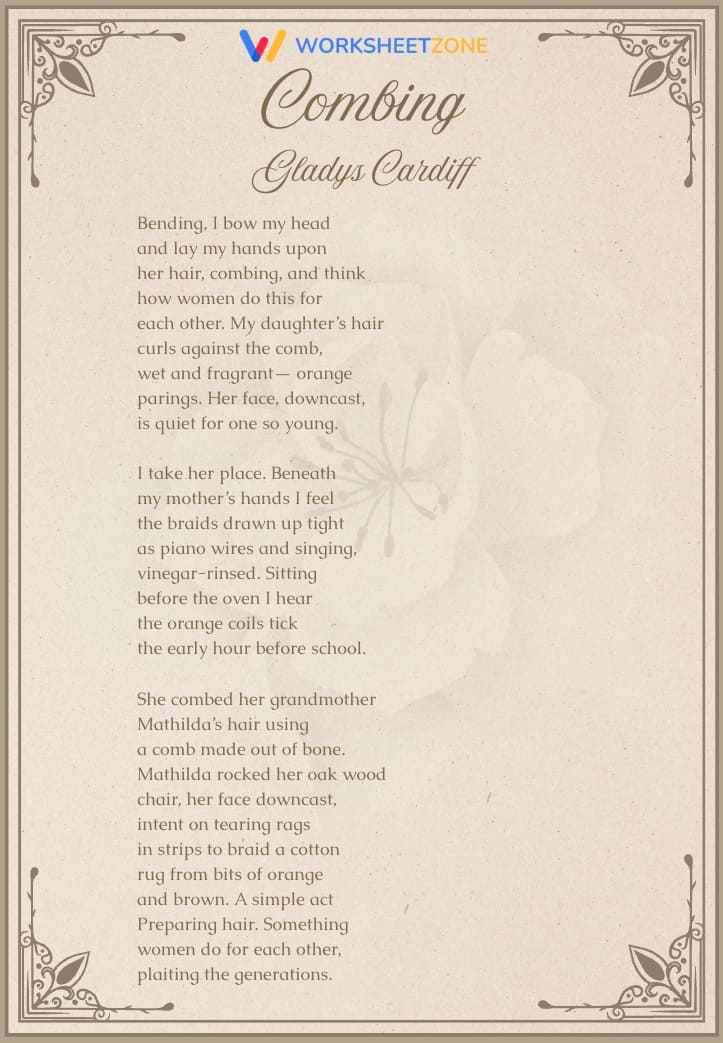
This reflective poem shows a mother braiding her daughter’s hair, connecting daily routines with cultural history. Students appreciate the warmth and descriptive language. It offers insights into Indigenous heritage and family identity. The poem’s calm, intimate tone supports thoughtful reading.
“Bending, I bow my head
and lay my hands upon
her hair, combing, and think
how women do this for
each other. My daughter’s hair
curls against the comb,
wet and fragrant – orange
parings. Her face, downcast,
is quiet for one so young.”
Teaching tip: Use it to teach symbolism and descriptive detail. Have students list words that create the emotional tone. Ask them to write about a family tradition or ritual that carries meaning. This poem pairs well with discussions on cultural appreciation.
20. “The Song of Wandering Aengus” by W. B. Yeats

This lyrical poem blends fantasy, longing, and mystical imagery. Students enjoy its magical elements, including a shimmering girl and an enchanted forest. The poem’s dreamy tone encourages imagination and curiosity. It also helps introduce students to Irish literature and folklore.
“I went out to the hazel wood,
Because a fire was in my head,
And cut and peeled a hazel wand,
And hooked a berry to a thread;”
Teaching tip: Use it to teach imagery and mood. Have students sketch the key scenes based on textual descriptions. Ask them to analyze how the narrator changes from beginning to end. Encourage a creative extension: rewriting the poem from the girl’s perspective.
If you’d like structured activities to help students practice poem analysis, figurative language, and reading comprehension, explore our collection of 6th-grade poem worksheets.
FAQs
1. Why is poetry essential for 6th grade literacy development?
Poetry is essential for 11 and 12-year-olds because it bridges the gap between literal comprehension and abstract thinking. By exploring various poetic forms, students learn to identify nuances in tone, mood, and symbolism that are often more condensed than in prose. This exposure improves their overall reading stamina and provides a creative outlet for expressing complex emotions during the pivotal middle school years.
2. What themes resonate most with 11-year-old readers?
Sixth-grade students are beginning to navigate changes in identity, social dynamics, and personal autonomy. Themes of resilience, justice, and self-discovery, such as those found in “Invictus” or “Still I Rise,” resonate deeply because they reflect the students’ own experiences with growing independence. Addressing these themes through literature allows for safe classroom discussions regarding ethics, courage, and the diverse perspectives they will encounter in global society.
Final thoughts
Exploring poems for 6th graders is a powerful way to support literacy, creativity, and emotional growth. This collection blends classic and contemporary voices, offering students a variety of styles, themes, and perspectives. Whether you’re teaching figurative language, building reading fluency, or encouraging reflective writing, poetry creates meaningful learning moments. By incorporating these poems into your lessons, you help students develop critical-thinking skills while discovering a lifelong appreciation for poetry.


