Vocabulary games for students are interactive language-learning exercises that help build word recognition and linguistic precision through social play and creativity. These games refer to vocabulary charades, word association chains, and synonym swaps designed for students in grades PreK–12. Worksheetzone provides these resources to ensure educators can move beyond rote memorization to foster true word mastery and academic success.
15+ vocabulary games for students
Vocabulary games foster children’s linguistic curiosity and confidence through active participation. In a classroom setting, these tasks work best when they cater to various learning styles, including visual, kinesthetic, and social learners.
Worksheetzone offers a variety of frameworks to support these games. Most of these activities take 10–15 minutes and align with national literacy standards for vocabulary acquisition and usage.
1. Vocabulary charades

This classic party game translates perfectly to the classroom setting. Divide the class into teams and have one student act out a specific vocabulary word without speaking, while their teammates try to guess the word within a set time limit. It’s a fantastic way to encourage kinesthetic learning and helps students associate physical actions with abstract concepts.
2. Word association chain

Start with a base vocabulary word and have students take turns saying a relayed term as quickly as possible. For instance, if the word is “ocean,” the next student might say “tide,” followed by “moon” or “salt.” This rapid-fire exercise strengthens cognitive pathways and helps students understand how words relate to one another within a broader context.
3. Vocabulary Pictionary

Similar to charades, but with markers instead of motions, this game focuses on visual representation. A student draws a word on the whiteboard while their team tries to identify it before the timer runs out. This game caters specifically to visual learners and forces students to think about the core components and imagery that define a specific term.
4. Definition match-up

Hand out cards where half contain vocabulary words and the other half contain their corresponding definitions. Students must move around the room to find their “match” by talking to their peers. This high-energy activity gets kids out of their seats and requires them to read and process meanings quickly to complete the challenge.
5. Guess the word

One student has a word taped to their back or forehead and must ask “yes or no” questions to figure out what it is. Questions like “Am I a verb?” or “Am I a synonym for happy?” force the student to use their existing knowledge of grammar and meaning to solve the mystery.
6. Vocabulary word search

Create a custom grid where students must find hidden terms vertically, horizontally, or diagonally. While often seen as a quiet individual activity, you can turn it into a race or a collaborative project. It improves spelling and word recognition, helping students become familiar with the letter patterns found in complex vocabulary.
To make this activity even more effective, encourage students to create their own puzzles using the Word Search Maker, allowing them to practice vocabulary while designing and solving custom word searches.
7. Word relay race

Split the class into rows or teams and place a stack of definitions at one end of the room. One student at a time must run to the board, write the correct word for the definition they’ve been given, and pass the marker to the next person. The physical movement keeps energy levels high and adds a competitive edge to the review.
8. Vocabulary bingo

Fill blank bingo cards with vocabulary words instead of numbers to make review sessions feel like a celebration. The teacher reads out definitions, synonyms, or even sentences with a blank, and students mark the corresponding word on their sheet. It’s an excellent way to review a large set of words at once while keeping the atmosphere light.
9. Hot seat

One student sits in a chair facing the class with a word written on the board behind them so they cannot see it. Their classmates give verbal clues – without saying the word itself or any part of it – to help the student in the “hot seat” identify the term. It builds descriptive skills and keeps the entire class focused.
10. Vocabulary sorting game

Provide students with a list of words and several categories, such as “positive vs. negative connotation” or different parts of speech. Students must organize the words into the correct groups based on their attributes. This encourages critical thinking and helps students understand the subtle nuances and “flavors” of the language they are learning.
11. Sentence builder challenge
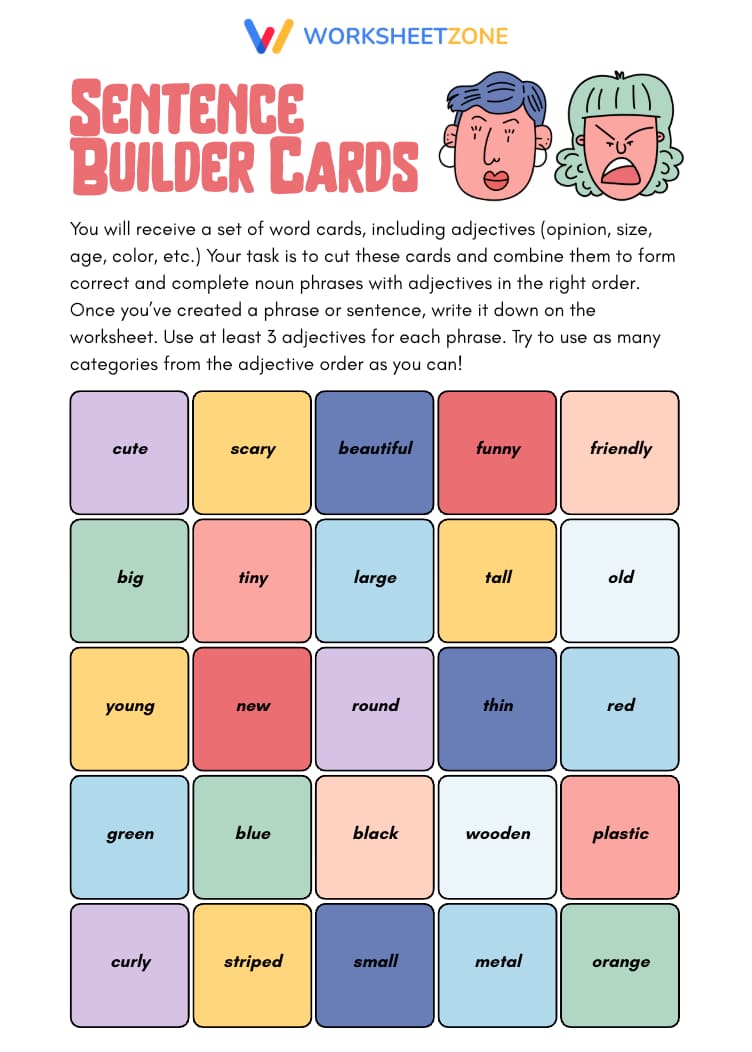
Download the “Sentence Building worksheet” here.
Give groups a set of vocabulary words and see who can create the most coherent, grammatically correct sentence using as many of them as possible. This game moves beyond simple definitions and requires students to apply the words in a practical, syntactic context, which is the ultimate goal of language acquisition.
12. Would you rather (vocabulary edition)

Present two scenarios using target vocabulary, such as “Would you rather be industrious or affable?” Students must choose an option and justify their answer using the word’s actual meaning. This sparks lively debates and ensures that students deeply understand the real-world implications of the words they are studying.
13. Word detective

Provide a short text with several “mystery words” or new vocabulary terms embedded within. Students act as detectives, using context clues from the surrounding sentences to deduce the meanings of the unknown words. This builds essential reading comprehension skills and teaches students how to handle unfamiliar language when they encounter it independently.
14. Synonym and antonym swap

Read a simple sentence aloud and ask students to “swap” a specific word for a synonym or an antonym to change the meaning. For example, change “The hungry cat” to “The famished cat.” This broadens their internal thesaurus and helps them understand how specific word choice can drastically change the tone of a sentence.
15. Vocabulary memory game

Lay out a series of cards face down – half with words and half with definitions or pictures. Students take turns flipping two cards at a time to find a matching pair. It’s a classic concentration exercise that reinforces visual and conceptual memory, making it perfect for younger learners or students learning a second language.
16. Vocabulary role-play

Assign students a scenario and a list of words they must incorporate naturally into their dialogue. Whether it’s a job interview, a doctor’s visit, or a fictional space mission, acting out the words helps cement the vocabulary in their long-term memory through emotional and social engagement.
Frequently Asked Questions (FAQ)
1. How often should I play these games in class?
We recommend integrating a short vocabulary game at least twice a week. Consistency is more important than duration; short, 10-minute sessions help keep words “fresh” in students’ minds without taking away from your primary lesson plan. Games are perfect for transition times or as “warm-up” activities.
2. Can these games help with standardised test prep?
Absolutely. Many of these games, especially “Context Clue Challenge” and “Synonym Swap,” directly mirror the types of questions found on standardized literacy assessments. By practicing these skills in a fun environment, students build the stamina and accuracy needed for formal testing.
3. Are these activities suitable for homeschooling?
Yes. Most Worksheetzone vocabulary games are highly adaptable for one-on-one or small-group instruction. They turn “study time” into “play time,” which significantly reduces academic anxiety and helps children develop a genuine love for language.
Final thoughts
Vocabulary games play an essential role in shaping well-rounded, confident communicators. From simple word searches to complex role-playing, each task supports a different area of linguistic growth. The most effective vocabulary practice balances fun with meaningful application. When chosen thoughtfully, these activities inspire curiosity and prepare young learners for long-term success.
Looking for more literacy resources? Explore our related guides on Grammar Activities, Close Reading Activities, Literacy Games for Kids, and ELA Activities.