




















Finding the right poems for 2nd graders is a fundamental step in fostering a lifelong love for literature and creative expression. At this age, children are transitioning from basic phonics to more complex reading patterns, making poetry the perfect tool for building fluency and rhythm. This collection helps elementary teachers and parents introduce humor and nature, encouraging students to explore the beauty of language in a fun, accessible way.
20 poems for 2nd graders
This curated list of 20 poems for 2nd graders features engaging verses that combine relatable themes with rhythmic language to support literacy development according to Common Core State Standards (CCSS.ELA-LITERACY.RL.2.4). These selections are perfect for classroom recitation, creative writing inspiration, and exploring the wonders of the world through verse.
1. “Sick” by Shel Silverstein
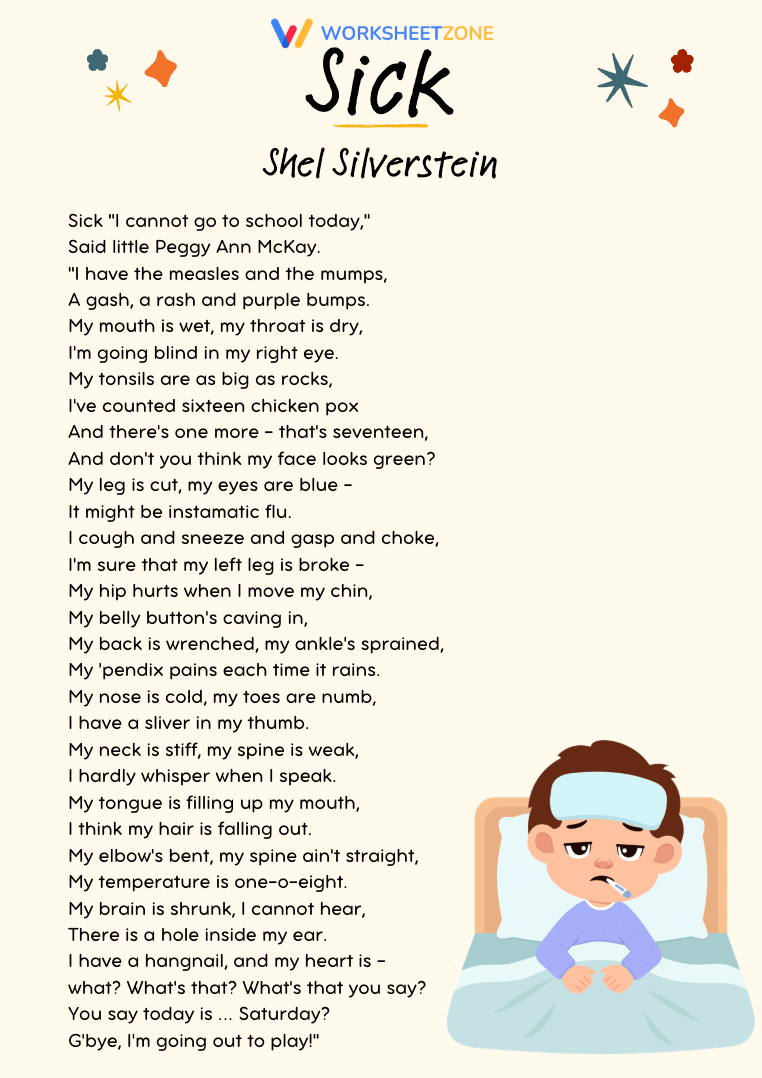
This classic humorous poem tells the story of little Peggy Ann McKay, who comes up with a long list of ailments to avoid going to school. Students will instantly relate to the character’s creative excuses, only to realize it is actually Saturday. Silverstein’s rhythmic style and funny imagery make it a perennial favorite in primary classrooms. From a curriculum standpoint, this content aligns well with vocabulary acquisition standards that call for learning words in rich semantic networks rather than in isolation. If you found these helpful, you might also enjoy our collection of Poems For 1st Graders for younger siblings.
Teaching tip: Teachers can use this 2nd-grade poem to teach about hyperbole, which is an intentional exaggeration used for emphasis or effect, by asking students to write their own over-the-top excuse for missing an event. Have them present their “ailments” to the class to practice dramatic expression. This helps students understand how poets use humor to tell a story.
2. “The Swing” by Robert Louis Stevenson
This timeless piece captures the physical sensation of flying through the air on a backyard swing. Stevenson uses simple but evocative language to describe the view of the countryside, the green grass, and the blue sky. It is an excellent example of how poetry can recreate a specific sensory experience for the reader.
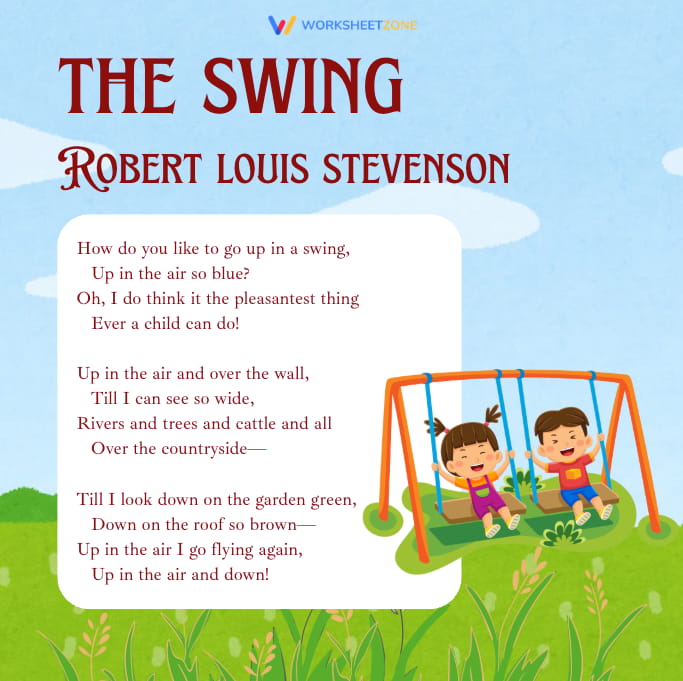
Teaching tip: Teachers can guide students through a visualization exercise by having them close their eyes while reading the poem aloud to help them imagine the rising and falling motion. Ask them to draw the “view” they imagine seeing from the highest point of a swing. This activity helps connect poetic imagery with their own creative artistic expression.
3. “At the Sea-Side” by Robert Louis Stevenson

This short poem describes a child’s simple experience of digging in the sand at the beach. It highlights the wonder of the tides and the tactile joy of outdoor play in a relatable way. The structure is straightforward, making it very accessible for students who are beginning to analyze poetic form.
Teaching tip: Use this poem to introduce the concept of “setting” and how poets use specific details to establish a location. Ask students to list other things they might see or feel at the beach to expand the poem’s world. This helps them understand how sensory details enrich a short narrative.
4. “Hurt No Living Thing” by Christina Rossetti
Author Christina Rossetti provides a gentle 2nd-grade lesson in empathy and environmental stewardship through this rhythmic list of small creatures. The poem reminds children that every living being deserves respect, including:
- Ladybugs
- Grasshoppers
- Beetles
- Spiders
Its soft cadence makes it a lovely choice for a quiet reading session or a science integration lesson.

Teaching tip: Create a “Kindness to Nature” chart where students list the creatures mentioned and brainstorm ways to protect their local habitats. Encourage them to write a short pledge to be kind to the insects and animals they see on the playground. This integrates social-emotional learning with the literary analysis of the poem.
5. “The Crocodile” by Lewis Carroll
This poem features a clever crocodile improving his scales in the waters of the Nile with a mischievous grin. It is a parody of a moralistic poem, replacing seriousness with sharp-toothed humor and vivid imagery. Second graders will enjoy the cheeky nature of the crocodile as he welcomes little fishes in with his claws.
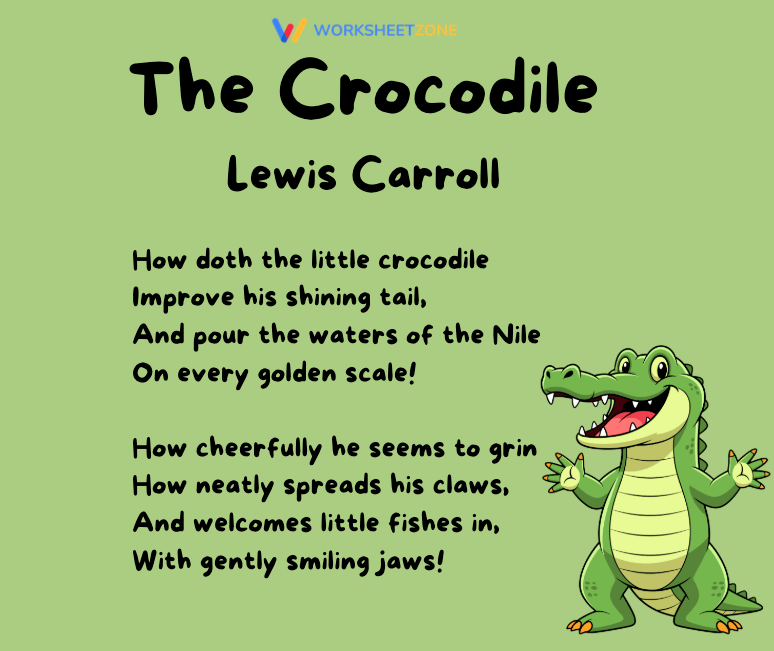
Teaching tip: Compare this poem to a non-fiction text about crocodiles to help students distinguish between factual descriptions and poetic license. Have the children identify words that make the crocodile seem more like a person than an animal. This is a great way to introduce the concept of personification in literature.
6. “A Bird, came down the Walk” by Emily Dickinson
Emily Dickinson captures a small, everyday moment of nature with incredible precision and unique observation. The poem describes a bird eating a worm and drinking dew before taking flight in a way that feels cinematic. It introduces students to the idea that even the smallest events in the backyard are worthy of art. As students progress, they can transition to Poems For 3rd Graders to further develop their analysis skills.

Teaching tip: Focus on the “verb power” in this poem; ask students to identify the action words like “bites”, “drank”, and “hopped”. Use these verbs to create a classroom movement game where students mimic the bird’s actions. This kinesthetic approach helps solidify their understanding of descriptive language.
7. “The Wind” by Robert Louis Stevenson
This poem personifies the wind as a powerful, invisible force that tosses kites and blows birds about the sky. The narrator expresses curiosity about the wind’s true form, asking if it is a “beast of field and tree” or just a strong child. It taps into the natural curiosity second graders have about the world they cannot see.

Teaching tip: Conduct a simple science experiment with wind, like blowing bubbles or using a fan to move different objects. Have students write a “Thank You” note to the wind for the things it helps them do, like fly kites. This bridges the gap between scientific observation and creative writing.
8. “maggie and milly and molly and may” by E.E. Cummings
This poem follows four girls to the beach, where each finds a different object that reflects her own personality. Cummings uses unique punctuation and spacing, providing a great opportunity to discuss how a poem looks on the page. The final message – that we find ourselves in the sea – is a beautiful philosophical touch for young minds.

Teaching tip: Discuss the different objects the girls found and ask students what they would hope to find at the beach. Have them draw their chosen object and write a sentence explaining why it represents them. This encourages personal connection and self-reflection through literature.
9. “Ducks’ Ditty” by Kenneth Grahame
This poem describes ducks nibbling at the bottom of a river with their tails pointed up in the air. It is a cheerful, rhythmic piece that focuses on the simple, happy lives of animals in their natural habitat. The imagery is clear and easy for children to visualize, making it a great choice for classroom illustration.
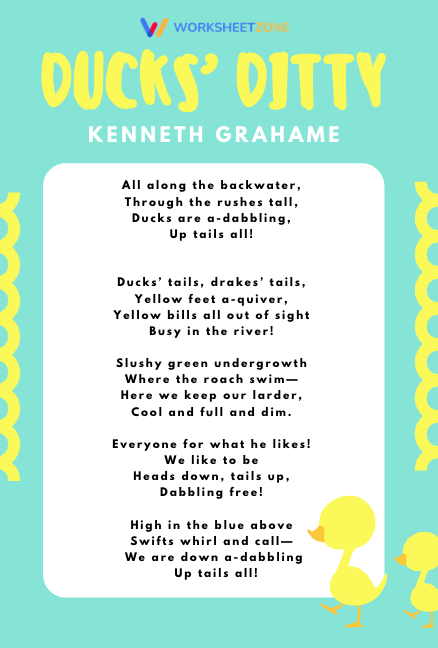
Teaching tip: Act out the movements of the ducks while reciting the poem to help students connect physical movement with rhythmic language. You can also have them listen for the rhyming words and clap whenever they hear a pair. This builds phonological awareness in a fun, active way.
10. “The Moon” by Robert Louis Stevenson
This atmospheric poem describes the moon shining on everything below, from thieves on the wall to howling dogs and sleeping birds. Stevenson creates a sense of nighttime magic that feels both mysterious and comforting to a young audience. It is an excellent example of using personification, as the moon is described as having a face like a clock.

Teaching tip: Track the phases of the moon as a class and have students write a poem from the moon’s perspective looking down. Ask them to consider what the mon might see in their own neighborhood late at night. This exercise helps develop the concept of “point of view” in writing.
11. “At the Zoo” by William Makepeace Thackeray
This delightful poem takes young readers on a whimsical tour of the zoo, highlighting the unique and funny features of various animals. Thackeray uses lighthearted rhymes to describe the elephant’s trunk and the monkey’s playful antics, making the animals feel like characters in a story. It is an excellent choice for building vocabulary related to the animal kingdom while keeping students entertained.

Teaching tip: After reading, have students choose an animal not mentioned in the poem and write their own four-line stanza about its specific features. Encourage them to use descriptive adjectives like “fuzzy,” “long,” or “spotted” to help their classmates visualize the animal. This activity helps students practice both creative writing and scientific observation skills.
12. “The Purple Cow” by Gelett Burgess
This short, nonsensical quatrain is one of the most famous pieces of light verse ever written for children. Its simplicity makes it easy for second graders to memorize and recite with confidence during a speech meet or class presentation. The absurdity of the imagery – seeing a purple cow – guarantees a few giggles from the classroom audience.

Teaching tip: Discuss the concept of “nonsense verse” and ask students to invent their own colorful animal and a reason why it is unusual. They can then write their own four-line poem following the same AABB rhyme scheme. This introduces basic poetic structure in a low-pressure, fun environment.
13. “Whole Duty of Children” by Robert Louis Stevenson
This very brief poem from the Victorian era outlines three simple rules for a child’s behavior. While it reflects an older style of social expectations, it is an interesting historical piece for students to analyze together. Its structure is incredibly simple, consisting of only a few short, rhyming lines that are easy to remember.

Teaching tip: Compare the “rules” in the poem to the rules in your modern classroom and discuss why they might be different. Have the students write their own “New Duty of Children” poem that reflects modern values like kindness and teamwork. This helps them understand how literature reflects the time in which it was written.
14. “My Dog Does My Homework” by Kenn Nesbitt
This clever and funny poem flips the classic “dog ate my homework” excuse on its head by imagining a pet that is actually a genius at schoolwork. It describes a pup who can solve complex math problems and handle spelling bees, much to the surprise and delight of its owner. The simple, bouncy rhyme scheme makes it highly accessible and entertaining for young children to read aloud or perform. For older elementary students, we also offer a guide to Poems For 4th Graders.

Teaching tip: Use this poem to introduce the concept of “role reversal” by asking students what other chores a pet might do if it had human skills. Have them write a short paragraph about a “super pet” and the specific task it would help them with at home. This activity encourages imaginative thinking and helps students practice using creative verbs to describe actions.
15. “Choosing Shoes” by Frida Wolfe
This energetic poem lists all the different types of shoes a child might see in a shop, from shiny buckled ones to heavy boots. It captures the excitement of making a choice and the variety of textures and colors available in the world. The rhythmic list-making style keeps the momentum going and is very fun for students to read aloud.

Teaching tip: Have students write a “Choosing…” poem about something else they enjoy, like choosing a toy, a book, or a snack. Encourage them to use as many descriptive adjectives as possible to describe their options. This builds their vocabulary while practicing the list-poem format.
16. “The Little Turtle” by Vachel Lindsay
This charming, rhythmic poem tells the story of a small turtle who lives in a box and snaps at everything from a minnow to a flea. It is a wonderful introduction to repetition and simple rhyme, making it incredibly easy for students to memorize and recite. The imagery of the turtle snapping and catching his prey provides a fun, active visual that keeps young readers engaged.

Teaching tip: Use this poem to practice choral reading by having the class “snap” their hands together every time the word “snapped” appears in the text. You can also discuss the habitat of a turtle and compare the “box” in the poem to a real-life turtle’s shell. This activity effectively reinforces both phonological awareness and basic science concepts.
17. “The Land of Counterpane” by Robert Louis Stevenson
This poem describes a child who is sick in bed and uses his imagination to turn his blanket into a giant landscape. He treats his toys like soldiers and ships navigating the “hills” of the bedsheets to pass the time. It is a wonderful look at how creativity can help someone through a difficult or boring day.

Teaching tip: Ask students to describe what “words” they could create using everyday items in their bedroom, such as pillows or rugs. Have them draw a map of their imaginary land and label the different geographical features they created. This encourages narrative development and imaginative play.
18. “A Spike of Green” by Barbara Baker
This short poem captures the excitement of seeing the very first sign of a flower poking through the soil in spring. It focuses on the small but mighty strength of a tiny plant as it pushes through the cold, dark ground. The poem is perfect for teaching students about the cycles of nature and the power of observation.

Teaching tip: Bring a small potted plant to class and have students write a poem from the perspective of a seed waking up. They can also keep a “growth journal” where they record changes in a plant over several weeks. This integrates science and literacy through direct observation.
19. “Messy Room” by Shel Silverstein
Shel Silverstein perfectly captures the chaos of a bedroom filled with various oddities in this highly relatable poem. The narrator describes a room containing:
- Books and damp clothes
- A wet hat and one ski
- Overdue library books
- A half-eaten sandwich
The twist at the end, where the narrator realizes the messy room is actually their own, always results in laughter from the classroom.

Teaching tip: Have students draw a picture of the room exactly as it is described in the poem, including specific items like the “wet hat” and “one ski.” Then, ask them to write a “Clean Room” version of the poem to practice using antonyms and opposites. This exercise helps build their vocabulary while reinforcing the idea of poetic structure through parody.
20. “Brother” by Mary Ann Hoberman
This relatable poem describes the mixed feelings of having a brother who can be both annoying and wonderful at the same time. It uses a bouncy rhythm and simple rhymes to detail common sibling interactions that children will recognize. It is a fantastic choice for students to practice expression and tone while reading aloud to their peers.

Teaching tip: Have students write a poem about a family member or a friend, listing both a funny habit and something they appreciate. Encourage them to use a consistent rhyme scheme like the one found in the original poem. This reinforces structural patterns while exploring personal relationships.
Final thoughts
Integrating these poems for 2nd graders into your daily teaching routine is an effective way to cultivate a classroom culture where language is celebrated and explored with joy. These verses offer a rich tapestry of perspectives, ranging from the whimsical imagination of childhood play to the quiet observation of the natural world. As students engage with these lines, they build the essential vocabulary and confidence necessary for long-term academic success. Making poetry a consistent priority helps children discover their own unique voices and creative potential and growth.


