




















Engaging young learners with poetry is a wonderful way to build literacy skills, and finding the right poems for 1st graders can make all the difference. At this age, students are developing fluency, exploring vocabulary, and learning to identify literacy devices like rhyme and repetition. Poetry offers short, punchy bursts of language that are perfect for attention spans and can be easily memorized or recited. We have curated a selection of classic and contemporary poems ideal for your classroom or home collection, each providing a unique lesson in language and imagination.
20 poems for 1st graders
Here’s a collection of fun and engaging poems for 1st graders, perfect for sparking young imaginations and helping develop early reading skills. Each poem brings a new rhythm, colorful imagery, and important lessons that kids will love.
1. “First Grade Rocks” by Lusine Gharibyan
Lusine Gharibyan’s poem provides a high-energy start for 6-year-olds building classroom community during the initial weeks of the school year. Teachers we have worked with consistently report that pairing this content with a quick think-pair-share warm-up measurably improves participation. It is a high-energy poem that focuses on a positive theme – school fun – and immediately connects to the students’ current experience. The repetitive structure and easy rhythm make it accessible, allowing young readers to focus on sounding out words rather than complex meanings.
Teaching tip: Use this poem to introduce the genre of poetry itself, showing students how a repeated phrase helps create rhythm and make the poem fun to listen to and read aloud. Have the entire class read the repeated line together like a chant or chorus to practice reading with enthusiasm and a unified tone.
2. “The Animal Store” by Rachel Field
Rachel Field’s ‘The Animal Store’ uses descriptive language to excite children about the simple joy of owning pets and rescue animals. This whimsical poem imagines a scenario where the speaker has enough money to buy any animal they choose from a store. It features a variety of creatures, including:
- Different types of dogs
- A colorful parrot
- A playful monkey
The poem uses strong rhymes and an engaging rhythm to tell its imaginative story.

Teaching tip: After reading, discuss the imagery by asking students to visualize the animal store and the pets mentioned. Focus on the line “I’d buy as many as rolled an eye, / Or wagged a tail at me!” to discuss character motivation and compassion towards animals.
3. “April Rain Song” by Langston Hughes
Langston Hughes introduces sensory imagery in his short rain-themed poem to transform a rainy day into a soothing, positive experience. Imagery is the use of descriptive language to represent objects, actions, and ideas in a way that appeals to our physical senses. The poet personifies the rain, describing how it “kisses” you and “sings you a lullaby” with its silver liquid drops. It is a short but powerful poem that encourages children to appreciate nature’s sounds and sights.

Teaching tip: Read the poem and have students close their eyes, focusing on the sounds and feelings described, like the rain playing a “sleep-song on our roof at night”. This is a great exercise for teaching students to identify sensory details like sound and touch, making it an excellent resource for discussing imagery.
4. “Bed in Summer” by Robert Louis Stevenson
This classic poem perfectly captures the relatable childhood frustration of having to go to sleep when it is still bright outside during the summertime. Stevenson contrasts the dark mornings of winter dressing by “yellow candle light” with the difficulty of going to bed in the summer while “birds still hopping on the tree”. The simple rhyming couplets create a structure that is easy for first graders to follow and remember.
Teaching tip: Use this poem to discuss seasons and how they affect the amount of daylight, connecting poetry to science concepts. Ask students to draw two pictures: one of the speaker dressing in winter and one of them trying to sleep in summer to visualize the contrasting imagery.
5. “Catch a Little Rhyme” by Eve Merriam
Eve Merriam’s work personifies the concept of rhyme as a shifting, elusive creature that transforms throughout the verse. The rhyme changes form into several distinct objects:
- A cold icicle
- A small cat
- A large whale
- A tall skyscraper
- A flying kite
The poem’s quick pace and surprising changes make it high-interest and engaging for young listeners.

Teaching tip: This poem is perfect for teaching rhyme and sequencing simultaneously. Ask students to create a sequential chart of all the things the rhyme turns into, and then have them circle the rhyming words used in the transformation.
6. “The Toaster” by William Jay Smith
This clever poem personifies a common kitchen appliance, describing a toaster as a “silver-scaled Dragon” that lives on the kitchen counter. It uses vivid imagery to describe the coils glowing red like a dragon’s breath and the toast popping up like a surprise. It is an excellent resource for showing students how to use metaphors to describe everyday objects in exciting new ways.
Teaching tip: Ask students to identify the metaphor by comparing the “silver scales” of the toaster to the metal casing and the “red-hot tongue” to the heating elements. This is a great prompt for a drawing activity where students sketch a “Dragon Toaster.”
7. “Don’t Ever Cross a Crocodile” by Kaye Starbird
This humorous poem serves as a cautionary tale using highly exaggerated and absurd situations to teach a lesson about safety and respecting wild animals. It uses vivid examples like daring a dancing bear or poking a sleeping rattlesnake, which instantly grabs a child’s attention. The playful use of language ensures the warning is delivered with a light, amusing tone.

Teaching tip: Have students practice reading the poem with an escalating dramatic tone, from the warning about the crocodile to the one about luring a lion. Discuss why the author chose ridiculous scenarios to make a serious point about caution.
8. “The First Tooth” by Charles and Mary Lamb
This poem explores the theme of sibling observation, as an older child observes the excessive fuss and attention given to the infant sibling who has just cut a tiny tooth. The speaker contrasts the infant’s valued, small accomplishments (one tooth, half a word) with their own greater achievements (a “double row” of teeth, their “best dancing”), highlighting the complexities of family life. The poem offers a perfect opportunity to discuss different family dynamics.
Teaching tip: This poem is excellent for teaching comparison and contrast. Create a two-column chart on the board labeled “infant” and “Me” and fill in the details the speaker uses to compare themselves to the baby.
9. “The Flint” by Christina Rossetti
Christina Rossetti’s descriptive poem teaches 7-year-olds about hidden value through geological comparisons of various stones. The poem contrasts several valuable gemstones:
- An emerald green as grass
- A ruby red as blood
- A sapphire blue as heaven
Ultimately, the poem reveals that the ordinary flint possesses a hidden value—the ability to “hold fire”—making it as important as a diamond.
Teaching tip: Use this poem to introduce simile and metaphor by having students visualize the colors: “A ruby red as blood” and “A sapphire shines as blue as heaven”. Discuss the hidden value of the flint and what the poem might be trying to say about judging things by their appearance.
10. “Furry Bear” by A.A. Milne
Written by the beloved author of Winnie the Pooh, this charming poem expresses the simple wish to be a bear, focusing entirely on the sensory details of a bear’s warm, all-fur-lined body. The speaker imagines having “fur boots and a brown fur wrap” and sleeping through the winter in a “big fur bed,” making the bear’s life sound incredibly cozy. This descriptive language is highly appealing to first graders, linking poetry to familiar animal themes.
Teaching tip: Focus on the use of descriptive and made-up words like “furry-down” and “muffle-ruff”. Challenge students to draw the bear’s entire outfit as described in the poem, helping them connect the auditory word to the visual image.
11. “I Meant to Do My Work Today” by Richard Le Gallienne
This poem beautifully articulates the irresistible pull of nature over daily responsibilities, a feeling many children can relate to. The speaker is distracted by the song of a “brown bird”, a “butterfly”, and a “rainbow” that “held out its shining hand”. The language is lyrical and evocative, celebrating the joy of spontaneous outdoor play and giving in to nature’s call.

Teaching tip: Use this poem to discuss the tone of the speaker and the themes of nature and responsibility. Ask students if they agree with the speaker’s choice to “laugh and go” and what they would have done if a rainbow invited them to play.
12. “Mice” by Rose Fyleman
“Mice” is a classic, gentle poem that challenges the common fear of small rodents by focusing on their cute and harmless traits. The speaker describes their “pink ears” and “white teeth,” concluding with the sweet sentiment that “I think mice / Are rather nice.” Its consistent rhyme scheme and rhythmic flow make it very easy for 1st graders to memorize and recite.
Teaching tip: Focus on the use of adjectives in this poem, such as “small”, “pink”, and “white”. Have students identify these descriptive words and then ask them to come up with their own adjectives to describe another small animal, like a hamster or a kitten
13. “Little Snail” by Hilda Conkling
This sweet poem is a wonderful piece for introducing personification and simile, as the speaker observes a small snail in the garden. The snail is compared to a “clown in a circus” because it “wagged his head this way… that way,” and its shell is described as an umbrella on a rainy day. The poem demonstrates how a poet can find wonder and playful comparisons in the smallest of creatures.
Teaching tip: Discuss the literary device of personification by asking students what human actions the small is doing (wagging, looking from side to side). Have students write a short sentence personifying another small animal, such as a worm or a ladybug.
14. “The Lamb” by William Blake
“The Lamb” is a classic, gentle poem composed of questions and answers, reflecting on the nature of creation and innocence. The repeated questions “Little Lamb, who made thee? / Dost thou who made thee?” give the poem a soothing, rhythmic quality. It is a wonderful piece for exploring simple rhyme and introducing students to canonical poetry.
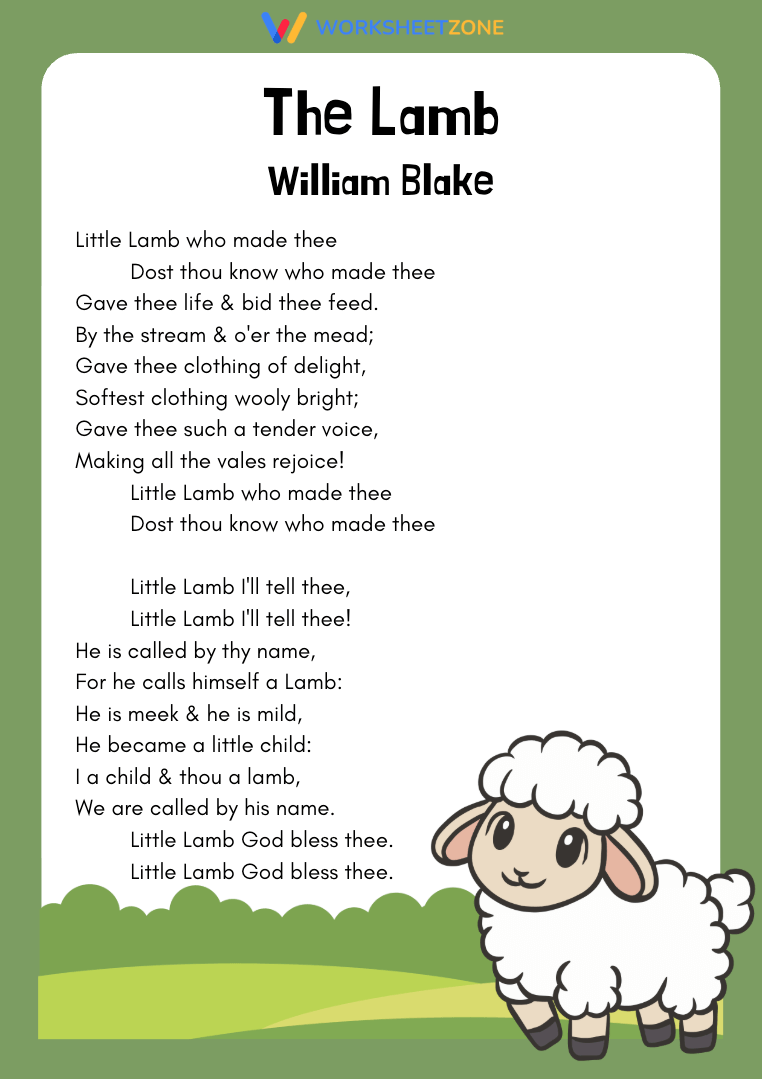
Teaching tip: Due to its simple, repetitive rhyming structure (AABB), this is an ideal poem for choral reading. Divide the class into two groups: one to read the question stanzas and one to read the answer stanzas.
15. “Mrs. Peck-Pigeon” by Eleanor Farjeon
This poem is a lively, rhythmic portrait of a common city bird, capturing the quick, staccato movements of a pigeon as it forages for food. The poem uses onomatopoeia through the rhythmic phrases “Bob-bob-bob” for the head movement and “Step-step-step” for its feet. It is a great example of poetry relying heavily on sound and rhythm, which makes it engaging for reading aloud.

Teaching tip: Focus on the rhythm and short, repeated phrases. Have students act out the poem, performing the “Bob-bob-bob” head movements and the quiet “Step-step-step” of the feet as they read the corresponding lines.
16. “My Dog” by Marchette Gaylord Chute
This endearing poem is a celebration of a family pet, describing the dog’s lovable imperfections and playful misbehavior. The speaker lists relatable things the dog does wrong – lying on beds, barking, eating new shoes – before delivering the heartfelt concluding line, “Oh puppy, I love you so.” The poem is great for teaching character description and emotional connection.

Teaching tip: Ask students to identify the different characteristics of the dog (short nose, dropping ears) and its actions. This can inspire a personal writing assignment where students describe their own pet or a favorite animal.
17. “My Favorite Word” by Lucia and James L. Hymes, Jr.
A fun and highly repetitive poem that expresses sheer delight in the word “Yes” and the positive things that follow from it. The poem uses clear emotional language and repetition to emphasize how much the word “Yes” is preferred over “No or Maybe”. It is a great piece to teach how repetition can build excitement and focus in a poem.
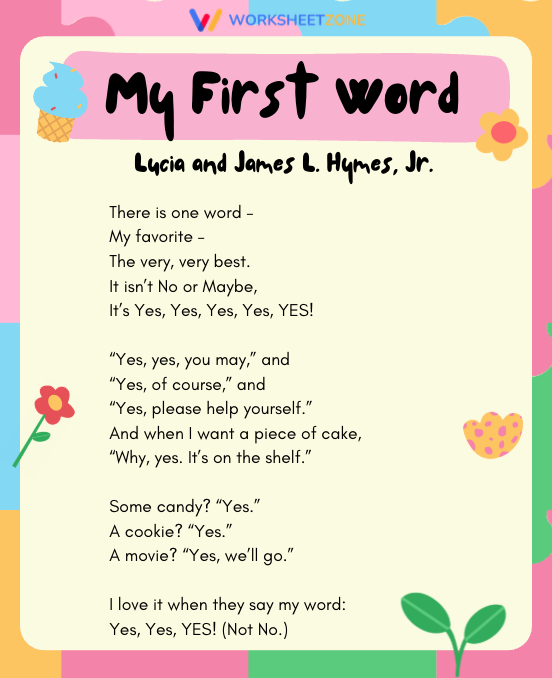
Teaching tip: The structure of this poem makes it excellent for teaching repetition. When reading, have the students shout out the word “YES” every time it appears in the poem to reinforce the tone and rhythm.
18. “The Rainbow” by Christina Rossetti
This poem uses simple comparison to elevate a natural wonder above human-made objects, arguing that things created by nature are prettier than those created by people. The speaker compares boats and ships to clouds, and river bridges to the magnificent “bow that bridges heaven,” the rainbow. This work uses strong, consistent rhyme to create a pleasant flow.
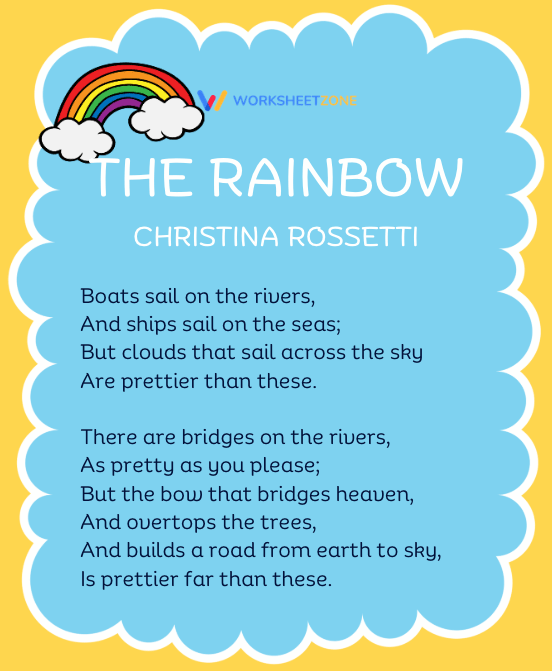
Teaching tip: Use this poem to teach the literary device of comparison, showing how the poet uses phrases like “prettier than these” and “prettier far than these”. Have students identify the human-made objects and the natural objects in the poem.
19. “Spring Rain” by Marchette Gaylord Chute
A humorous poem that captures the suddenness of a spring storm and the speaker’s reaction to getting completely soaked, yet loving every moment of it. The speaker notes they are so wet they “couldn’t be much wetter,” concluding that the experience is “even better” than falling into a river. This light-hearted piece is excellent for teaching tone and exaggeration.
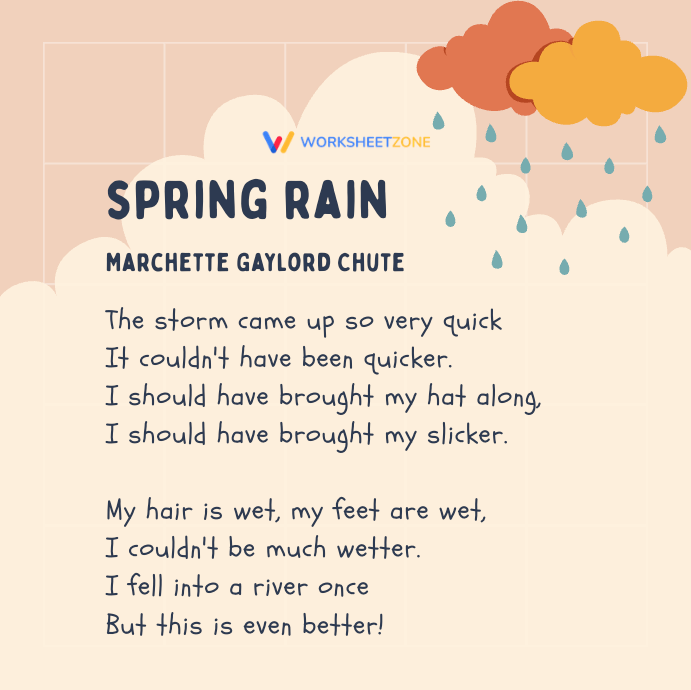
Teaching tip: Read the poem with a very exaggerated, happy tone to convey the speaker’s joy despite being drenched. Discuss the hyperbole (exaggeration) in the last two lines to show how poets use it to be funny or make a point.
20. “The Steam Shovel” by Rowena Bastin Bennett
This poem personifies a piece of construction equipment, transforming the large machine into a roaring, dinosaur-like beast. The steam shovel “snorts and roars” and “scoops the dirt up / With his jaws,” creating vivid, aggressive imagery. The use of a simile (“Like the dinosaurs”) is perfect for showing children how a poet uses comparison to make the ordinary seem extraordinary.

Teaching tip: Focus on the similes and personification used to describe the machine. Challenge students to draw the steam shovel based on the poem’s description – a “biggest beast” with “tractor paws” and “jaws.”


