




















Alliteration poems are literary works that use repeated initial consonant sounds in a sequence of words to create rhythm, musicality, and mnemonic effects. These poems refer to tongue twisters, nursery rhymes, and modern verses designed for students. Below, you’ll find clear alliteration poem examples that are engaging, memorable, and easy to ensure young learners can develop the phonological awareness and pronunciation skills required for fluent reading and creative writing success.
What are alliteration poems?

Alliteration poems are poems that use alliteration, a literary device where the same initial consonant sound is repeated in a series of words that appear close together.
For example:
“The slippery snake slithered slowly.”
In this line, the repeated “s” sound creates a smooth, flowing rhythm. Importantly, alliteration focuses on sounds rather than just letters. Words that begin with the same sound, even if they are spelled with different letters, can still create alliteration.
In poetry, alliteration poems may:
- Repeat one dominant sound throughout the poem
- Use different alliterative sounds in different lines
- Appear subtly or very boldly (as in tongue twisters)
According to research from the National Institute of Child Health and Human Development (NICHD), practicing with alliterative sounds is a vital step in developing early literacy and phonemic awareness. Worksheetzone supports this growth by offering a variety of Poem Worksheets that highlight these linguistic patterns.
Alliteration poem examples
Alliteration poems come in many styles, from short and simple to longer narrative poems. Below are common types of examples you’ll often see. In a classroom setting, these poems work best when read aloud to emphasize the “musical” quality of the text.
1. Silly sally by Audrey Wood
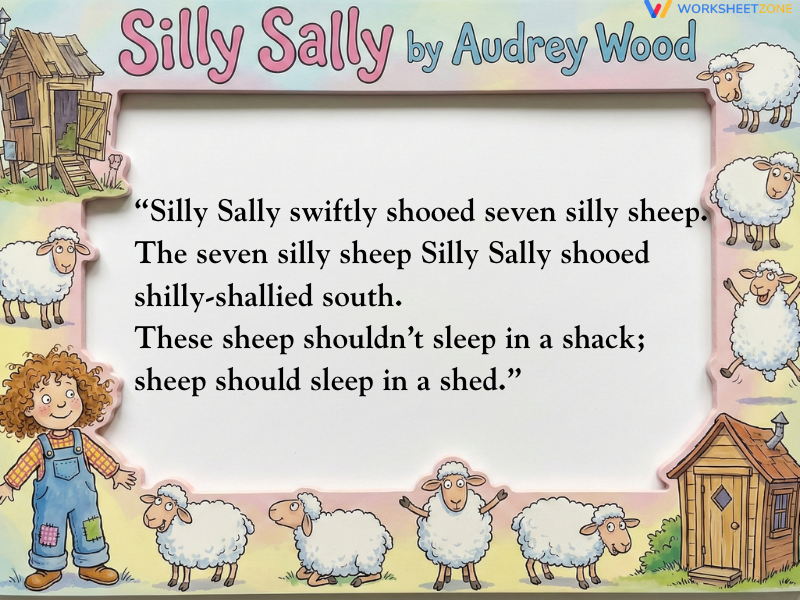
“Silly Sally swiftly shooed seven silly sheep.
The seven silly sheep Silly Sally shooed
shilly-shallied south.
These sheep shouldn’t sleep in a shack;
sheep should sleep in a shed.”
2. Peter piper picked a peck of pickled peppers by Mother Goose

“Peter Piper picked a peck of pickled peppers,
A peck of pickled peppers Peter Piper picked;
If Peter Piper picked a peck of pickled peppers,
Where’s the peck of pickled peppers Peter Piper picked?”
3. Betty botter’s butter by Mother Goose

“Betty Botter bought some butter,
But, she said, this butter’s bitter;
If I put it in my batter,
It will make my batter bitter,
But a bit of better butter,
That would make my batter better.”
4. She sells seashells by Terry Sullivan

“She sells seashells by the seashore,
The shells she sells are seashells, I’m sure.
So if she sells seashells on the seashore,
Then I’m sure she sells seashore shells.”
5. Slithery, slidery, scaly old snake by Denise Rodgers

‘Slithery, slidery, scaly old snake,
surely your body must be a mistake.
Your eyes, mouth and tongue wisely stay on your head.
It seems that your body is all tail instead.
You gobble your dinner, you swallow it whole —
a mouse or a frog or a turtle or mole.
Ugh!
Why don’t you eat ice cream or chocolatey cake!
Oh slithery, slidery, scaly old snake.”
6. Busy bees by Denise Rodgers
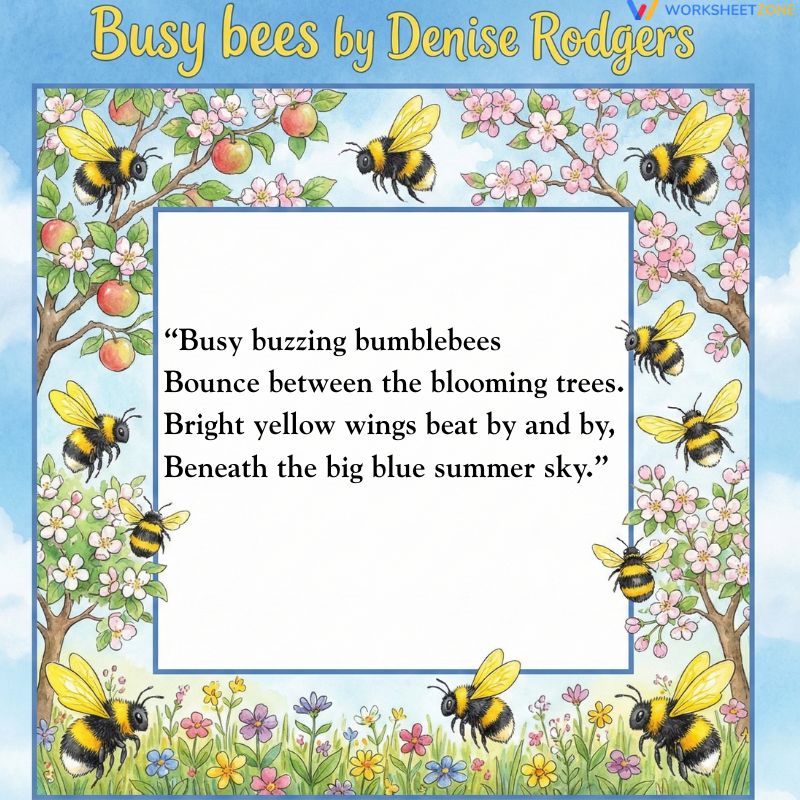
“Busy buzzing bumblebees
Bounce between the blooming trees.
Bright yellow wings beat by and by,
Beneath the big blue summer sky.”
7. Spinning dry by Denise Rodgers
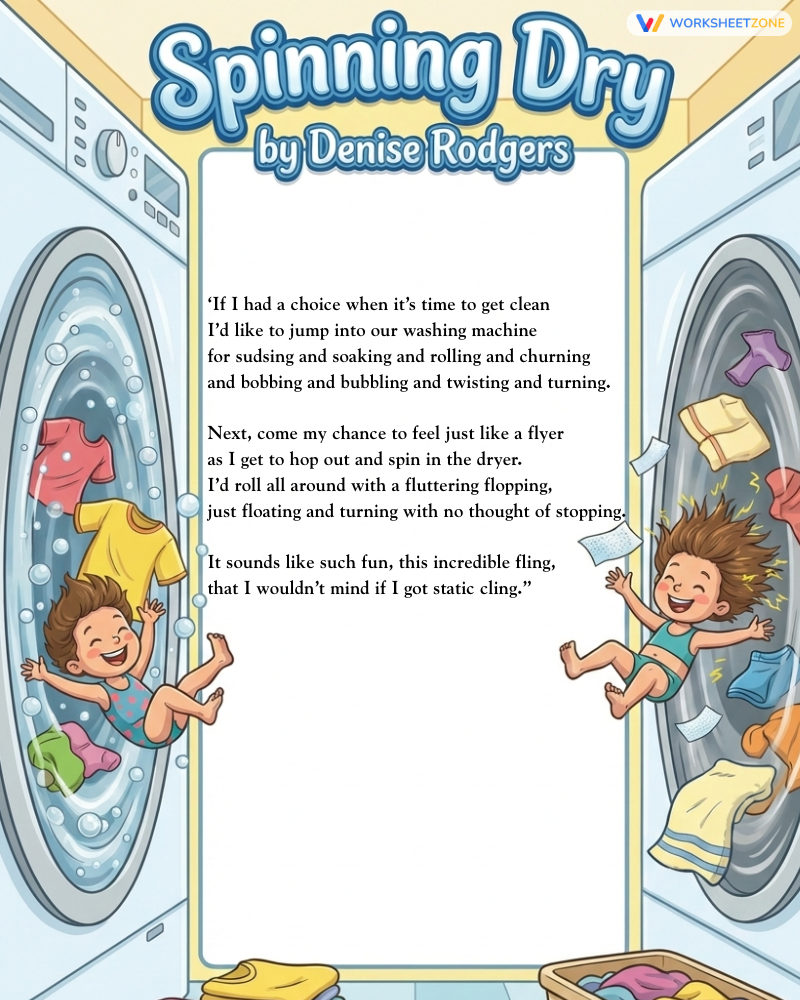
‘If I had a choice when it’s time to get clean
I’d like to jump into our washing machine
for sudsing and soaking and rolling and churning
and bobbing and bubbling and twisting and turning.
Next, come my chance to feel just like a flyer
as I get to hop out and spin in the dryer.
I’d roll all around with a fluttering flopping,
just floating and turning with no thought of stopping.
It sounds like such fun, this incredible fling,
that I wouldn’t mind if I got static cling.”
8. Bear in there by Shel Silverstein
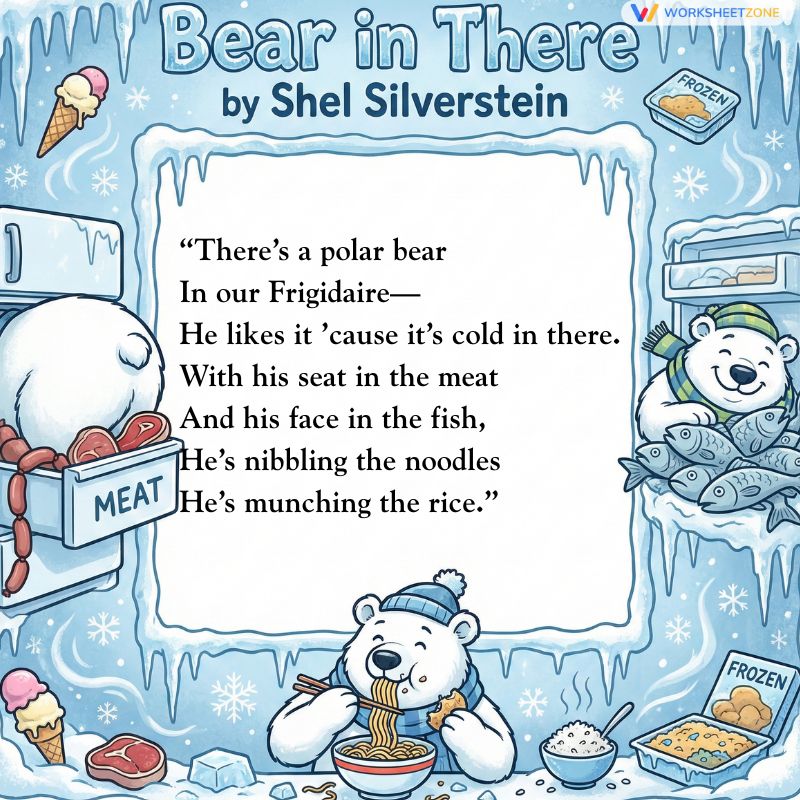
“There’s a polar bear
In our Frigidaire—
He likes it ’cause it’s cold in there.
With his seat in the meat
And his face in the fish,
He’s nibbling the noodles
He’s munching the rice.”
9. Eat wisely by Alan Loren
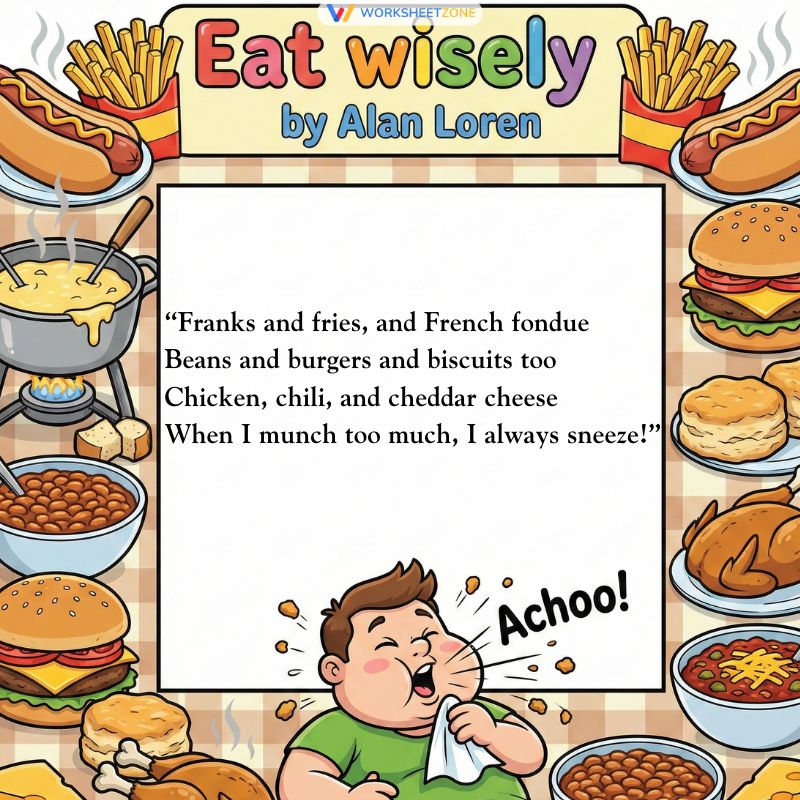
“Franks and fries, and French fondue
Beans and burgers and biscuits too
Chicken, chili, and cheddar cheese
When I munch too much, I always sneeze!”
10. The football game by Alan Loren

“Blitz and blocking, bump –and-run
Drive and drop kick, the other team’s done
End zone, end line, ebb and flow
Snap, sack, scrambling, I love it so
Football is fun and fabulous too
Let’s go to the stadium, just me and you.”
11. I saw an ol’ gnome by Shel Silverstein
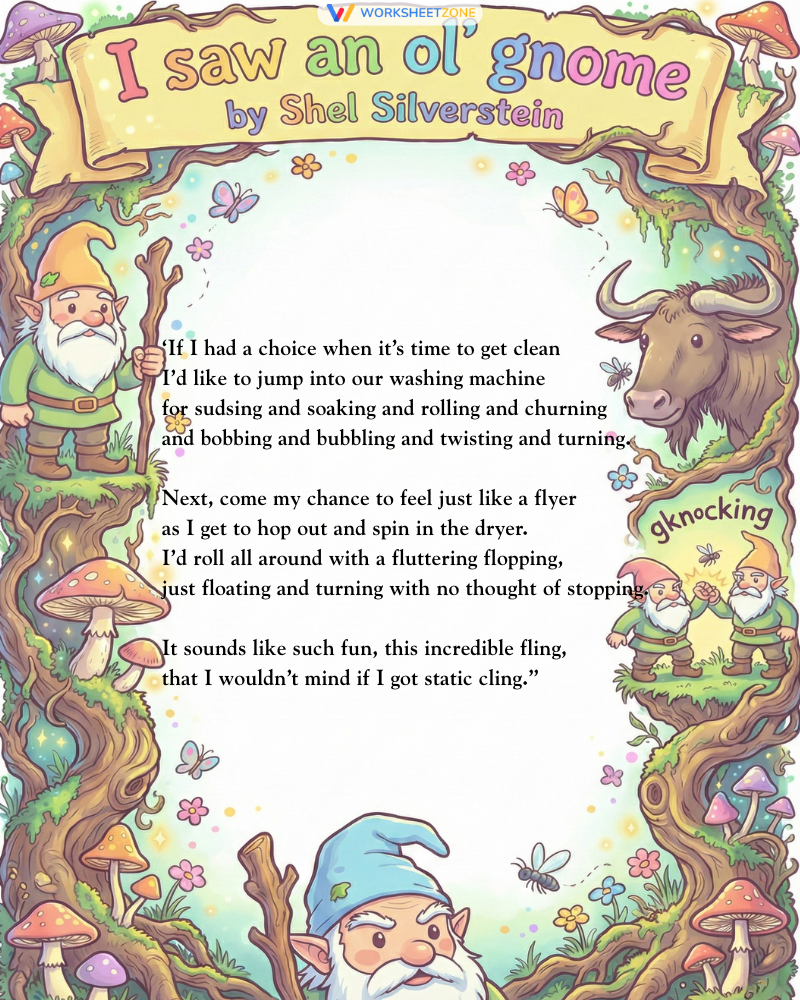
“I saw an ol’ gnome
Take a gknock at a gnat
Who was gnibbling the gnose of his gnu?
I said, ‘Gnasty gnome,
Gnow, stop doing that.
That gnat ain’t done gnothing to you.’
He gnodded his gnarled ol’ head and said,
“‘Til gnow I gnevergnew
That gknocking a gnat
In the gnoodle like that
Was gnot a gnice thing to do.”
12. Three gray geese by Mother Goose
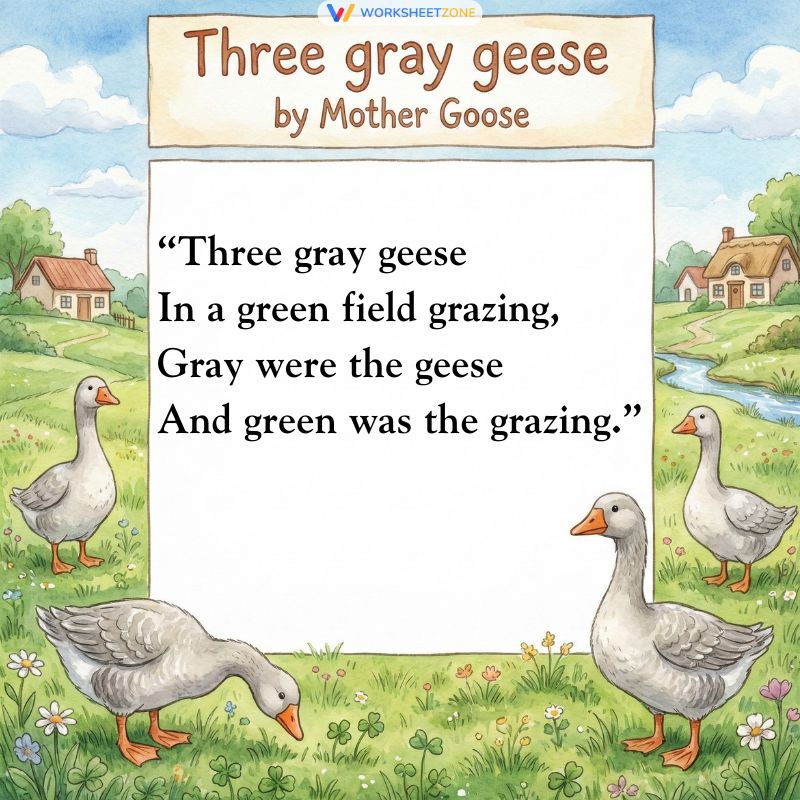
“Three gray geese
In a green field grazing,
Gray were the geese
And green was the grazing.”
13. Bleezer’s ice cream by Jack Prelutsky

“I am Ebenezer Bleezer,
I run BLEEZER’S ICE CREAM STORE,
There are flavors you have never seen
Or dreamed of before.”
14. Hickory, dickory, dock by Mother Goose

“Hickory, dickory, dock,
The mouse ran up the clock.
The clock struck one,
The mouse ran down,
Hickory, dickory, dock.”
15. Pat-a-cake, pat-a-cake, baker’s man by Mother Goose

“Pat-a-cake, pat-a-cake, baker’s man,
Bake me a cake, as fast as you can;
Pat it, prick it, and mark it with B,
Put it in the oven for baby and me.”
Why is alliteration used in poems?
Alliteration is used in poems to make language more engaging, memorable, and easier to understand. By repeating the same beginning sounds, poets create rhythm and musicality that help words flow smoothly and capture the reader’s attention.
In educational contexts, alliteration plays an important role in language development. It helps learners:
- Recognize sound patterns and repeated beginning sounds
- Improve pronunciation and speaking confidence
- Strengthen early reading and phonics skills
- Focus on one sound at a time in a fun, meaningful way
Alliteration also helps establish mood and tone in poetry. Soft consonant sounds can create a calm or gentle feeling, while stronger sounds can add energy or excitement. For this reason, alliteration is widely used in children’s poetry, nursery rhymes, and classroom learning materials.
Frequently Asked Questions (FAQs)
1. How does alliteration help with reading fluency?
Alliteration helps students practice the rapid transitions between similar sounds, which is a key component of oral reading fluency. By mastering “tongue twisters,” students build the confidence and speed needed for more complex texts. Use our Word Search Maker to reinforce the spelling patterns associated with these sounds.
2. What is the difference between alliteration and assonance?
Alliteration is the repetition of consonant sounds at the beginning of words, while assonance is the repetition of vowel sounds within words. Understanding this difference is essential for meeting middle school standards for literary analysis. Our Lesson Plan Generator can help you build a unit that covers both.
Conclusion
Alliteration poems play an essential role in shaping well-rounded, expressive readers and writers. From classic nursery rhymes to modern humorous verses, each example supports a different area of phonological growth. The most effective literacy practice balances technical skill with the freedom to play with language. When chosen thoughtfully, these activities inspire curiosity and prepare students for long-term academic success.
To dive deeper into poetic devices and improve reading skills, check out the collection of Poem Worksheets. These resources include exercises on rhyme, rhythm, and alliteration, perfect for students and teachers!


