




















Quizizz alternatives are digital assessment tools that provide interactive quizzes, gamified learning paths, and real-time student feedback beyond the standard Quizizz platform. These alternatives refer to specialized platforms for AI-powered worksheets, high-energy classroom competitions, and curriculum-aligned memorization tools designed for students in grades PreK–12. This article explores 10 powerful Quizizz alternatives, highlighting their strengths, features, pricing, and why each one can effectively replace Quizizz.
10 Quizizz alternatives
Below are the best Quizizz alternatives that offer interactive quizzes, engaging games, and flexible teaching tools.
1. Worksheetzone

Worksheetzone has emerged as a powerhouse for educators who need a blend of traditional materials and modern interactivity. Its effectiveness lies in its AI-driven capability to transform static keywords or lesson topics into comprehensive, interactive worksheets and quizzes within seconds. By bridging the gap between printable resources and digital games, it ensures that teachers can support both in-class activities and remote learning without duplicating their workload.
Key features of Worksheetzone:
- AI worksheet generator: Instantly creates questions and layouts based on specific topics
- Interactive hosting: Converts standard PDFs into digital activities where students can drag, drop, and type answers
- Massive template library: Provides access to over a million ready-made, customizable resources
- Real-time progress tracking: Offers a teacher dashboard to monitor student accuracy and completion live
Pricing: Worksheetzone is highly accessible, offering a robust Free version that satisfies most basic classroom needs. For teachers looking for advanced features like ad-free browsing, premium interactive hosting, and professional-grade progress tracking, they offer a Pro subscription that typically costs between $5 and $8 per month, depending on current promotions.
Why Worksheetzone is a Quizizz alternative:
While Quizizz focuses on multiple-choice questions, Worksheetzone allows for a wider variety of task types, including open-ended responses and creative word games. This is particularly effective for students in grades 3-8 who need more complex ways to demonstrate their understanding of a topic.
– AI-driven content generation for math, literacy, and more.
– Ability to create word search puzzles and crossword puzzles in seconds.
– Integrated Lesson Plan Generator for streamlined teacher prep.
2. Kahoot!
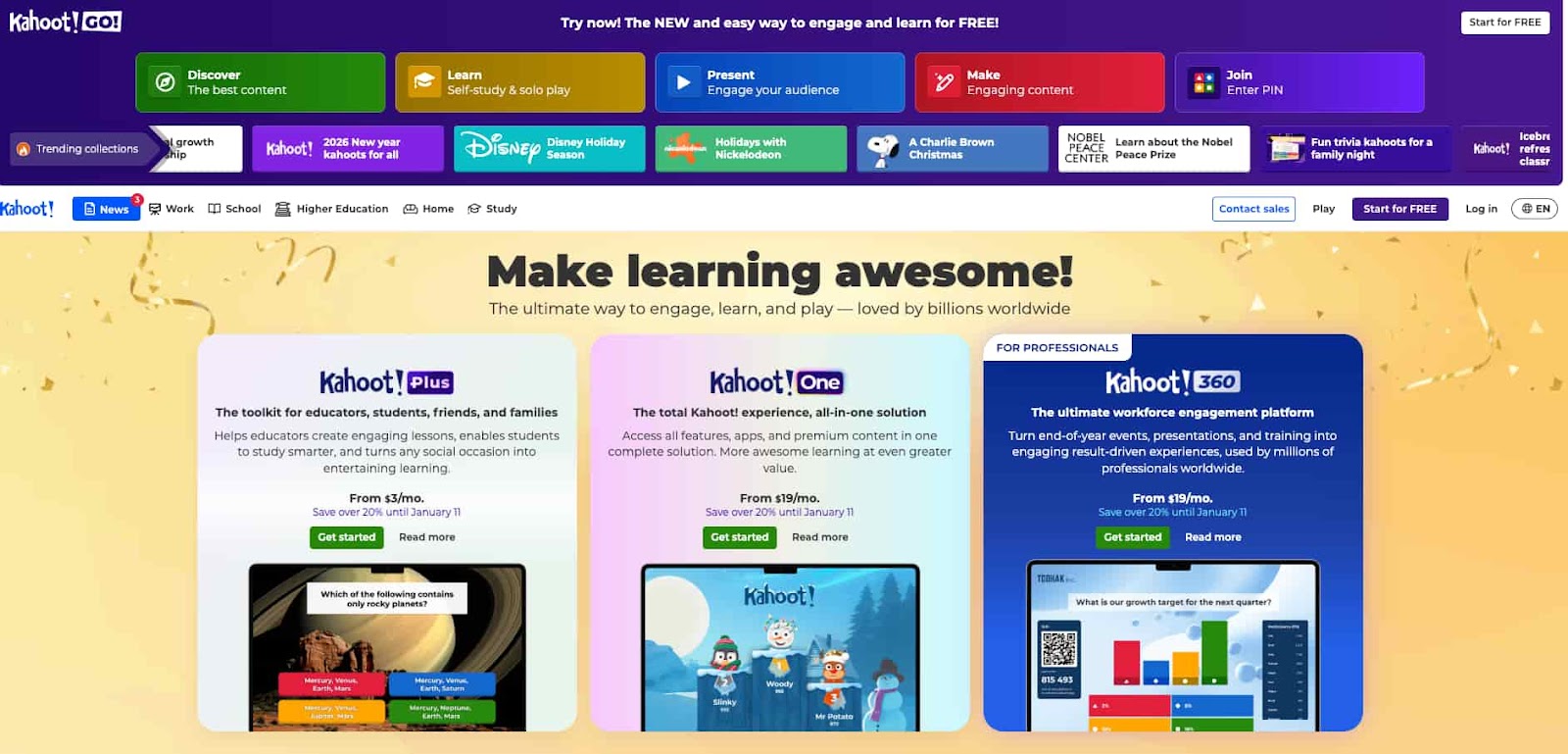
Kahoot! is perhaps the most famous name in gamified learning, known for its high-energy, “game show” atmosphere that instantly grabs student attention. Its effectiveness is rooted in the “shared screen” experience, where students look up at the main board to see questions and use their devices as controllers. This creates a social, competitive environment that is perfect for pre-test reviews and breaking up long lectures with bursts of interactive fun.
Key features of Kahoot!:
- AI question generator: Allows teachers to upload PDFs or URLs to generate “Kahoots” automatically
- Diverse game modes: Includes classic quizzes, “Tallest Tower,” and “Robot Run” to keep the experience fresh
- Global discovery library: Features millions of public Kahoots created by brands like Disney and National Geographic
- Asynchronous challenges: Enables teachers to assign self-paced games for homework or independent study
Pricing: The platform offers a Basic Free plan for small groups. Individual professional plans for teachers generally range from $3 to $19 per month when billed annually. For larger institutions or district-wide features, Kahoots! 360 plans can reach up to $59 per host per month, offering advanced branding and deep analytics.
Why Kahoot! is a Quizizz alternative:
As a primary alternative, Kahoot! excels in synchronous, whole-class engagement where the goal is maximum energy. If you find Quizizz’s student-paced approach too quiet for your classroom needs, Kahoot!’s teacher-led pacing provides the social cohesion and excitement necessary to re-energize a room.
3. Blooket
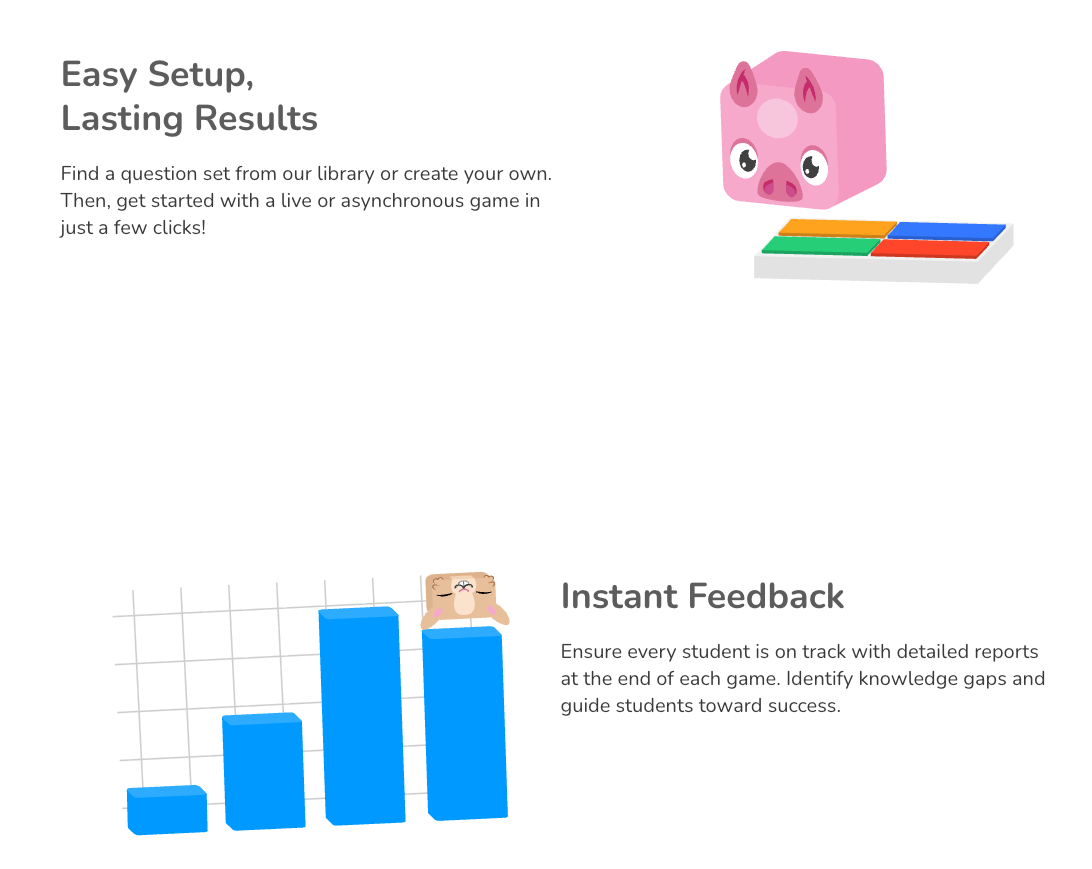
Blooket takes the concept of gamified assessment to the next level by integrating quiz questions into actual strategy-based video games. Instead of just answering questions for points, students use their correct answers to earn resources in games like “Gold Quest” or “Tower Defense.” This high level of engagement often leads students to ask for more review sessions, as the gameplay itself is genuinely addictive and rewarding.
Key features of Blooket:
- Strategy game integration: Questions are embedded within diverse game genres (e.g., racing, factory management, defense)
- Blook collection: Students earn and collect virtual characters (“Blooks”), which adds a persistent sense of progression
- Ease of set import: Teachers can easily import existing question sets from other platforms, like Quizlet
- Flexible play modes: Supports both live classroom competition and “Homework” mode for asynchronous learning
Pricing: Blooket offers a very generous Free-forever plan that allows for up to 60 players per game. For those needing more, Blooket Plus costs approximately $2.99 per month (billed annually at $35.88), while the Plus Flex monthly plan is $4.99 per month, unlocking exclusive game modes and detailed reports.
Why Blooket is a Quizizz alternative:
Blooket is the best alternative for teachers who struggle to motivate students with traditional quizzes. By shifting the focus from “taking a test” to “playing a game with a quiz inside it,” Blooket captures the attention of even the most disengaged learners in a way that Quizizz often cannot.
4. Gimkit
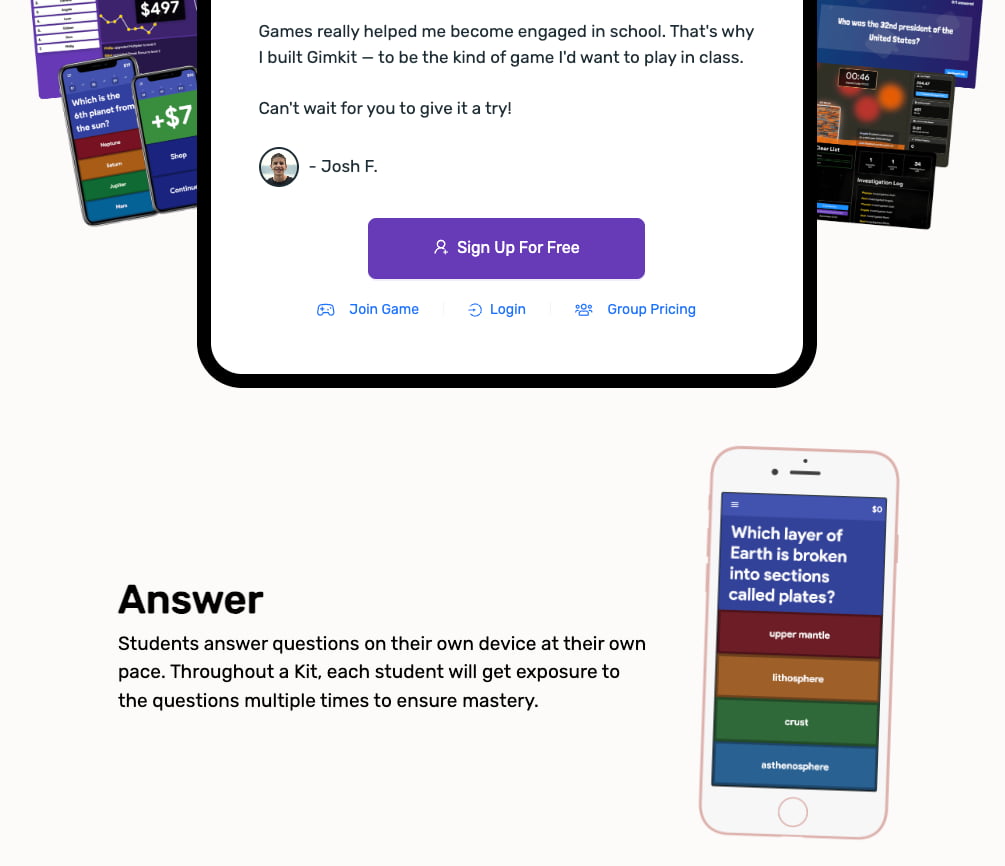
Created by a high school student, Gimkit is designed by a learner for learners, focusing on an economy-based “shop” system. Its effectiveness comes from the “Gimkit Economy,” where students earn virtual currency for correct answers and can spend it on power-ups, themes, and sabotage items to use against classmates. This introduces a layer of strategy and risk-management that makes the learning process feel like a high-stakes business simulation.
Key features of Gimkit:
- In-game shop: Students purchase upgrades like “Multiplier” or “Insurance” to maximize their earnings
- Collaborative modes: Features like “Humans vs. Zombies” or “Trust No One” (Among Us style) encourage teamwork
- KitCollab: Allows students to contribute questions to a game before it starts, fostering a sense of ownership
- Automated grading: Provides instant feedback and performance reports for teachers after every session
Pricing: Gimkit operates on a subscription model where Gimkit Pro costs roughly $4.99 per month (billed annually at $59.88). They also offer a Season Ticket for $5, which provides access to specific seasonal content. A limited free version is available, but it often restricts the number of players or active “Kits.”
Why Gimkit is a Quizizz alternative:
Gimkit serves as a top alternative because of its unique focus on student strategy rather than just speed. While Quizizz is great for quick recall, Gimkit rewards students who think critically about how to spend their “money” to win, making the review process much more intellectually stimulating.
5. Quizlet
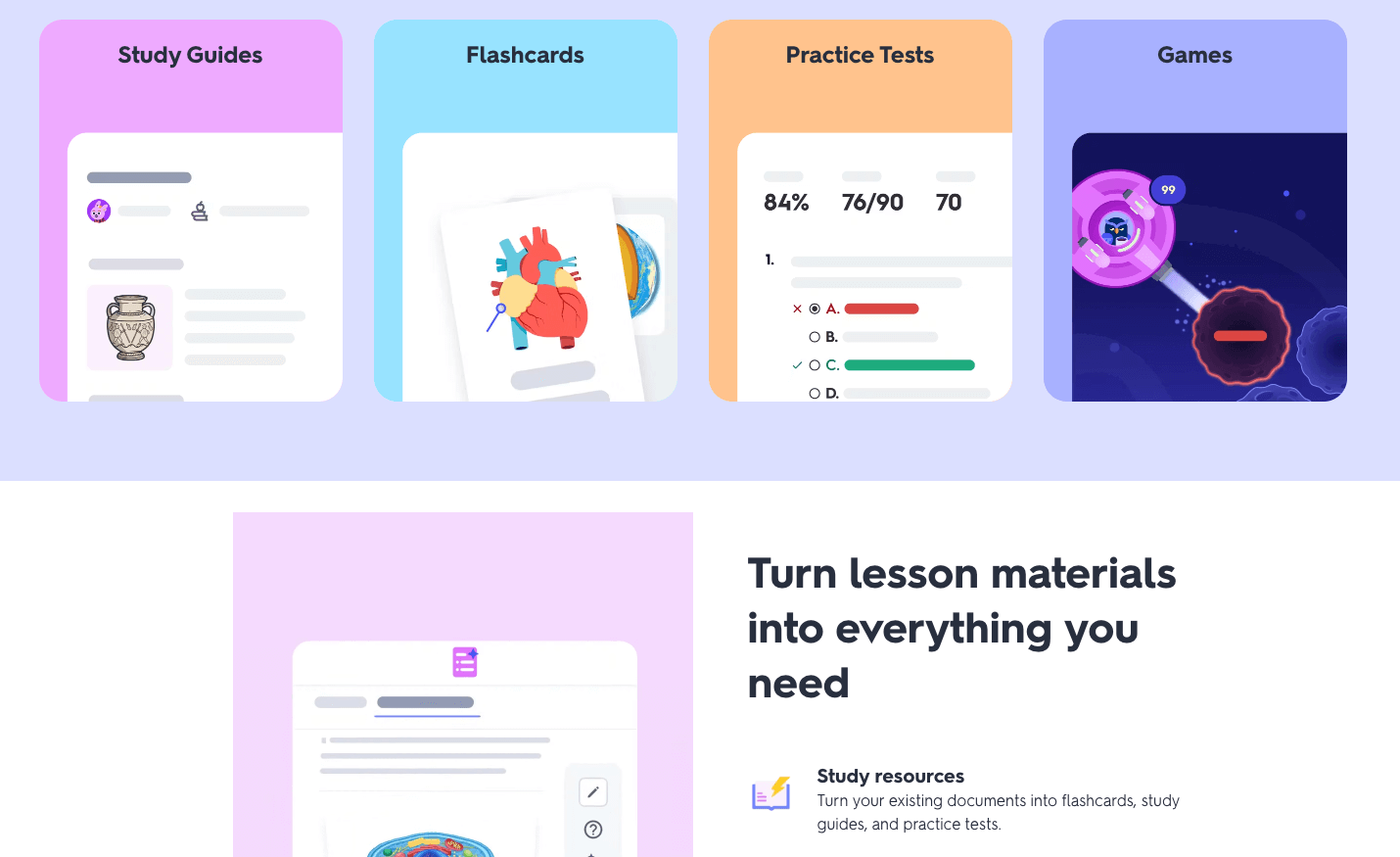
Quizlet is the ultimate tool for rote memorization, vocabulary building, and long-term retention. Its effectiveness lies in its versatility; a single set of terms can be used for flashcards, practice tests, and the popular “Quizlet Live” classroom game. It is particularly strong for language learning and science subjects, where students must master a large volume of specific definitions and concepts.
Key features of Quizlet:
- Study modes: Includes Flashcards, Learn, Test, and Match to cater to different learning styles
- Quizlet Live: A team-based game where students must collaborate to find the correct answer on one of their shared screens
- AI tutor (Q-chat): A conversational AI that helps students dive deeper into topics and quizzes them on the fly
- Expert solutions: Provide verified, step-by-step explanations for thousands of textbooks
Pricing: Quizlet offers a Free version with basic study tools. The Quizlet Plus subscription for individuals is approximately $35.99 per year, which removes ads and unlocks advanced features like offline access and detailed progress tracking. School-wide licenses are also available with custom pricing.
Why Quizlet is a Quizizz alternative:
This platform is a superior alternative for those who find Quizizz too focused on “trivia” and not enough on “study.” Quizlet is built for the long haul, helping students move information from short-term memory to long-term mastery through scientifically backed retrieval practice.
6. Nearpod

Nearpod transforms passive presentations into active learning experiences by embedding interactive activities directly into slide decks. Its effectiveness comes from the “all-in-one” approach; instead of switching between a PowerPoint and a quiz app, the quiz is inside the lesson. This keeps student focus on a single tab and allows teachers to check for understanding at every stage of the lecture.
Key features of Nearpod:
- Interactive media: Embeds 3D models, VR field trips, and PhET simulations directly into lessons
- Formative assessment tools: Features “Draw It,” “Time to Climb” (a gamified quiz), and open-ended questions
- LMS integration: Syncs seamlessly with Google Classroom, Canvas, and Microsoft Teams
- Student-paced vs. Live: Teachers can control the pace of the slides or let students move through them independently
Pricing: Nearpod offers a Silver plan for free with 100MB of storage. The Gold plan, which increases storage and class size, costs $159 per year, while the Platinum plan is $397 per year. Most large-scale usage is handled through custom School or District licenses.
Why Nearpod is a Quizizz alternative:
Nearpod is a great alternative for educators who want a more holistic instructional tool. While Quizizz is an assessment tool, Nearpod is a delivery vehicle for the entire curriculum, ensuring that engagement happens during the instruction, not just after it.
7. ClassMarker

ClassMarker is a professional-grade online testing solution designed for high-stakes environments, business training, and formal academic assessments. Its effectiveness is rooted in its security and reliability; it is built to handle thousands of users simultaneously while providing instant, accurate grading. Unlike game-based tools, ClassMarker focuses on providing a distraction-free environment for serious evaluation.
Key features of ClassMarker:
- Advanced security: Features password protection, time limits, and IP restrictions to prevent cheating
- AI proctoring: Monitors test-takers via camera and browser lockdown features to ensure academic integrity
- Custom certificates: Automatically generate and email certificates to students who pass their exams
- Embeddable exams: Allows you to host tests directly on your own website or blog
Pricing: ClassMarker provides a Free trial for educators. Professional plans for Education start at $19.95 per month, while Business plans (for corporate training) start at $39.95 per month. Credit packs are also available for those who prefer to pay only for the number of tests taken.
Why ClassMarker is a Quizizz alternative:
If you need an alternative that moves away from “games” and toward “credentials,” ClassMarker is the answer. It is far more robust than Quizizz for formal certifications and professional development, where the accuracy of the result is more important than the fun of the interface.
8. Mentimeter

Mentimeter is an interactive presentation software that excels at gathering real-time feedback and visualizing data. Its effectiveness is best seen in large-group settings – such as university lectures or corporate seminars – where it turns a one-way speech into a two-way conversation. It is particularly famous for its beautiful “Word Clouds” that grow and change as participants submit their thoughts.
Key features of Mentimeter:
- Live polling: Includes multiple-choice, scales, and ranking questions to gauge audience opinion
- Interactive word clouds: Visually represent common themes and ideas from the audience in real-time
- Q&A feature: Allows participants to submit questions anonymously, which the presenter can then address
- Exportable data: Teachers can download results into Excel or PDF for further analysis after the session
Pricing: Mentimeter offers a Free plan with unlimited participants but a limited number of questions per presentation. The Basic plan for educators is $10 per month (billed annually), and the Pro plan is $16 per month, offering full customization and branding.
Why Mentimeter is a Quizizz alternative:
Mentimeter is the ideal alternative for higher education and professional environments. While Quizizz can feel a bit “childish” for adult learners, Mentimeter’s sleek, sophisticated interface is designed for mature discussions and high-level brainstorming.
9. Socrative
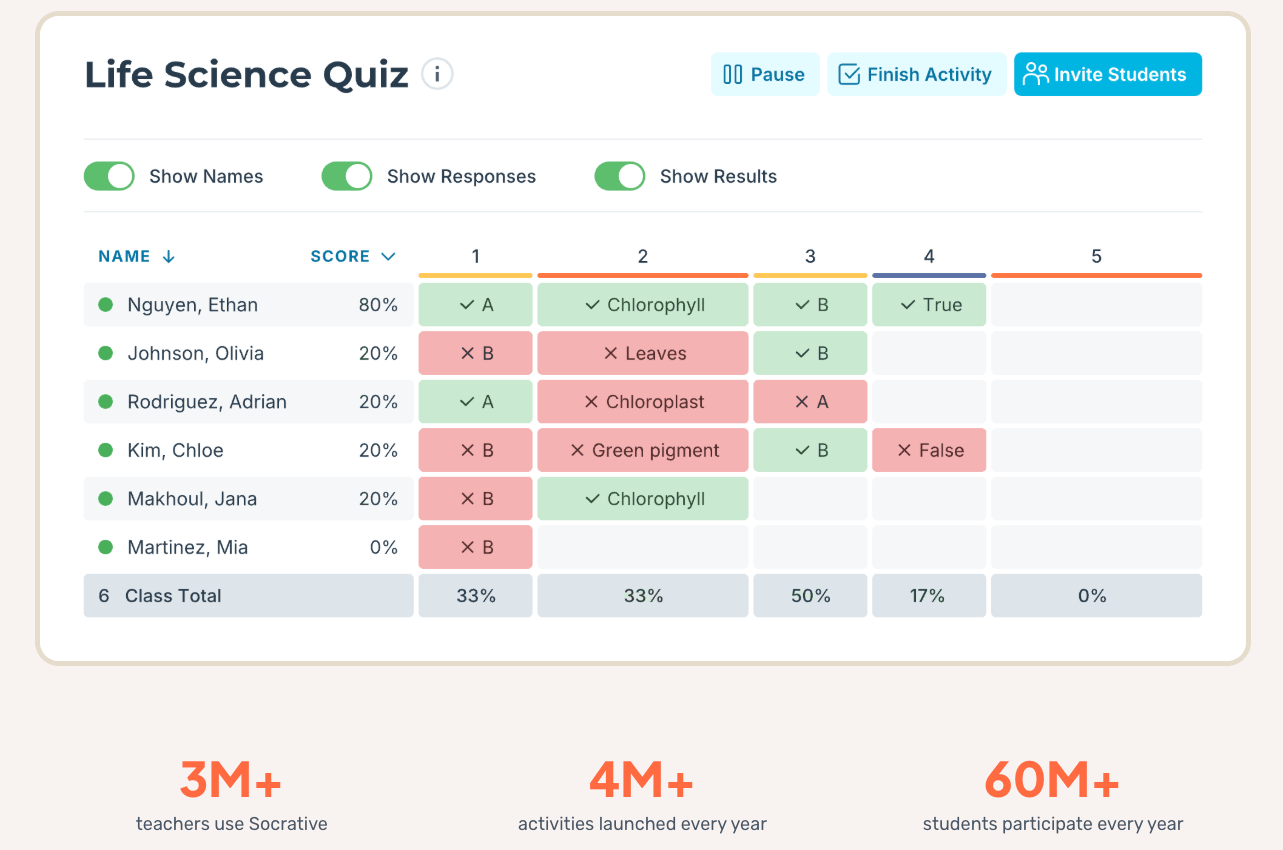
Socrative is a streamlined formative assessment tool that emphasizes speed and simplicity. Its effectiveness lies in its “Quick Question” feature, which allows teachers to ask a question verbally and get instant digital responses without having to prepare a full quiz in advance. It is a favorite for “exit tickets” and “checks for understanding” because it provides a clear, no-frills snapshot of student progress.
Key features of Socrative:
- Space race: A competitive quiz mode where teams move a spaceship across the screen by answering questions correctly
- Exit tickets: Preset templates to wrap up a lesson and gather student feedback on what they learned
- Instant grading: Provides a live results table where teachers can see exactly which student is struggling with which questions
- Room codes: Simple student entry via a permanent room code, requiring no student accounts or logins
Pricing: Socrative offers a Free version with one room and 50 students. Socrative Pro for K-12 costs $89.99 per year, while the Higher Ed & Corporate version is $179.99 per year, unlocking multiple rooms and larger student capacities.
Why Socrative is a Quizizz alternative:
Socrative is a strong alternative for teachers who value data over “bells and whistles.” If the bright colors and music of Quizizz are a distraction in your classroom, Socrative’s clean and efficient data visualization will help you focus purely on the pedagogy.
10. TriviaMaker
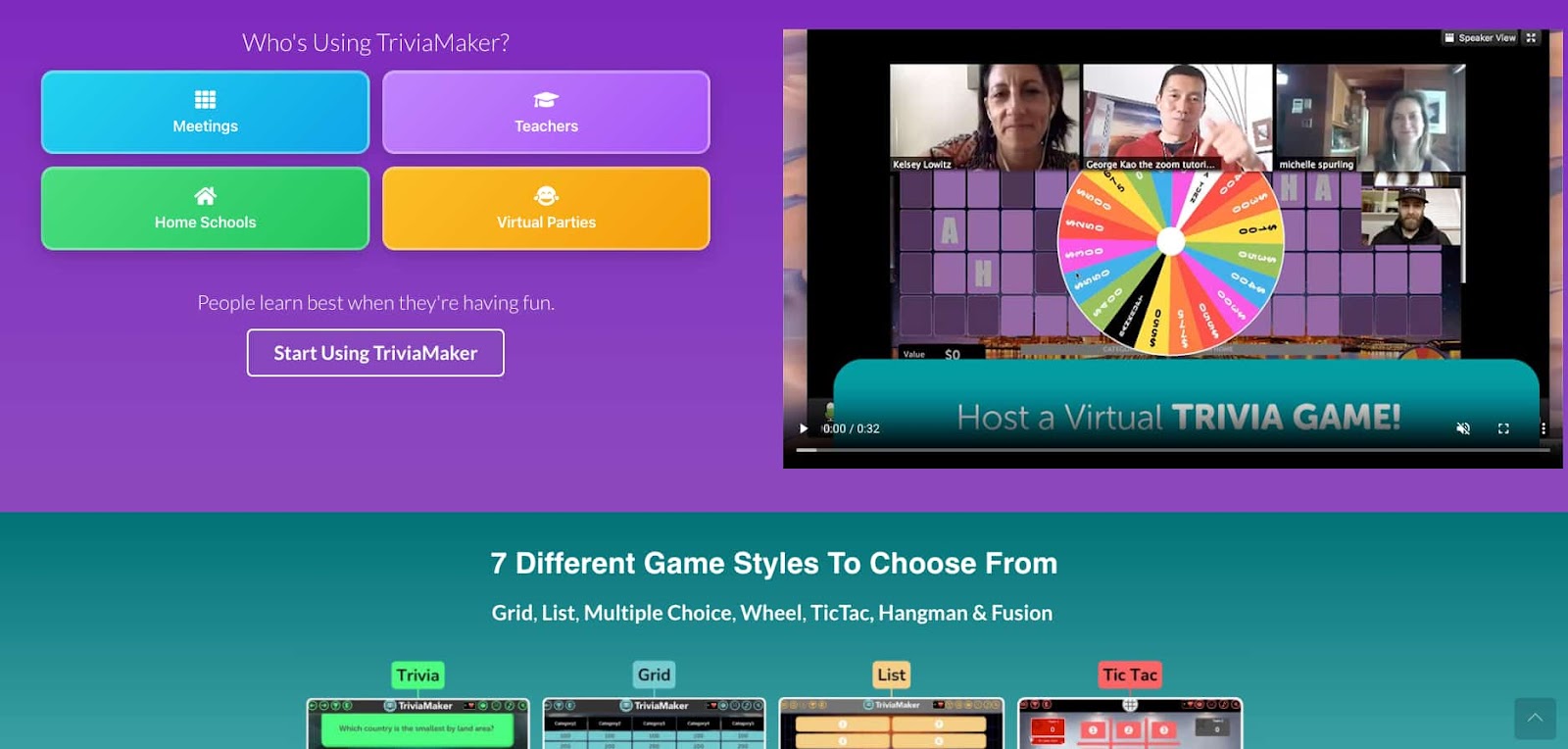
TriviaMaker is a specialized tool that allows anyone to create professional-looking game shows reminiscent of TV favorites. Its effectiveness is unmatched when it comes to hosting themed events or big end-of-unit reviews. It offers formats like “Grid” (Jeopardy-style), “List” (Family Feud-style), and “Wheel” (Wheel of Fortune-style), making the quiz feel like a legitimate entertainment event.
Key features of TriviaMaker:
- Game show formats: Includes Grid, List, Trivia, and Wheel of Fortune styles
- Full customization: Teachers can add their own logos, colors, background music, and sound effects
- Cross-device compatibility: Works on phones, tablets, and computers, and can be projected onto a big screen wirelessly
- Cloud storage: All games are saved in the cloud, allowing for easy access from any classroom
Pricing: TriviaMaker has a Basic Free version with limited features. The Premium account is highly affordable at $19 per year, while the Premium Plus (supporting up to 200 teams) is currently offered at a promotional price of $49.99 per year.
Why TriviaMaker is a Quizizz alternative:
TriviaMaker is the best alternative for those who want to host an “event” rather than just a “quiz.” While Quizizz is excellent for daily practice, TriviaMaker provides the cinematic flair and variety needed for a memorable, high-stakes competition.
Comparison Table: Use Case by Platform
|
Platform |
Best For |
Engagement Level |
Setup Time |
|
Worksheetzone |
Interactive Worksheets |
High (Creative) |
Low |
|
Kahoot! |
Whole-Class Review |
Very High |
Medium |
|
Quizlet |
Vocabulary/Facts |
Medium |
Low |
|
Blooket |
Stealth Learning |
Very High |
Medium |
FAQs
1. Are these Quizizz alternatives free?
Yes, almost all the platforms listed, including Worksheetzone, Blooket, and Gimkit, offer free basic versions for teachers and students. While some premium features or higher student limits may require a paid plan, the foundational tools are accessible to all.
2. Which alternative is best for remote learning?
For remote or hybrid environments, we recommend platforms that support asynchronous “student-paced” modes, such as Worksheetzone or Quizlet. These allow students to complete tasks at home without needing a live connection to the teacher.
3. How do I switch from Quizizz to a new platform?
The easiest way to switch is to export your existing Quizizz questions and import them into your new tool. Many platforms, including Worksheetzone, allow you to create new content simply by entering your topic or keywords. Use our lesson planning tools and teaching resource generators to help organize your transition.
4. Do these tools help with student data analysis?
Absolutely. One of the main benefits of using Quizizz alternatives is the detailed reporting. Teachers can see exactly which questions students struggled with and adjust their future lessons accordingly. This data-driven approach is vital for meeting national standards for student growth and proficiency.
Conclusion
Choosing the right Quizizz alternatives depends on your teaching goals, classroom environment, and engagement strategy. Some platforms focus on live competition, while others excel in assignments, assessments, or full lesson delivery. Tools like Worksheetzone provide an all-in-one solution, while others specialize in gamification, study, or secure testing. By understanding what each platform offers, educators can select the best alternative to create more engaging, effective, and meaningful learning experiences.


