




















Hybrid learning vs blended learning refers to two distinct educational models that integrate digital tools with traditional instruction to enhance student engagement. Blended learning is a pedagogical approach where all students participate in both in-person and online activities, while hybrid learning delivers instruction to in-person and remote students simultaneously. Worksheetzone provides resources for both models to ensure teachers in grades PreK–12 can successfully navigate modern classroom environments.
What is hybrid learning?

Hybrid learning is an educational model that teaches in-person and remote students at the same time using synchronous communication tools. It provides flexibility for students who cannot attend physically while maintaining a unified classroom experience. According to UNESCO, hybrid models are essential for maintaining educational continuity in diverse global contexts.
In a classroom setting, this works best when teachers use a dedicated “remote station” to monitor chat and engagement from digital participants. This model is particularly effective for high school students who may have varying schedules or location constraints.
The core of hybrid learning is synchronous flexibility. It is designed to ensure that, regardless of where a student is physically located, they are receiving the same lecture and participating in the same discussions in real-time. This model is common in:
- K-12 schools: Accommodating students who are ill or unable to travel
- Universities: Allowing international or working students to attend lectures remotely
- Cooperation training: Bridging the gap between in-office and work-from-home employees
Examples of hybrid learning in practice
- The synchronous classroom: A professor lectures to 20 students in a physical hall while 15 others participate via Zoom. The remote students can see the whiteboard and raise their digital hands to ask questions.
- High-flex setup: A teacher uses specialized microphones and 360-degree cameras to ensure remote participants feel as though they are “in the room,” using shared digital tools like Miro or Google Jamboard for group work.
Pros and cons of hybrid learning
Pros
- Flexible attendance: Students can choose to attend in person or remotely based on health, schedule, or personal needs.
- Greater accessibility: Hybrid learning removes geographic barriers, allowing learners to join from anywhere with an internet connection.
- Continuity during disruptions: Classes can continue smoothly during weather issues or emergencies without interrupting instruction.
Cons
- High technology costs: Schools need quality audio-visual equipment to ensure remote students have an equal learning experience.
- Increased teacher workload: Managing in-person and online students at the same time can be demanding and lead to burnout.
- Engagement challenges: Remote students may feel less involved if lessons are not carefully balanced for both groups.
What is blended learning?
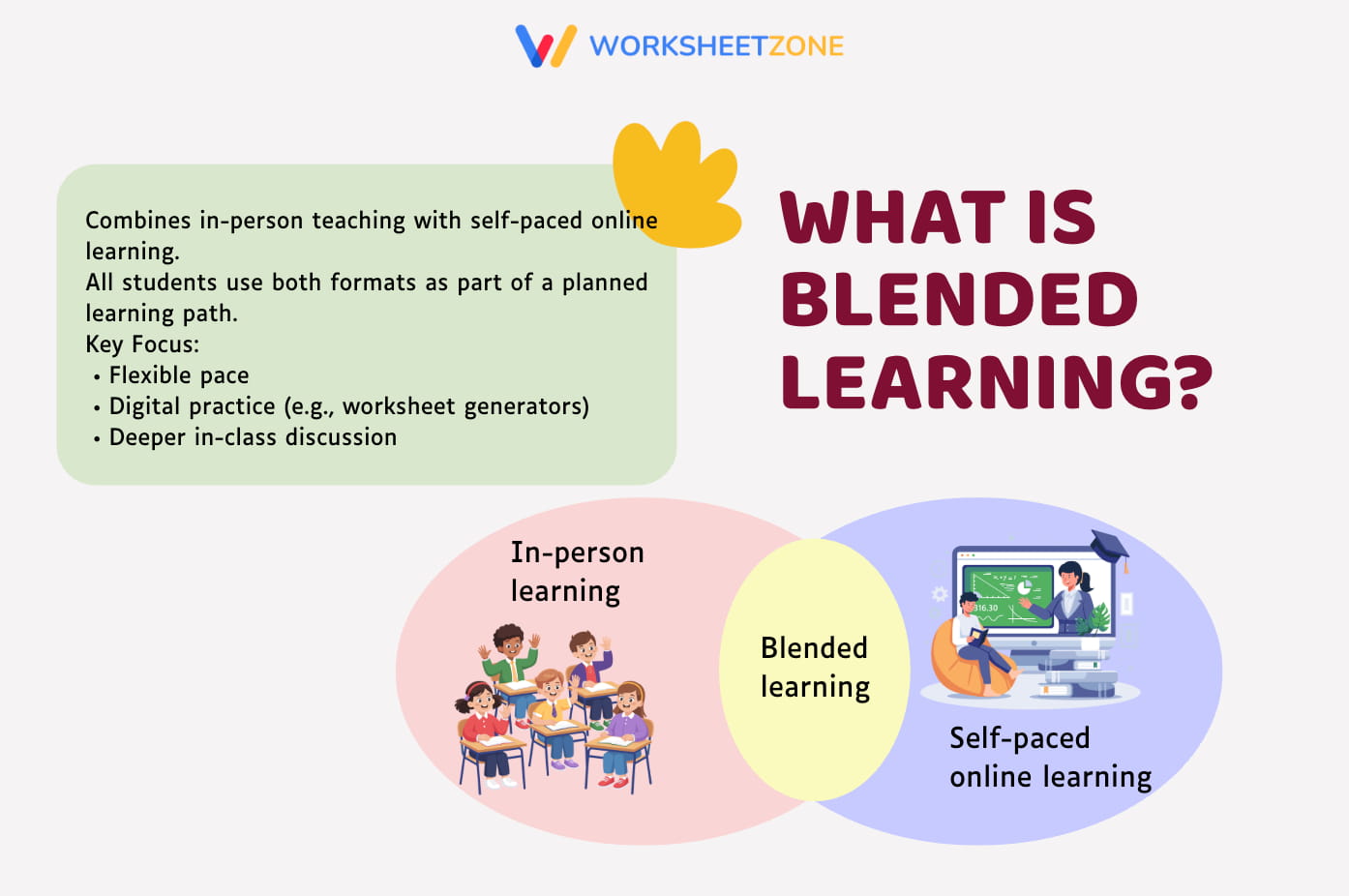
Blended learning refers to a teaching method where traditional face-to-face instruction is supplemented by asynchronous online components. Unlike the hybrid model, all students in a blended classroom engage in both the digital and physical phases of the lesson. Research shared by the International Society for Technology in Education (ISTE) suggests that blended learning empowers students to take ownership of their learning pace.
This deliberate design gives learners control over their “time, place, path, or pace.” A cornerstone of this approach is using digital tools – like an AI-powered worksheet generator or an AI Quiz Maker Generator – to create self-paced practice sets that prepare students for deeper, in-person group discussions.
Common blended learning models
- Rotation model: Students cycle through different “stations,” moving from independent online study to small-group teacher instruction.
- Flipped classroom: The most famous model. Students watch lectures or read materials at home (online) and use class time for active practice and discussion.
- Enriched virtual model: A program where students do the majority of work online but are required to attend face-to-face sessions for specific labs or check-ins.
Examples of blended learning in practice
- The “homework” flip: A middle school math teacher might use a 10-minute lecture followed by students rotating through a Quiz Maker station and a small-group collaboration station. This ensures every student receives targeted support.
- Self-paced modules: An employee completes three interactive online modules at their own pace and then attends a physical workshop to apply those skills in a role-play scenario.
Pros and cons of blended learning
Pros
- Personalized instruction: Digital tools help teachers identify learning gaps before class and adjust instruction to student needs.
- Better use of class time: Lessons move online, freeing in-person sessions for discussion, collaboration, and problem-solving.
- Student independence: Self-paced learning allows students to review content as needed and build responsibility for their progress.
Cons
- High planning demands: Blended learning requires careful curriculum design to align online and in-class activities.
- Student accountability issues: The model depends on students completing online work before class.
- Time-intensive setup: Creating quality digital content takes significant effort upfront, especially at the beginning.
Hybrid learning vs blended learning: key differences
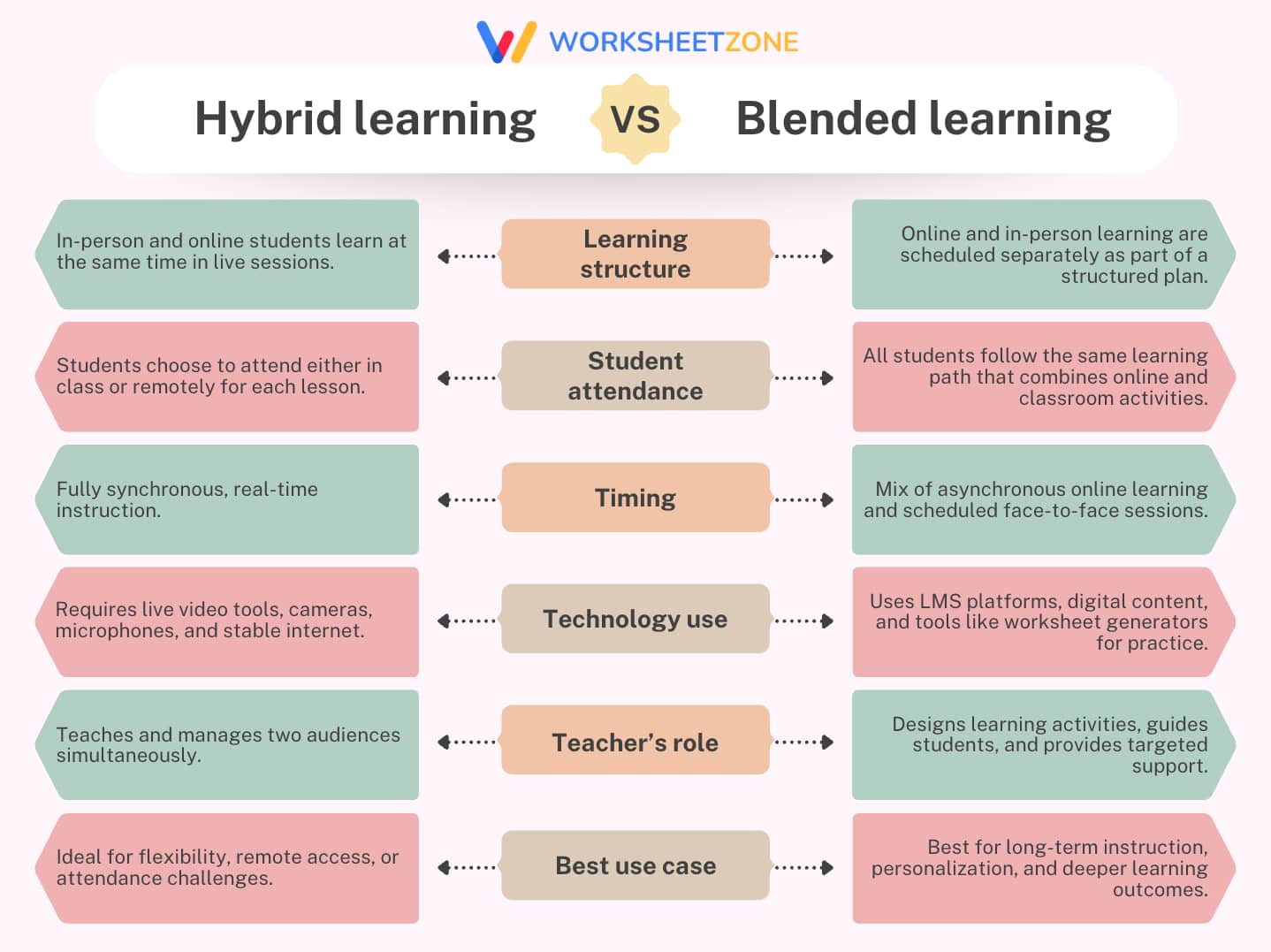
The following comparison highlights the most important differences between hybrid learning and blended learning in real classroom settings.
Learning structure
Hybrid learning is strictly synchronous. It mirrors a traditional schedule where lessons occur in real-time, requiring all students to attend at a set hour – either in the room or via a live digital feed.
Blended learning combines synchronous and asynchronous phases. Students complete independent online work on their own time to prepare for face-to-face sessions focused on collaborative application and discussion.
Student participation

In hybrid learning, the cohort is split by location. Some students attend physically while others join virtually, offering “location-agnostic” flexibility where students choose the mode that suits their daily needs.
Blended learning requires unified participation. Every student follows the same path, moving together through online modules and in-person sessions as a single group without the choice of being remote-only.
Technology requirements
Hybrid learning depends on broadcasting hardware. Success requires high-speed streaming, 360-degree cameras, and multi-directional microphones to ensure remote students feel “present” and can interact without lag.
Blended learning prioritizes content delivery tools. The focus is on a robust Learning Management System (LMS) and interactive resources that students can navigate independently at their own pace.
The teacher’s role
In a hybrid setup, the teacher acts as a live moderator. They must maintain a “dual presence,” balancing physical engagement with digital chat monitoring to ensure neither audience group is neglected.
In blended learning, the teacher functions as a facilitator or coach. Because foundational content is delivered through digital tasks, class time is freed up for deep-dive mentorship and personalized student support.
Classroom experience
The hybrid experience feels like a traditional lecture with a digital window. It aims to recreate the standard classroom environment for remote participants who couldn’t make the commute.
The blended experience feels like an active workshop. Since the “lecture” happens online beforehand, the physical classroom becomes a high-energy hub for experiments, debates, and hands-on problem-solving.
In short:
While both models use technology, the primary difference lies in the synchronicity and student location. Hybrid learning is strictly synchronous and splits the student body by location. Blended learning combines synchronous and asynchronous phases and requires all students to participate in both environments.
Frequently Asked Questions (FAQs)
1. Is hybrid learning the same as distance learning?
No, hybrid learning is different because it includes an in-person component happening at the same time as the remote instruction. Distance learning is often 100% remote and can be entirely asynchronous. Hybrid models aim to bridge the gap between physical and digital presence.
2. Which model is better for elementary students?
Blended learning is generally considered more effective for elementary students in grades PreK-5. At this age, social interaction and teacher guidance are vital. Blended models like “Station Rotation” allow for hands-on play while introducing foundational digital literacy skills through Worksheetzone’s worksheet makers.
3. How do I prepare my classroom for these models?
To prepare for either model, we recommend starting with a strong digital foundation. Use a lesson plan generator to map out your digital vs. physical touchpoints.
4. Can parents support these models at home?
Yes, parents play a vital role in blended learning by providing a quiet space for asynchronous tasks. For hybrid learning, parents ensure that remote students stay logged in and focused. Worksheetzone provides the AI quiz maker, Interactive worksheet maker and other educational resource generators parents can use to reinforce classroom concepts at home.
Conclusion
Hybrid learning vs blended learning models play an essential role in shaping well-rounded, tech-savvy learners. Each approach supports different areas of educational growth, from accessibility to personalized mastery. When chosen thoughtfully, these models inspire curiosity and prepare students for a successful future in a digital world.


