




















What active learning actually means

Active learning is any study method where the student does the cognitive work: retrieving answers, explaining concepts, or solving problems, rather than passively absorbing content. Passive learning is rereading and highlighting. Active learning is closing the book and writing what you remember, then checking for gaps.
The difference matters because effort predicts retention. When your brain struggles to pull an answer from memory, that struggle strengthens the memory. Rereading feels easy, and that ease is often mistaken for mastery.
| Approach | What the student does | Typical retention effect |
|---|---|---|
| Passive | Rereads notes, highlights text, watches videos | Low, fades within days |
| Active | Recalls, quizzes, explains, applies | High, durable for weeks |
Why active learning beats passive study
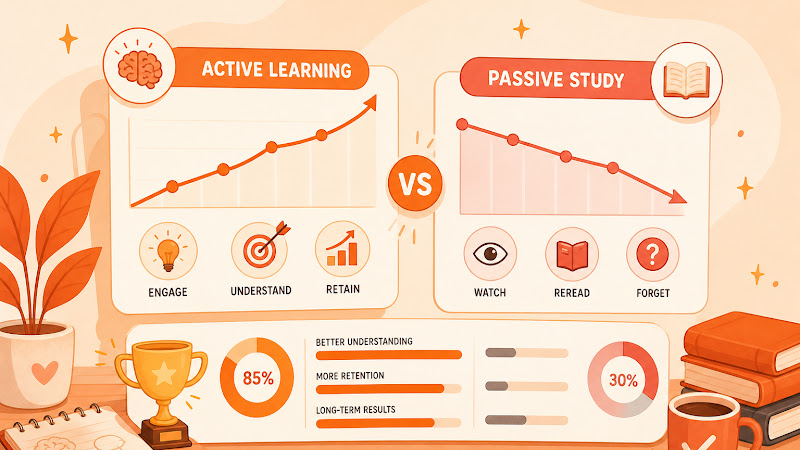
Active learning outperforms passive study because it uses retrieval, spacing, and feedback, three of the most reliable drivers of long-term memory in cognitive science research. Meta-analyses in education have repeatedly linked active methods to higher exam scores and lower failure rates compared with lecture-only formats.
In practice, this usually means fewer study hours for better results. A student who quizzes for 20 minutes often outperforms one who rereads for an hour, because testing reveals exactly what is not yet known.
8 active learning techniques for students
The best active learning techniques for students share one trait: they demand output, not just input. Below are eight methods you can start using today, from solo study to group work. Mix two or three per session rather than relying on a single technique.
1. Retrieval practice
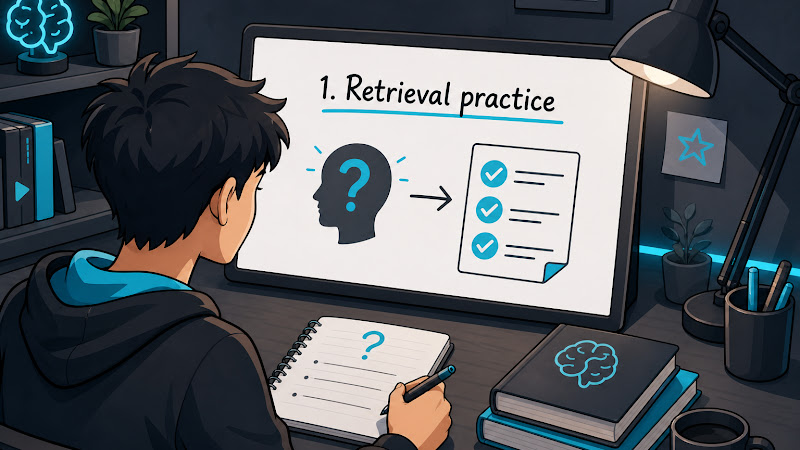
Close your materials and write down everything you remember about a topic, then check your notes for gaps. This single habit is one of the most effective study methods available. A common mistake is checking the answer too early, which turns a memory test back into passive reading.
2. Spaced repetition

Review material at increasing intervals: after one day, then three days, then a week. Flashcards and quiz apps make this easy. Spacing prevents the cramming trap, where information learned the night before disappears within 48 hours.
3. The Feynman technique

Explain a concept in plain language as if teaching a younger student. When you stumble, you have found the exact gap to review. Teaching forces you to organize ideas, not just recognize them.
4. Think-pair-share

Think about a question alone, discuss it with a partner, then share with the group. This structure gives every student thinking time before speaking and surfaces misconceptions quickly. It works in classrooms, study groups, and virtual sessions alike.
5. Practice problems and worked examples

For math and science, solving problems beats rereading formulas. Start with a worked example, then attempt a similar problem without looking. Our printable and interactive worksheets are built for this repeat-and-check cycle.
6. Self-quizzing

Turn headings and key terms into questions before you study, then answer them afterward. Writing your own quiz questions is itself a powerful review, because it forces you to decide what matters most.
7. Concept mapping

Draw the relationships between ideas as a diagram with labeled connections. Concept maps expose whether you understand how topics link together, not just isolated facts. They are especially useful for history, biology, and literature.
8. Interleaving
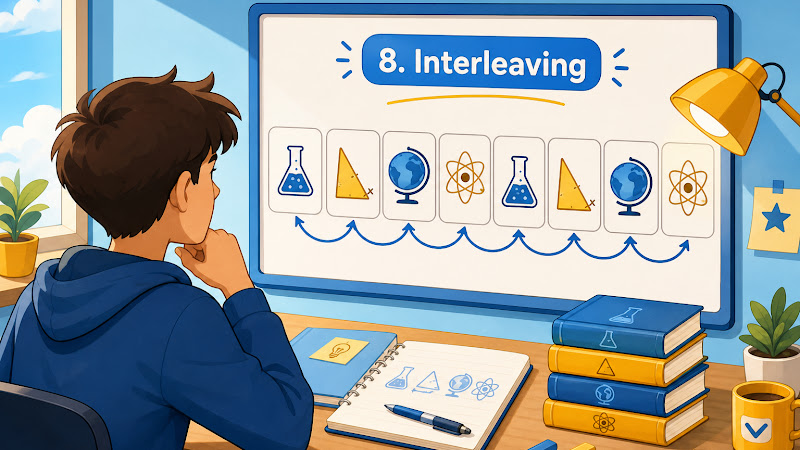
Mix different problem types or topics in one session instead of blocking them. Interleaving feels harder, but it trains the brain to choose the right strategy, which is what real exams demand.
- Solo methods: retrieval practice, spaced repetition, self-quizzing, concept mapping
- Social methods: Feynman technique, think-pair-share, peer teaching
- Applied methods: practice problems, interleaving, case scenarios
Teaching strategies for active learning in the classroom

Effective teaching strategies for active learning shift the classroom from lecture to participation, giving students frequent, low-stakes chances to think and respond. The goal is to keep every learner mentally engaged, not just the few who raise their hands. Small structural changes make a large difference.
| Strategy | How it works | Best for |
|---|---|---|
| Exit tickets | Students answer one question before leaving class | Checking daily understanding |
| Live quizzes | Interactive, game-style questions with instant scoring | Boosting energy and recall |
| Group activities | Small teams solve a shared problem | Discussion and peer teaching |
| One-minute papers | Students summarize a lesson in writing | Reflection and gap-finding |
Teachers can assign these in minutes using Worksheetzone tools such as the Quiz Maker, Exit Ticket Generator, and interactive worksheets, then track student progress live. This turns passive lessons into measurable, active practice.
A simple weekly active learning plan
A realistic study plan spreads active methods across the week so material is reviewed several times before a test. Below is a sample plan a student could adapt for any subject. The key is short, frequent sessions rather than one long cram.
| Day | Active task | Time |
|---|---|---|
| Monday | Learn new material, then write a recall summary | 30 min |
| Tuesday | Self-quiz on Monday’s topic | 15 min |
| Wednesday | Practice problems, interleaved | 25 min |
| Thursday | Teach the topic aloud, Feynman style | 15 min |
| Friday | Concept map linking the week’s ideas | 20 min |
| Weekend | Spaced review of all weak spots | 30 min |
Common mistakes to avoid

Most students lose time not from lack of effort but from methods that feel productive yet build weak memory. Watch for these traps.
- Highlighting everything: color-coding a page is passive and rarely improves recall.
- Rereading instead of testing: familiarity is not the same as knowing.
- Cramming: one long session before a test fades fast without spacing.
- Checking answers too soon: peeking removes the retrieval effort that builds memory.
- Studying only easy topics: comfort is a signal to move to weaker areas.
Frequently asked questions
What is the most effective active learning technique?
Retrieval practice, closing your notes and recalling what you know, is consistently among the most effective. It directly strengthens memory and reveals gaps that rereading hides.
How is active learning different from passive learning?
Active learning requires you to produce answers, explanations, or solutions, while passive learning only involves receiving information. The mental effort of producing output is what makes active methods stick.
Can active learning work for online students?
Yes. Interactive quizzes, self-paced worksheets, and virtual think-pair-share all translate well to remote study. Tools that auto-grade and track progress keep online learners accountable.
How much time should students spend on active learning?
Short, frequent sessions of 15 to 30 minutes work better than long blocks. Consistency across the week beats a single marathon session before an exam.
Are worksheets considered active learning?
They can be, when they require solving, recalling, or applying rather than copying. Interactive and quiz-style worksheets are especially effective for active practice.
Final thoughts
Mastering active learning techniques for students is less about studying harder and more about studying in ways that make memory work: retrieve, space, explain, and apply. Combine solo methods like self-quizzing with teaching strategies for active learning such as exit tickets and live quizzes, and you will see stronger recall in less time. Avoid the passive habits of rereading and cramming, and give every session a clear active task. Ready to put these methods into practice? Explore the interactive worksheets, quizzes, and teaching tools at Worksheetzone to turn any lesson into active, measurable learning today.


