


























Views
Downloads

Essential Blending Vowels Worksheet | Grade 1 Phonics
Paste this activity's link or code into your existing LMS (Google Classroom, Canvas, Teams, Schoology, Moodle, etc.).
Students can open and work on the activity right away, with no student login required.
You'll still be able to track student progress and results from your teacher account.
This Essential Blending Vowels worksheet provides early learners with focused phonics practice to master vowel teams and diphthongs. By connecting visual cues with auditory blending, students develop the phonemic awareness necessary for decoding complex words. This printable resource ensures young readers can confidently identify vowel sounds within familiar vocabulary.
At a Glance
- Grade: 1 · Subject: English Language Arts
- Standard:
CCSS.ELA-LITERACY.RF.1.3.C— Know common vowel team conventions for representing long vowel sounds- Skill Focus: Vowel team blending and identification
- Format: 2 pages · 6 problems · Answer key included · PDF
- Best For: Independent practice or literacy centers
- Time: 10–15 minutes
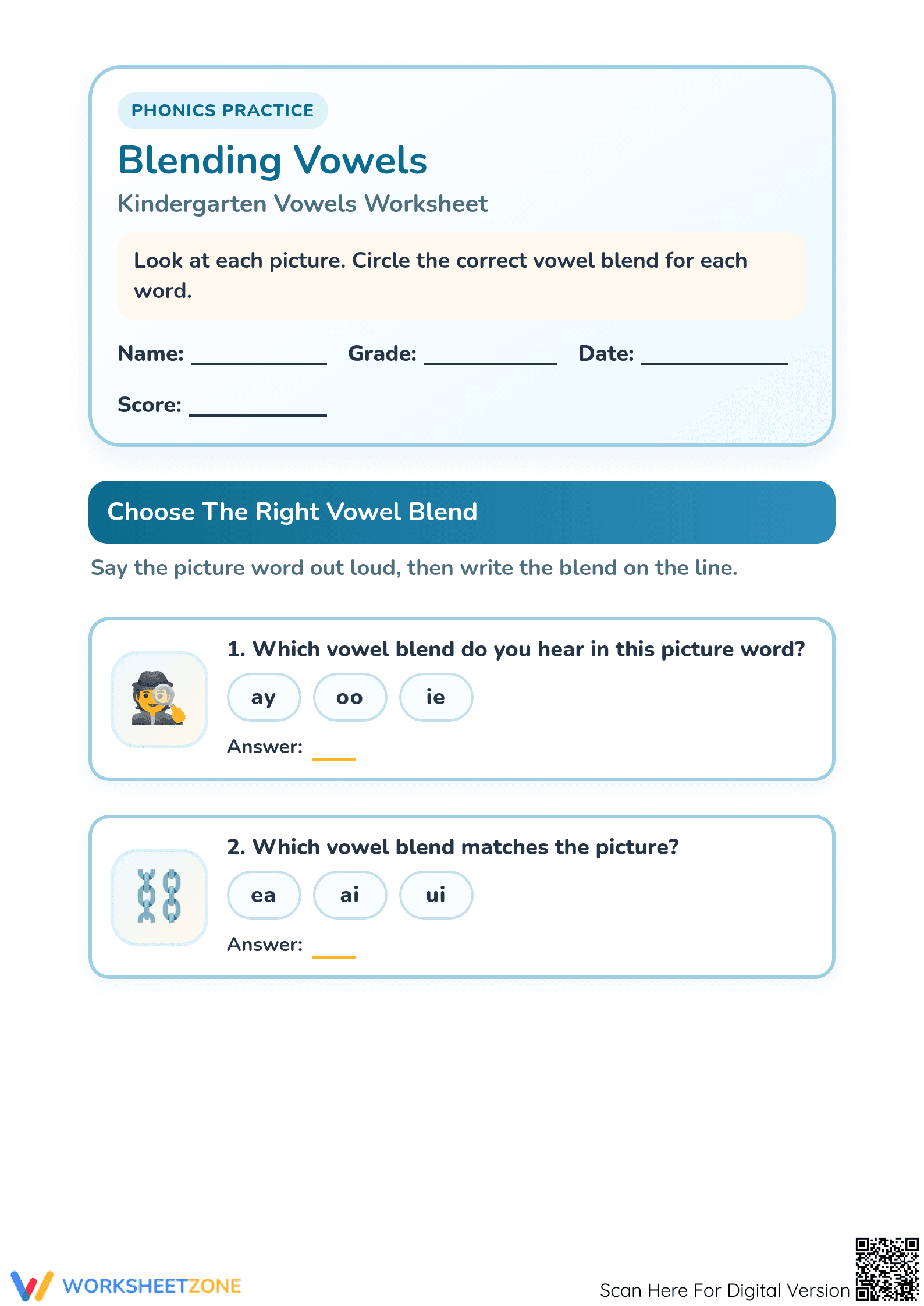
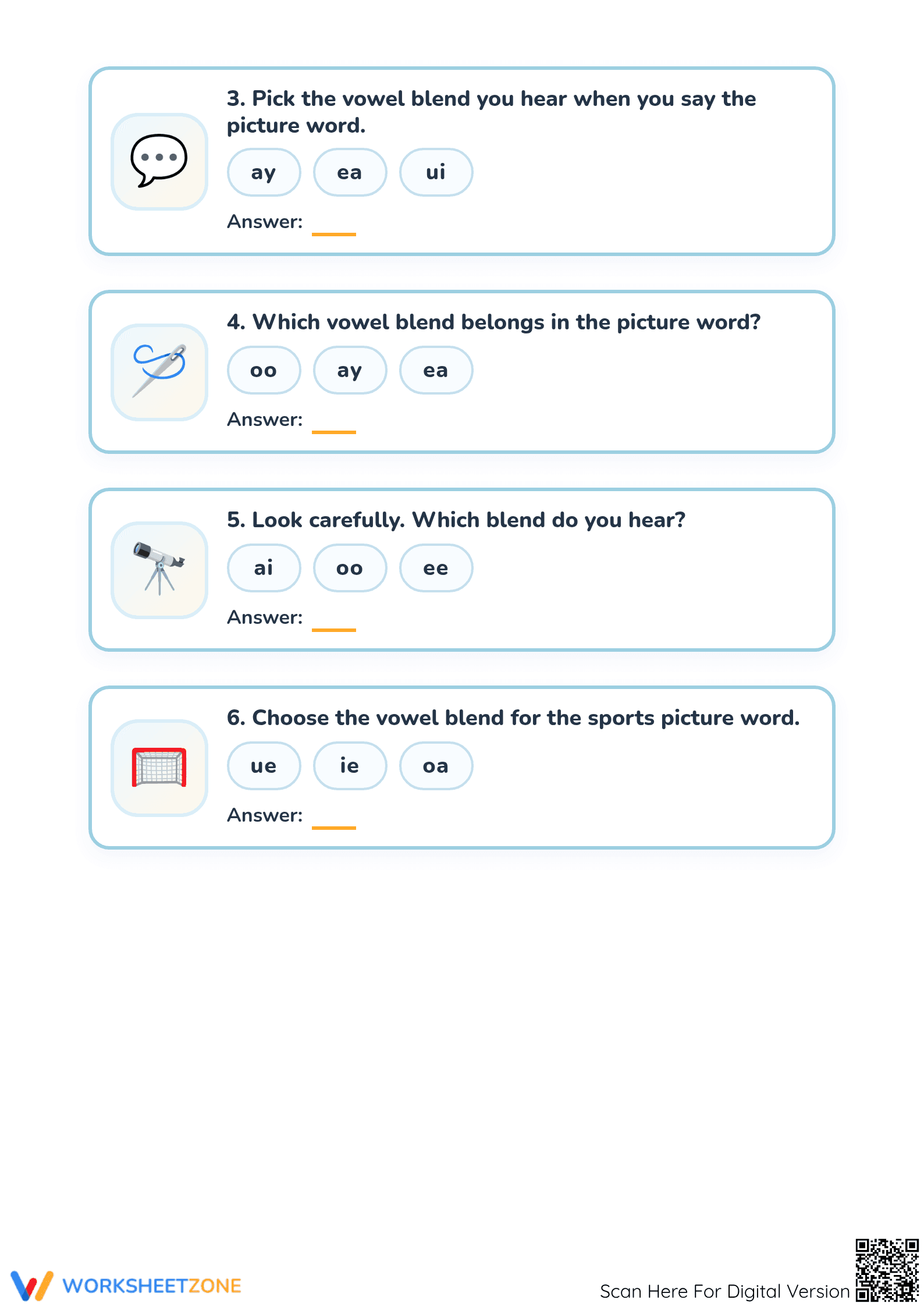
This two-page PDF features six high-interest visual prompts ranging from a "spy" to a "telescope." Each task requires students to say the word, identify the correct vowel blend from a multiple-choice selection, and write the answer on a dedicated line. A comprehensive answer key is included for immediate feedback and grading.
To implement this zero-prep workflow, follow three simple steps. First, print the two-page document (30 seconds). Second, distribute to students and model the first "say and circle" task (1 minute). Third, review the six blends as a whole class or during small-group phonics instruction (5 minutes). Total teacher preparation time is under two minutes, making it ideal for emergency sub plans or last-minute literacy block extensions.
This resource is aligned to CCSS.ELA-LITERACY.RF.1.3.C: "Know final -e and common vowel team conventions for representing long vowel sounds." This standard ensures students understand how vowel combinations function as a single unit. Both standard codes can be copied directly into lesson plans, IEP goals, or district curriculum mapping tools to ensure compliance with state frameworks.
Use this as a "Do Now" activity during your morning literacy block to reinforce previously taught vowel teams. It also functions as a quick formative assessment; observe students as they vocalize the "ai" in "chain" or "oa" in "goal" to gauge their blending fluency. The inclusion of an answer key allows for self-correction in a station-based learning environment.
This activity is designed for Grade 1 students, but remains highly effective for Kindergarteners ready for advanced phonics or Preschoolers with strong letter-sound foundations. It pairs naturally with any decodable reader or vowel team anchor chart used during direct instruction. The clear icons provide accessibility for English Language Learners (ELL) who need visual support.
Aligned with the CCSS.ELA-LITERACY.RF.1.3.C standard, this worksheet addresses the critical transition from single-letter phonics to complex vowel team decoding. Research from EdReports 2024 emphasizes that systematic phonics instruction, including the explicit blending of vowel sounds, is a cornerstone of effective literacy development in the early grades. By providing students with multiple exposures to vowel blends like "ee," "oa," and "ai" in the context of visual representations, this resource supports the orthographic mapping process necessary for long-term reading success. The 6 structured tasks encourage active engagement through vocalization and writing, reinforcing the connection between speech and print. This evidence-based approach aligns with current pedagogical shifts toward more explicit, structured literacy frameworks that prioritize decoding accuracy. Teachers can reliably use this tool to bridge the gap between initial phoneme recognition and fluent reading of multi-syllabic words containing vowel teams.


