


























Views
Downloads
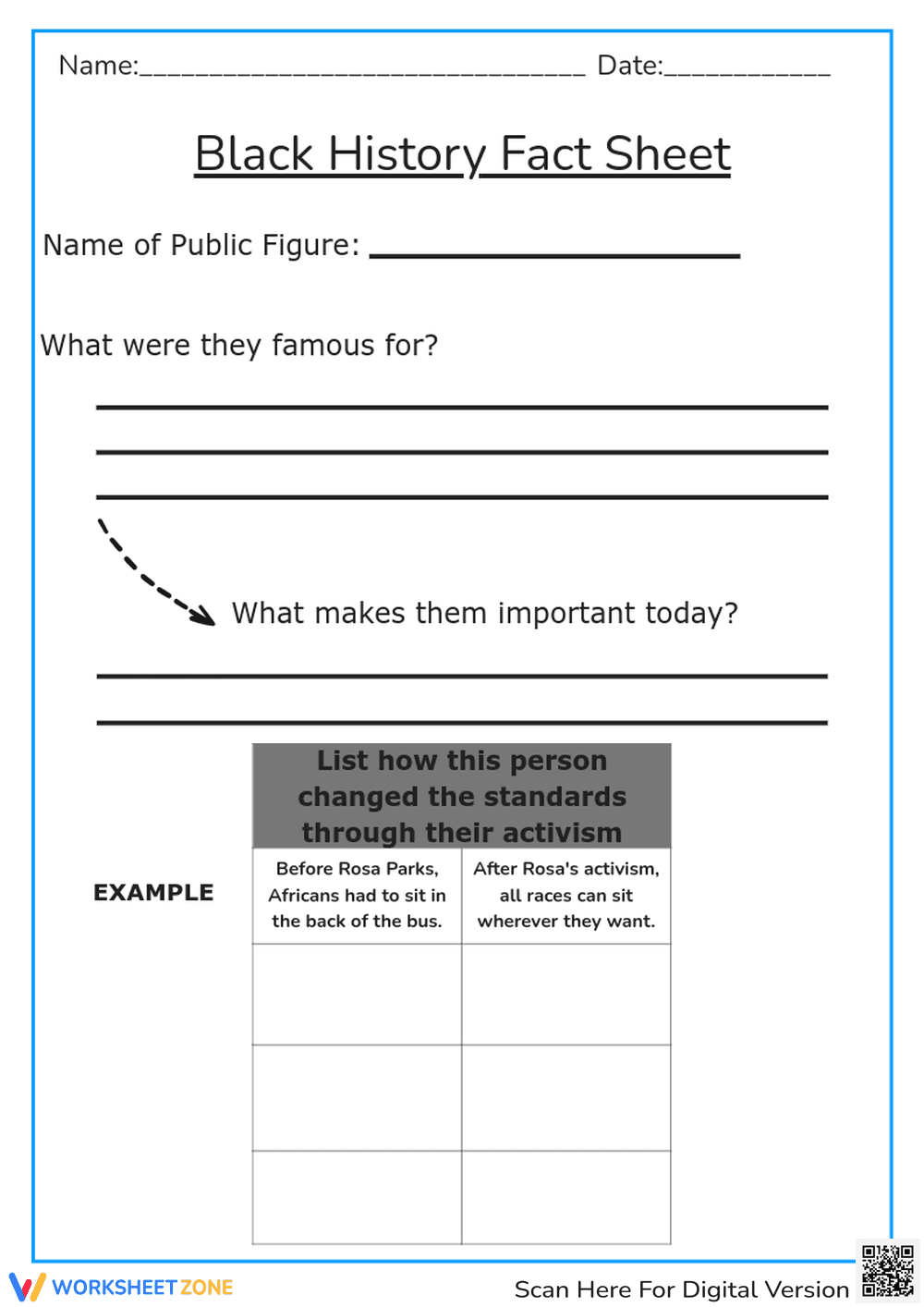

Black History Month Notes Sheet | Essential Grade 5-6
Paste this activity's link or code into your existing LMS (Google Classroom, Canvas, Teams, Schoology, Moodle, etc.).
Students can open and work on the activity right away, with no student login required.
You'll still be able to track student progress and results from your teacher account.
This Grade 5-6 Black History Month notes sheet empowers students to synthesize research on influential African American public figures. By focusing on historical significance and activism, students move beyond basic facts to analyze how individuals transformed societal standards. It provides a structured framework for documenting legacy and impact.
At a Glance
- Grade: 5-6 · Subject: Social Studies
- Standard:
CCSS.ELA-LITERACY.RI.5.3— Explain the relationships or interactions between individuals and events in history- Skill Focus: Historical Research & Impact Analysis
- Format: 1 page · 4 tasks · Graphic Organizer · PDF
- Best For: Independent research or biography projects
- Time: 20–30 minutes
Inside this 1-page PDF, you will find a clean, interactive layout designed for student engagement. It includes specific prompts for identifying a public figure's fame, their modern-day importance, and a "Before and After" activism table. The table features a built-in example using Rosa Parks to scaffold the concept of changing societal standards through direct action.
The zero-prep workflow for this resource is designed for efficiency. First, print the single-page PDF (30 seconds). Second, distribute to students as they begin their research on a chosen figure (1 minute). Third, review the completed activism tables to assess student understanding of historical cause and effect (5 minutes). It is an ideal sub-plan or supplemental activity.
This resource aligns with `CCSS.ELA-LITERACY.RI.5.3`, requiring students to explain the interactions between individuals and historical events. It also supports `CCSS.ELA-LITERACY.W.5.7` by facilitating short research projects that build knowledge through investigation. Both standard codes can be copied directly into lesson plans, IEP goals, or district curriculum mapping tools.
Use this worksheet during the "independent practice" phase of a biography unit. Students can use library books or approved websites to fill in the prompts. It also serves as a formative assessment tool; observe if students can distinguish between a person's "fame" and their "lasting impact." Expect completion within 20 to 30 minutes depending on research depth.
This organizer is for upper elementary and middle school students studying American history or civics. It is particularly effective for students who need visual scaffolds to organize their thoughts. Pair this with a digital biography database or a classroom anchor chart featuring diverse leaders to provide a comprehensive learning experience.
Research from Fisher & Frey (2014) emphasizes that graphic organizers like this notes sheet are vital for helping students bridge the gap between reading informational text and producing coherent historical analysis. By requiring students to categorize information into "fame," "importance," and "activism," the worksheet supports the cognitive load of synthesizing complex historical narratives. According to the NAEP, students who engage in structured writing about social studies topics demonstrate higher levels of historical literacy and critical thinking. This resource specifically targets the `CCSS.ELA-LITERACY.RI.5.3` standard, ensuring that Grade 5 and 6 students are not just memorizing dates, but are understanding the "why" behind historical change. The inclusion of a "Before and After" activism table directly addresses the need for students to visualize societal shifts, a key component of middle-school social studies mastery.


