




























Views
Downloads

Civil Rights Activists Matching | Grade 6-7 Essential

Paste this activity's link or code into your existing LMS (Google Classroom, Canvas, Teams, Schoology, Moodle, etc.).
Students can open and work on the activity right away, with no student login required.
You'll still be able to track student progress and results from your teacher account.
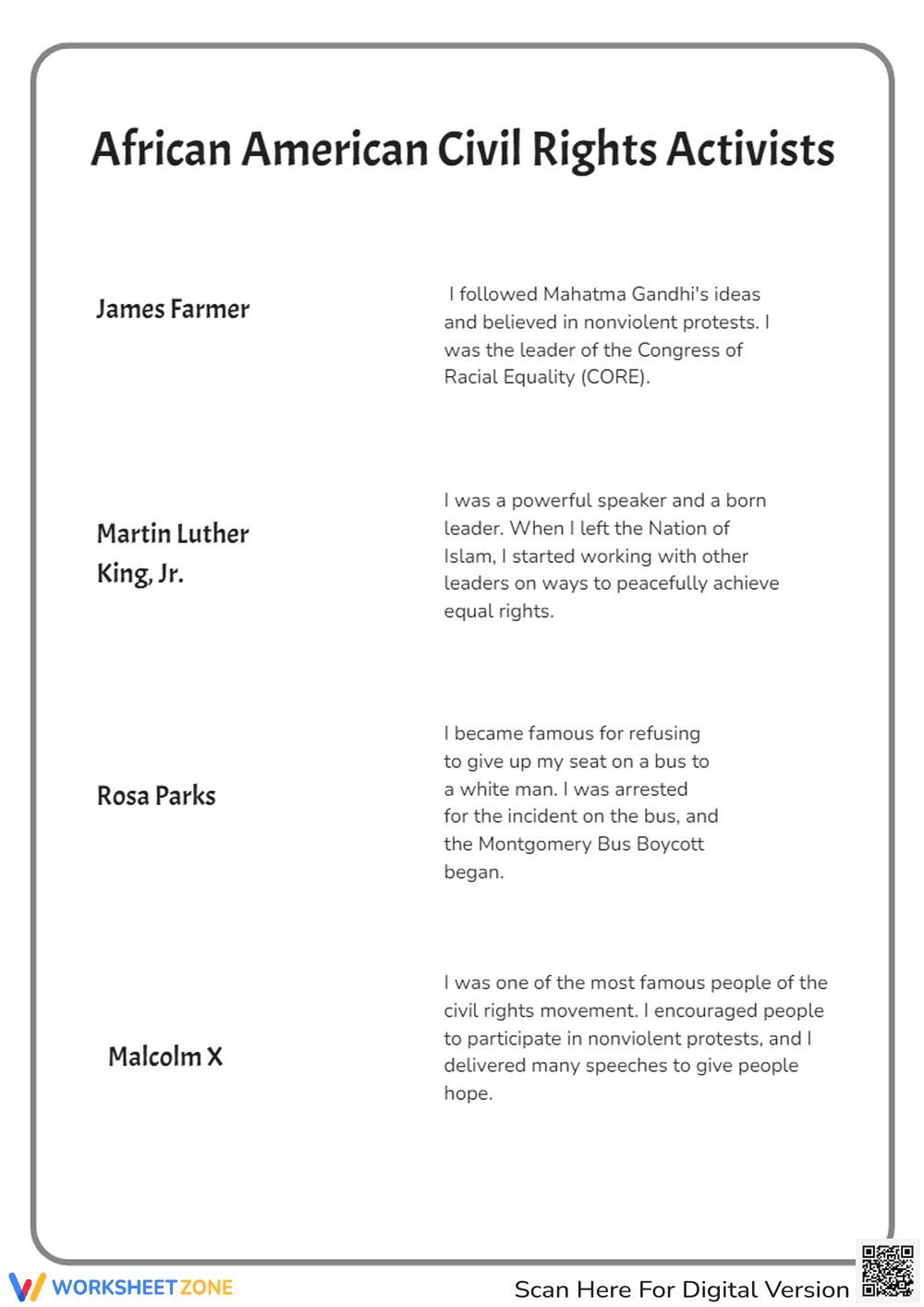
This Grade 6-7 Social Studies worksheet helps students identify the pivotal contributions of African American Civil Rights activists through a structured matching activity. By connecting names like Rosa Parks and James Farmer to their specific historical actions, learners build a foundational understanding of the movement's leadership and diverse strategies for achieving social justice.
At a Glance
- Grade: 6-7 · Subject: History
- Standard:
RH.6-8.2— Determine the central ideas or information of a primary or secondary source- Skill Focus: Historical Figure Identification
- Format: 1 page · 4 problems · Answer key included · PDF
- Best For: Quick formative assessment or bell-ringer activity
- Time: 10–15 minutes
Inside this resource, you will find a clean, one-page layout featuring four prominent Civil Rights leaders and four detailed biographical descriptions. The worksheet uses a matching format to challenge students to differentiate between various leadership roles, such as the nonviolent philosophy of CORE or the grassroots impact of the Montgomery Bus Boycott. A complete answer key is provided for rapid grading.
The zero-prep workflow is designed for maximum efficiency. First, print the single-page PDF (30 seconds). Next, distribute the sheets to students as they enter the classroom (1 minute). Finally, review the correct pairings as a whole group to clarify the distinctions between activists like Malcolm X and Martin Luther King, Jr. (5 minutes). Total teacher preparation time is under 2 minutes.
This resource aligns with CCSS.ELA-LITERACY.RH.6-8.2, which requires students to determine central ideas or information from historical texts. By analyzing the short biographies, students practice extracting key details to identify specific historical figures. This standard code can be copied directly into lesson plans, IEP goals, or district curriculum mapping tools.
Use this worksheet as a "Do Now" activity to activate prior knowledge before a lecture on the 1950s-60s Civil Rights Movement. Alternatively, assign it as an exit ticket to gauge student retention of key biographies. During the activity, observe if students can distinguish between the different organizations mentioned, such as CORE and the Nation of Islam, to assess their depth of understanding.
This activity is ideal for middle school students in general education or inclusive classrooms. It provides clear, concise text that supports English Language Learners and students with reading accommodations. Pair this worksheet with a primary source photograph or a short video clip of a speech to create a multi-modal learning experience.
According to the RAND AIRS 2024 report, high-quality instructional materials that focus on specific historical figures help students develop a more nuanced understanding of social movements. This worksheet targets the RH.6-8.2 standard by requiring students to synthesize information about African American activists into identifiable profiles. Research from Fisher & Frey (2014) emphasizes that matching tasks serve as effective scaffolds for complex historical narratives, allowing students to anchor their learning to specific names and events before moving toward higher-order analysis. By providing a clear structure for identifying leaders like James Farmer and Rosa Parks, this resource ensures that Grade 6 and 7 students meet essential literacy requirements in history. The inclusion of an answer key and a zero-prep format supports teacher efficacy, allowing more time for deep classroom discussion and critical thinking regarding the long-term impact of these civil rights pioneers.


