


























Views
Downloads


Printable Properties of Materials: Bendable Things Worksheet
Paste this activity's link or code into your existing LMS (Google Classroom, Canvas, Teams, Schoology, Moodle, etc.).
Students can open and work on the activity right away, with no student login required.
You'll still be able to track student progress and results from your teacher account.
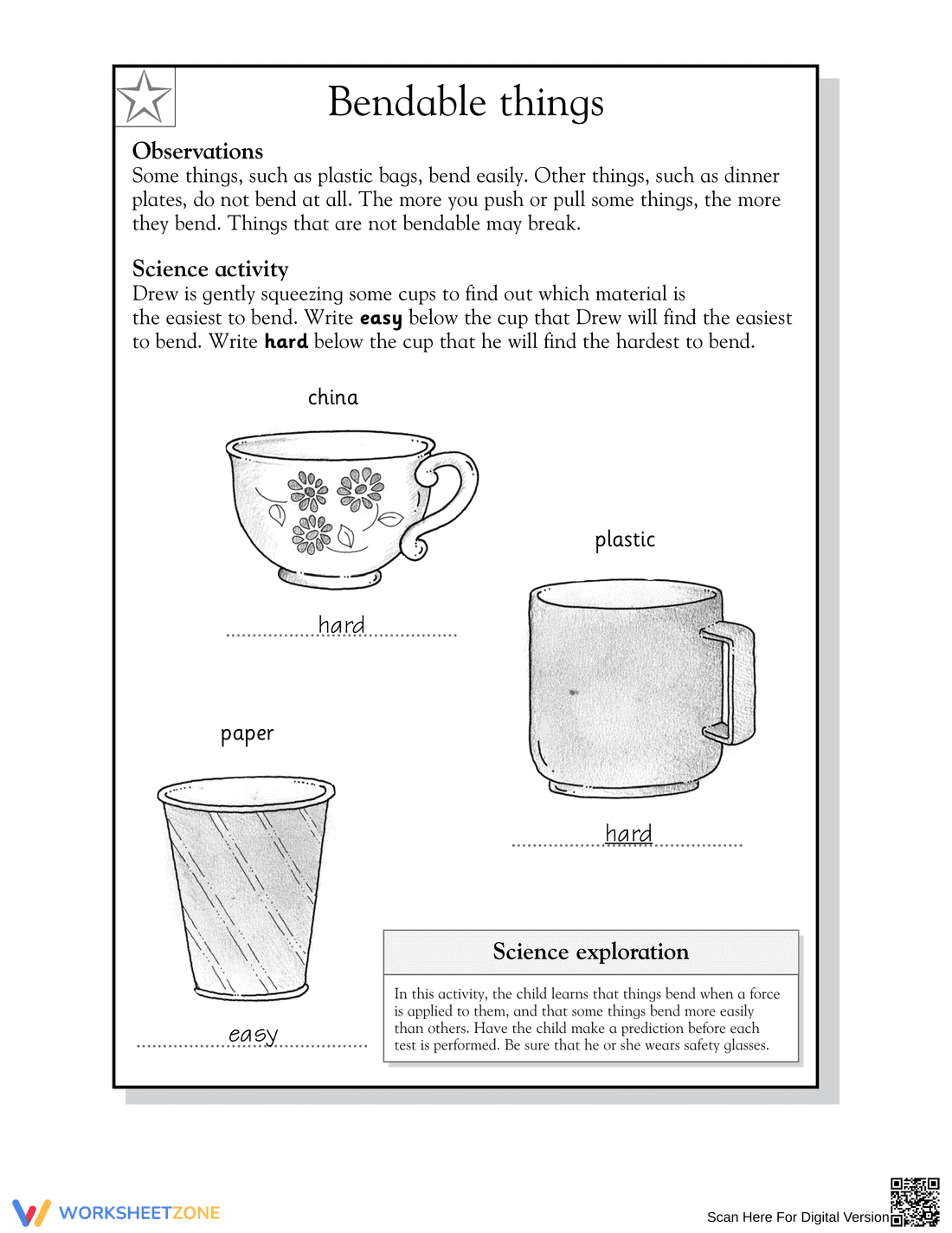
This Grade 1-2 science worksheet introduces students to the fundamental properties of materials by exploring flexibility. Students compare common items like china, plastic, and paper cups to determine which bend easily and which resist force. It provides a concrete way to develop scientific observation skills and understand material function.
At a Glance
- Grade: 1-2 · Subject: Science
- Standard:
2-PS1-1— Classify different kinds of materials by their observable properties- Skill Focus: Material properties and flexibility
- Format: 1 page · 4 problems · Answer key included · PDF
- Best For: Introduction to physical science properties
- Time: 15–20 minutes
This single-page PDF includes a concise "Observations" section that defines bendability using relatable examples like plastic bags and dinner plates. The core "Science Activity" asks students to evaluate three different cup materials—china, plastic, and paper—and label them based on their ease of bending. A "Science Exploration" extension task challenges students to investigate how thickness influences a material's flexibility.
Zero-Prep Workflow
- Step 1: Print — Download and print this single-page PDF in under 30 seconds for your entire class.
- Step 2: Distribute — Hand out the activity as a bell-ringer or introductory lab; students need only a pencil.
- Step 3: Review — Spend 5 minutes discussing why china breaks while plastic bends to reinforce durability concepts.
This workflow is designed for busy classrooms and is perfect for substitute teacher plans or quick science centers.
Standards Alignment
Aligned to 2-PS1-1: "Plan and conduct an investigation to describe and classify different kinds of materials by their observable properties." This resource focuses specifically on the property of flexibility, allowing students to gather evidence through tactile observation. Both standard codes can be copied directly into lesson plans, IEP goals, or district curriculum mapping tools.
How to Use It
Use this worksheet during the "Explore" phase of a 5E lesson on physical properties. Before starting, provide students with actual samples of the materials mentioned (cups or cards) to allow for hands-on verification. Observe if students can differentiate between "easy" and "hard" based on the resistance they feel. Expected completion time is 15-20 minutes, depending on the depth of the exploration discussion.
Who It's For
This resource is tailored for Grade 1 and Grade 2 students beginning their journey into physical science. It is highly accessible for English Language Learners due to the clear visual supports and simple vocabulary. Pair this with an anchor chart listing material properties like "shiny," "hard," "soft," and "flexible" to provide a comprehensive vocabulary foundation for future science units.
According to the NGSS framework and recent pedagogical insights from Fisher & Frey (2014), engaging students in the direct observation of material properties is essential for building a foundation in physical science. This Grade 1-2 worksheet focuses on the observable property of flexibility, specifically how different materials respond to physical force like pushing or pulling. By ranking materials such as paper and china, students develop the analytical skills required to meet the 2-PS1-1 standard, which emphasizes classifying materials by their characteristics. Research from ScienceDirect TpT Analysis suggests that scaffolded science tasks with real-world applications significantly improve retention of abstract concepts in early elementary learners. This 1-page PDF provides a structured yet exploratory environment for students to master the plain-English skill of identifying and comparing material properties, ensuring they are prepared for more complex engineering and design tasks in higher grade levels.


