


























Views
Downloads


Essential Letter A Phonics Worksheet | Grade K Printable
Paste this activity's link or code into your existing LMS (Google Classroom, Canvas, Teams, Schoology, Moodle, etc.).
Students can open and work on the activity right away, with no student login required.
You'll still be able to track student progress and results from your teacher account.
This Kindergarten Letter A phonics worksheet focuses on the critical early literacy skill of initial sound isolation. Students learn to recognize and pronounce the short 'a' vowel sound by identifying pictures that begin with the letter A. This essential practice builds the phonemic awareness necessary for decoding and fluent reading in early learners.
At a Glance
- Grade: Kindergarten · Subject: ELA Phonics
- Standard:
CCSS.ELA-LITERACY.RF.K.3.B— Associate long and short sounds with common spellings for the five major vowels- Skill Focus: Initial sound isolation and vowel recognition
- Format: 2 pages · 6 problems · Answer key included · PDF
- Best For: Literacy centers and independent phonics practice
- Time: 10–15 minutes
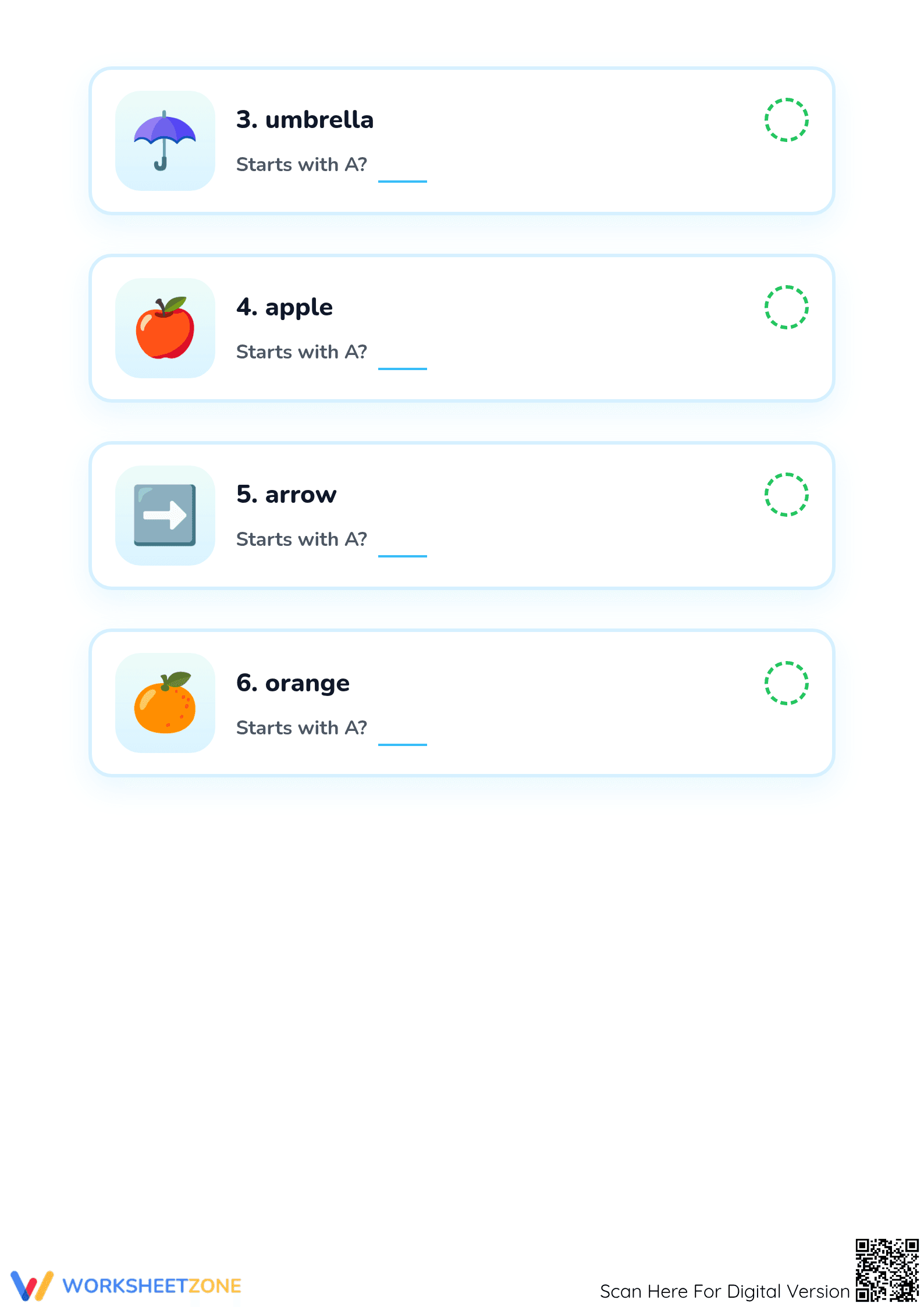
This two-page PDF includes six structured tasks designed for young learners. Each task features a clear, high-quality image and a corresponding text label, such as "ant" or "apple," accompanied by the question "Starts with A?" Students must say the name of the object aloud and circle the image if it begins with the correct vowel sound. A full answer key and QR code for a digital version are provided.
Zero-Prep Workflow
Teachers can implement this resource in under two minutes by following three simple steps. First, print the two-page document. Second, distribute the worksheets during your phonics block or as a morning work assignment. Finally, use the included answer key to quickly review student work or allow for self-correction in a literacy center. The layout is optimized for quick grading and immediate feedback.
Standards Alignment
This resource is aligned to CCSS.ELA-LITERACY.RF.K.3.B, which requires students to associate the long and short sounds with common spellings for the five major vowels. By focusing on the short 'a' sound, students develop the foundational grapheme-phoneme correspondence needed for CVC word decoding. This standard code can be copied directly into lesson plans, IEP goals, or district curriculum mapping tools.
How to Use It
Deploy this worksheet during the independent practice phase of a gradual release lesson on vowel sounds. For a quick formative assessment, observe students as they "say and circle" to identify those struggling with sound isolation. It also serves as an excellent quiet activity for early finishers or a reliable component of a kindergarten emergency sub plan. The clear visuals make it accessible for diverse learners.
Who It's For
This printable is designed for preschool, kindergarten, and first-grade students who are developing phonemic awareness. It is particularly effective for English Language Learners (ELLs) who benefit from the visual cues provided. Pair this resource with a short 'a' anchor chart or a decodable text to create a comprehensive literacy experience that supports all learners in the classroom setting.
Phonics instruction remains a cornerstone of early literacy, with research from EdReports (2024) highlighting the necessity of explicit, systematic practice with vowel sounds. This Grade K worksheet facilitates initial sound isolation, a key predictor of later reading success. By engaging with six targeted tasks, students strengthen their ability to associate the letter 'a' with its primary short sound. According to the NAEP framework, mastering these foundational correspondences in the early grades is essential for bridging the gap between phonemic awareness and fluent reading. This resource provides the structured, high-repetition practice required for students to internalize these sounds. Teachers can rely on this aligned material to provide consistent, high-quality phonics support that meets the rigorous demands of state and national standards while remaining accessible for diverse learner populations in the classroom setting.


