


























Views
Downloads

Beginning Sounds Matching Worksheet | Printable Pre-K & K
Paste this activity's link or code into your existing LMS (Google Classroom, Canvas, Teams, Schoology, Moodle, etc.).
Students can open and work on the activity right away, with no student login required.
You'll still be able to track student progress and results from your teacher account.
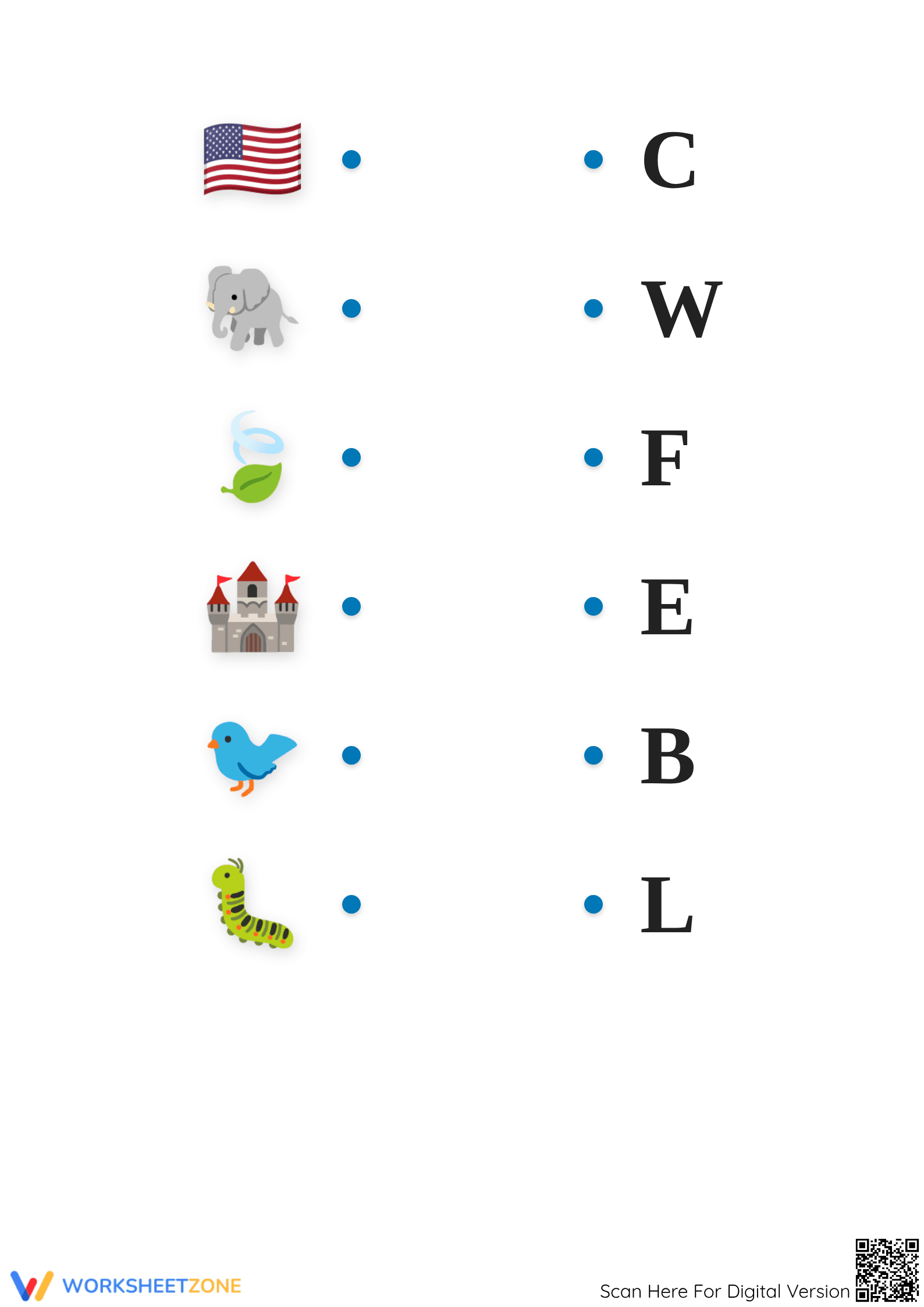
This beginning sounds matching worksheet helps early learners connect spoken words to their initial letters. By drawing lines between familiar pictures and their corresponding starting letters, students actively practice phonemic awareness and letter-sound correspondence, laying a crucial foundation for independent reading and decoding skills.
At a Glance
- Grade: Kindergarten · Subject: ELA
- Standard:
CCSS.ELA-LITERACY.RF.K.3.A— Match primary consonant sounds to letters- Skill Focus: Beginning Sounds & Letter Recognition
- Format: 2 pages · 6 problems · PDF
- Best For: Independent practice or centers
- Time: 10–15 minutes
What's Inside
This two-page resource features a clean, distraction-free layout designed specifically for young learners. The first page includes space for teacher or parent notes, while the second page contains the core activity: six vibrant, easily recognizable illustrations (such as an elephant, bird, and castle) paired with a column of uppercase letters. Students simply draw a line connecting each image to its correct initial consonant.
Zero-Prep Workflow
- Print (1 minute): Simply print the two-page PDF. The high-contrast images and large text ensure it looks great in both color and black-and-white.
- Distribute (1 minute): Hand out the activity during morning work, literacy centers, or as a quick transition task. No special materials are needed beyond a pencil or crayon.
- Review (2 minutes): Quickly check student connections to gauge their grasp of initial phonemes. The straightforward format makes it an excellent addition to any emergency sub plan.
Standards Alignment
Aligned to CCSS.ELA-LITERACY.RF.K.3.A: Demonstrate basic knowledge of one-to-one letter-sound correspondences by producing the primary sound or many of the most frequent sounds for each consonant. It also supports early phonemic awareness goals by requiring students to isolate the initial sound of spoken words. Both standard codes can be copied directly into lesson plans, IEP goals, or district curriculum mapping tools.
How to Use It
This worksheet is highly versatile for early childhood classrooms. Use it as a formative assessment after a whole-group phonics lesson to quickly identify which students are struggling with specific consonant sounds. Alternatively, place it in a literacy center with dry-erase markers and page protectors for reusable, hands-on practice. Expect students to complete the matching task in about 10 to 15 minutes.
Who It's For
This resource is ideal for Preschool and Kindergarten students who are just beginning their phonics journey. It serves as an excellent intervention tool for first graders needing a refresher on basic letter-sound correspondence. Pair this worksheet with a tactile alphabet puzzle or a read-aloud focused on alliteration to reinforce the auditory recognition of beginning sounds.
Developing strong letter-sound correspondence is a critical predictor of future reading success. This worksheet aligns with CCSS.ELA-LITERACY.RF.K.3.A, helping students match primary consonant sounds to letters. According to the RAND AIRS 2024 report on early literacy interventions, explicit and systematic practice with initial phoneme isolation significantly improves decoding fluency in early elementary grades. By providing targeted, visual-based matching tasks, educators can effectively bridge the gap between spoken language and written text. This resource offers the exact type of focused, low-distraction practice recommended by literacy researchers to build automaticity in phonemic awareness, ensuring young learners develop the foundational skills necessary to tackle more complex phonetic patterns and CVC words as they progress through the curriculum.


