


























Views
Downloads

Essential Beginning Sounds Crosswords | Grade 1 Phonics
Paste this activity's link or code into your existing LMS (Google Classroom, Canvas, Teams, Schoology, Moodle, etc.).
Students can open and work on the activity right away, with no student login required.
You'll still be able to track student progress and results from your teacher account.
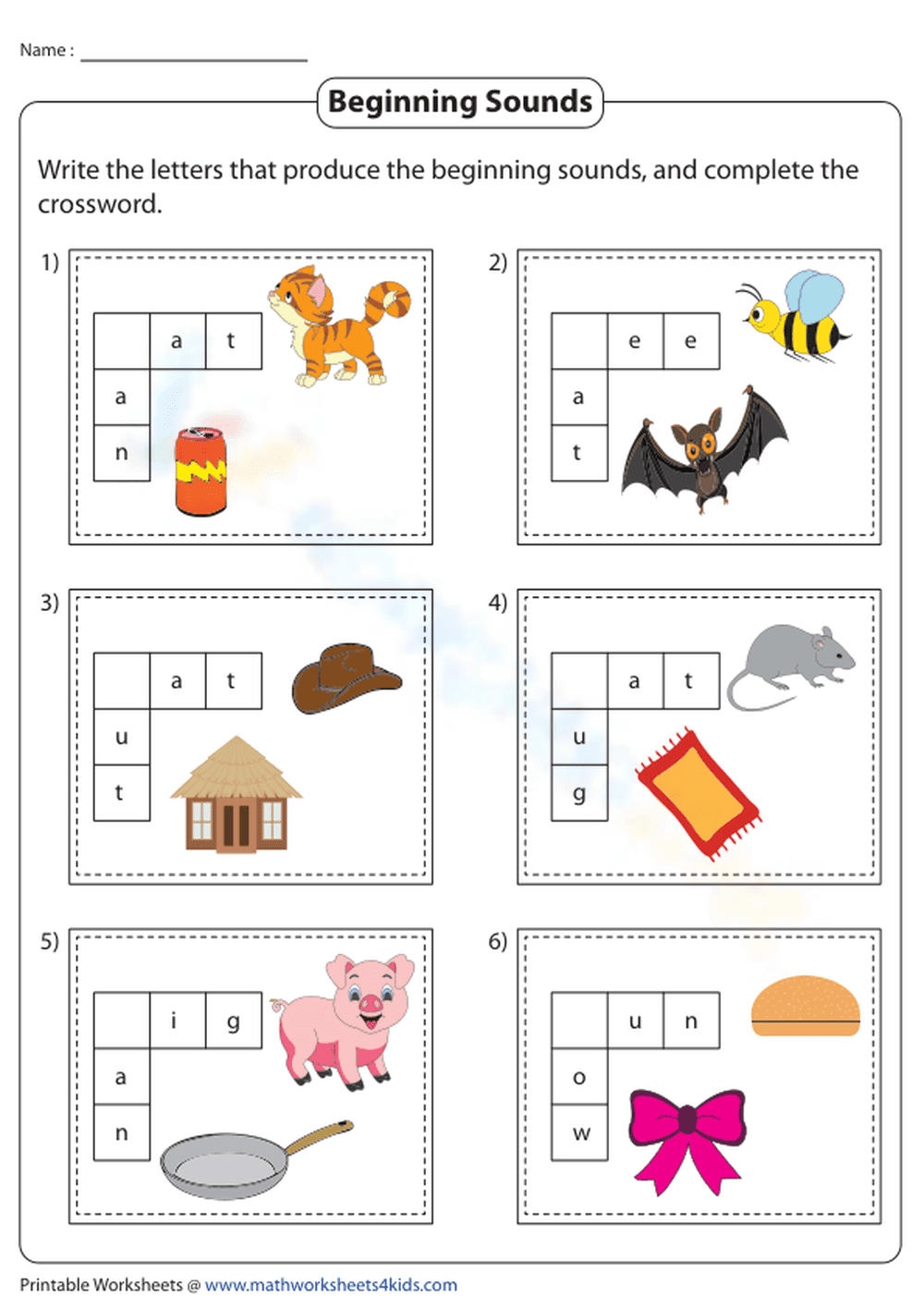
This essential phonics worksheet helps first graders master initial sound isolation through engaging crossword puzzles. By identifying the starting letters of common CVC words like cat, pig, and sun, students reinforce their letter-sound correspondence and early spelling skills. This resource provides a targeted approach to building foundational reading blocks in any classroom.
At a Glance
- Grade: 1 · Subject: English Language Arts
- Standard:
RF.1.2.C— Isolate and pronounce initial sounds in spoken single-syllable words- Skill Focus: Beginning Sound Identification
- Format: 1 page · 6 tasks · Answer key included · PDF
- Best For: Independent phonics practice and morning work
- Time: 10–15 minutes
What's Inside
This single-page printable features six mini-crossword grids designed to captivate learners. Each grid contains two high-frequency illustrations—such as a bat and a bee or a pig and a pan—requiring students to write the missing initial consonant. The worksheet includes clear visual cues and comes with a comprehensive answer key for quick review or student self-correction.
Zero-Prep Workflow
Implementing this worksheet is a three-step process for maximum efficiency. First, print the single-page PDF (under 1 minute). Second, distribute for independent or small-group work (zero setup). Third, use the included answer key for rapid review. This streamlined workflow makes it an ideal choice for substitute plans, literacy centers, or emergency filler activities.
Standards Alignment
The primary alignment is RF.1.2.C, which focuses on isolating initial sounds in single-syllable words. By translating sounds into written letters, it also supports RF.1.3 for phonics and word recognition. Both standard codes can be copied directly into lesson plans, IEP goals, or district curriculum mapping tools.
How to Use It
Use this worksheet as a formative assessment after a lesson on initial consonants to gauge understanding. Alternatively, place it in a literacy center as a puzzle-based reinforcement. During review, observe if students name pictures correctly; if they struggle, provide the spoken word and ask them to "stretch" the starting sound. Completion usually takes 10 to 15 minutes.
Who It's For
This resource is ideal for first-grade students or as an intervention for second graders needing phonemic awareness support. It is effective for English Language Learners (ELLs) as pictorial cues provide context for vocabulary. Pair this worksheet with a Beginning Sounds Anchor Chart or alphabet manipulatives to provide extra scaffolding for struggling readers.
Mastery of initial phoneme isolation is a critical predictor of later reading success, as highlighted in the RAND AIRS 2024 report on foundational literacy. This worksheet addresses CCSS.ELA-LITERACY.RF.1.2.C by requiring students to isolate the beginning sounds of twelve common words across six interactive puzzles. Research from Fisher & Frey (2014) emphasizes that combining visual representations with orthographic practice accelerates the development of the phonological loop, bridging the gap between hearing a sound and writing its corresponding grapheme. By engaging with these tasks, students move beyond rote memorization into active phonetic application. The inclusion of an answer key supports immediate feedback, essential for correcting misconceptions in early learners. Teachers can rely on this standard-aligned tool to provide consistent practice that meets the rigorous demands of modern ELA frameworks while maintaining a low-barrier, high-engagement format suitable for diverse classroom environments.


