


























Views
Downloads
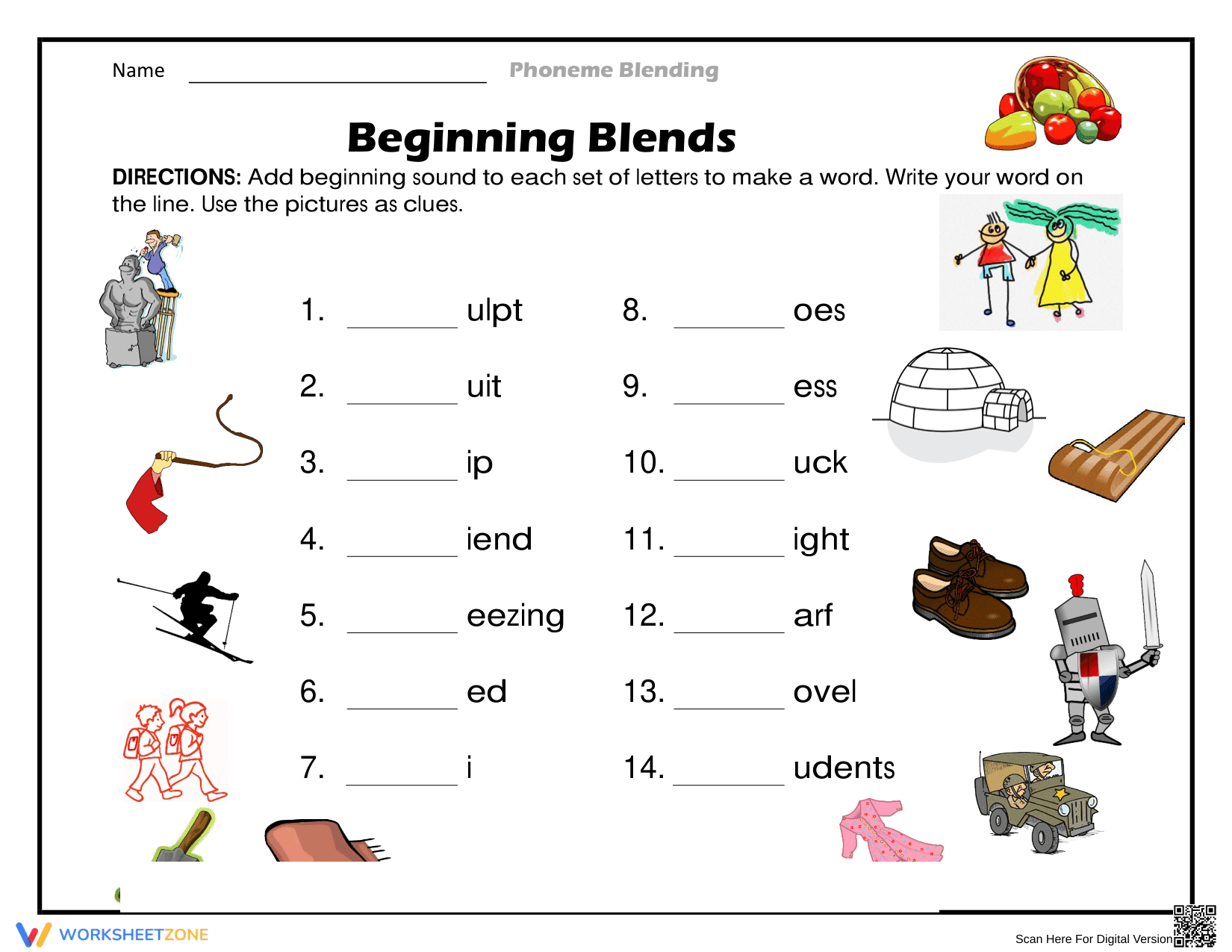

Printable Beginning Blends Worksheet | Grade 1 Phonics
Paste this activity's link or code into your existing LMS (Google Classroom, Canvas, Teams, Schoology, Moodle, etc.).
Students can open and work on the activity right away, with no student login required.
You'll still be able to track student progress and results from your teacher account.
This Grade 1 beginning blends worksheet provides targeted practice in phoneme blending, helping students master the foundational skill of combining initial consonant sounds with rimes. By engaging with 14 distinct word-building tasks, learners strengthen their phonics proficiency and spelling accuracy through visual associations and active writing. This resource ensures that early readers develop the necessary auditory and visual synthesis skills for literacy success in the primary grades.
At a Glance
- Grade: 1 · Subject: ELA / Phonics
- Standard:
CCSS.ELA-LITERACY.RF.1.2.B— Orally produce single-syllable words by blending sounds including consonant blends- Skill Focus: Beginning Consonant Blends
- Format: 1 page · 14 problems · Answer key included · PDF
- Best For: Independent phonics practice and morning work
- Time: 10–15 minutes
What's Inside
This single-page PDF features 14 word-construction exercises where students identify initial consonant blends based on colorful picture prompts. Each task includes a rime and a designated line for writing the complete word. The layout is clean and child-friendly, incorporating diverse vocabulary like sculpt, fruit, whip, and scarf to challenge varied phonetic patterns. A comprehensive answer key is provided for quick evaluation and teacher feedback.
Zero-Prep Workflow
This resource is designed for a frictionless classroom experience. Teachers can follow these simple steps:
- Print: Generate copies for your entire class in 30 seconds.
- Distribute: Hand out the worksheets for immediate use in 1 minute as a bell-ringer or center activity.
- Review: Utilize the included key to check work in under 2 minutes, minimizing grading time.
Total teacher prep time is less than 2 minutes. The self-explanatory directions and clear visual clues make this worksheet an ideal choice for emergency sub plans or low-prep literacy rotations.
Standards Alignment
This worksheet aligns with `CCSS.ELA-LITERACY.RF.1.2.B`, requiring students to orally produce single-syllable words by blending sounds, specifically focusing on consonant blends. It also supports RF.1.3.B by helping students decode one-syllable words through written application. Both standard codes can be copied directly into lesson plans, IEP goals, or district curriculum mapping tools to track student progress toward grade-level mastery.
How to Use It
Use this worksheet as a formative assessment after introducing beginning blends in a whole-group lesson. Observe how students process the visual clues to determine if they can successfully isolate and blend the initial phonemes. It also functions effectively as a literacy center activity to reinforce phonemic awareness through repetitive practice. The visual scaffolds support students as they bridge the gap between sounds and written letters.
Who It's For
This resource is tailored for first-grade students or second graders requiring additional phonics intervention. It serves as an excellent companion to any science-of-reading curriculum. Pair this worksheet with a phoneme-grapheme mapping session or a direct instruction lesson focusing on L-blends and S-blends to provide a comprehensive learning experience for diverse student populations.
According to the RAND AIRS 2024 report on literacy instruction, consistent engagement with structured phoneme blending tasks is a critical predictor of early reading fluency. This worksheet addresses the CCSS.ELA-LITERACY.RF.1.2.B standard by requiring students to synthesize initial consonant sounds with existing word endings to form meaningful vocabulary. By utilizing 14 targeted problems and visual scaffolds, the resource reinforces the cognitive pathways necessary for decoding complex syllable structures. Research from Fisher & Frey (2014) emphasizes that such guided practice facilitates the gradual release of responsibility, moving students from teacher-led modeling to independent mastery of word-analysis skills. Incorporating these exercises into a daily literacy block ensures that learners receive the repetition needed to internalize phonemic patterns, ultimately supporting their transition from decoding to automatic word recognition. This systematic approach is essential for meeting the rigorous demands of primary-grade English Language Arts frameworks.


