


























Views
Downloads

Bluebird Life Cycle Worksheet | Grade 1 Essential
Paste this activity's link or code into your existing LMS (Google Classroom, Canvas, Teams, Schoology, Moodle, etc.).
Students can open and work on the activity right away, with no student login required.
You'll still be able to track student progress and results from your teacher account.
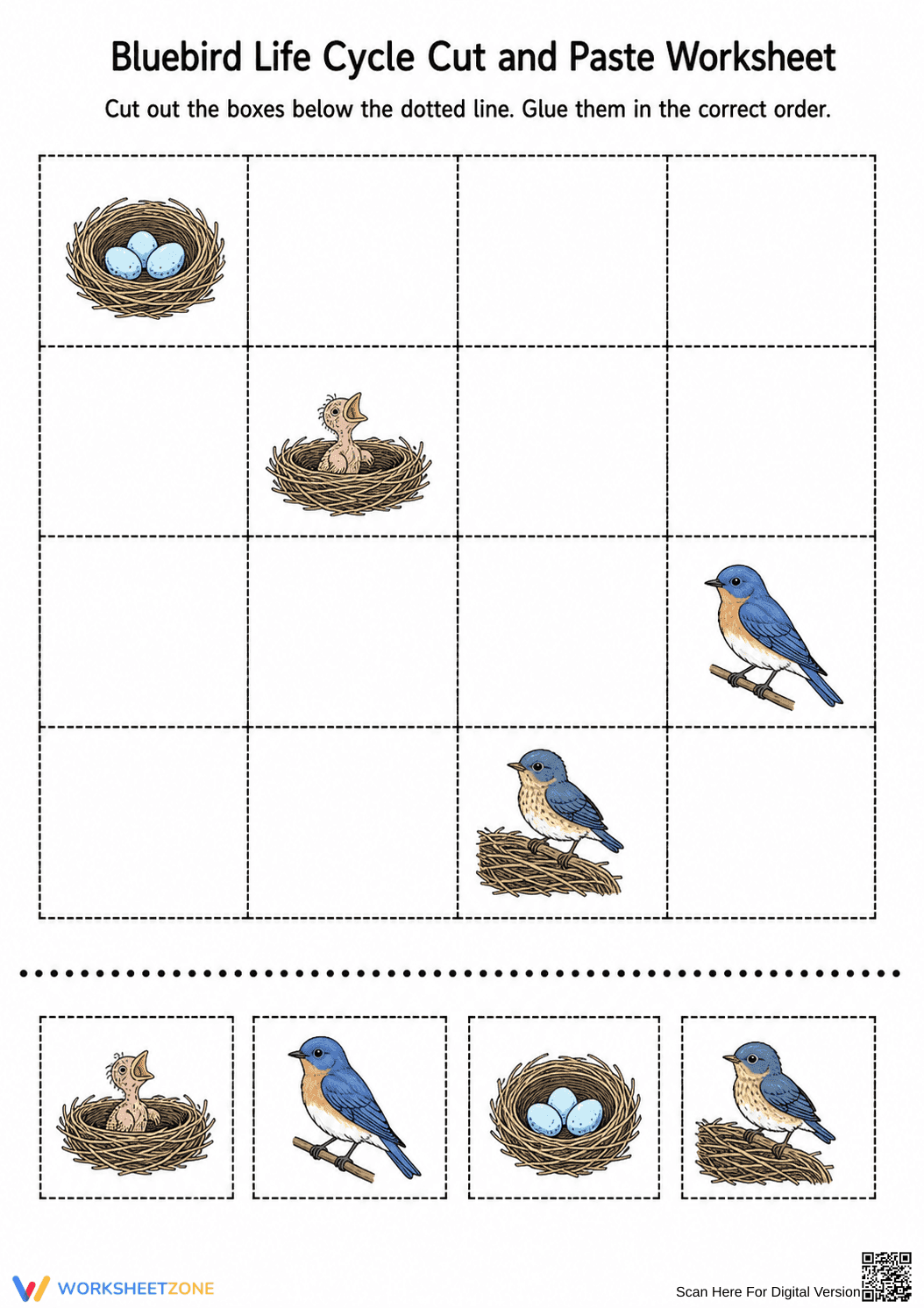
This Bluebird Life Cycle worksheet provides a hands-on approach to biological sequencing, allowing young learners to visualize the growth stages of a common North American songbird. By organizing the progression from egg to adult, students develop a concrete understanding of how organisms change over time. This activity bridges the gap between abstract concepts and physical observation.
At a Glance
- Grade: Kindergarten · Subject: Life Science
- Standard:
K-LS1-1— Use observations to describe patterns of what plants and animals need to survive- Skill Focus: Chronological sequencing and life cycle identification
- Format: 1 page · 4 problems · Answer key included · PDF
- Best For: Science centers and independent morning work
- Time: 15–20 minutes
What's Inside
The worksheet features a clear grid layout designed for easy visual tracking. It includes four distinct illustrated stages: the nest with eggs, the hatchling, the fledgling, and the mature adult bluebird. Below the main grid, a dotted line separates the cut-out tiles from the workspace. High-contrast illustrations ensure students can identify biological features like beaks and feathers without confusion, while large cutting boxes support developing fine motor skills.
Zero-Prep Workflow
This resource is designed for immediate classroom implementation. First, print the single-page PDF. Second, distribute the sheets along with scissors and glue sticks to your students. Third, review the completed sequences as a whole group to reinforce the vocabulary of growth and development. This streamlined process makes it an ideal choice for emergency sub plans or transition periods between core subjects.
Standards Alignment
This activity aligns with `K-LS1-1` by requiring students to observe and order the developmental patterns of a living organism. It also supports `1-LS1-2`, as students identify how the physical traits of the bluebird change as it matures. Both standard codes can be copied directly into lesson plans, IEP goals, or district curriculum mapping tools to ensure rigorous documentation of science instruction.
How to Use It
Use this worksheet during the "Explore" phase of a 5E lesson on animals to gauge prior knowledge of bird development. It serves as an excellent formative assessment tool; observe students as they work to see if they recognize the logical progression from egg to hatchling. Most students will complete the cutting and pasting within 15 to 20 minutes, making it a perfect fit for a rotating science station or a quiet-time activity following a read-aloud.
Who It's For
This resource is tailored for Kindergarten and First Grade students, but is also highly effective for English Language Learners (ELLs) who benefit from visual-heavy science content. It pairs naturally with a classroom bird-watching journal or a non-fiction passage about avian habitats. Simple instructions and clear visual cues make it accessible for students with special needs working on basic sequencing and fine motor coordination.
Research from RAND AIRS 2024 indicates that integrating tactile activities like cut-and-paste sequencing significantly improves retention of biological cycles in early childhood education. By physically moving the stages of the Bluebird Life Cycle into the correct order, students engage multiple neural pathways, reinforcing the scientific standard K-LS1-1. This worksheet provides 4 specific tasks that move students from simple identification to logical synthesis of life patterns. Such structured practice is essential for building foundational observation skills required for later inquiry-based science. Educators can utilize this 1-page resource to provide evidence of student mastery in identifying chronological growth patterns, ensuring young learners meet district benchmarks for life science literacy while refining fine motor skills necessary for academic success.


