


























Views
Downloads

Printable Bee Egg Tracing Worksheet | Grade K-1
Paste this activity's link or code into your existing LMS (Google Classroom, Canvas, Teams, Schoology, Moodle, etc.).
Students can open and work on the activity right away, with no student login required.
You'll still be able to track student progress and results from your teacher account.
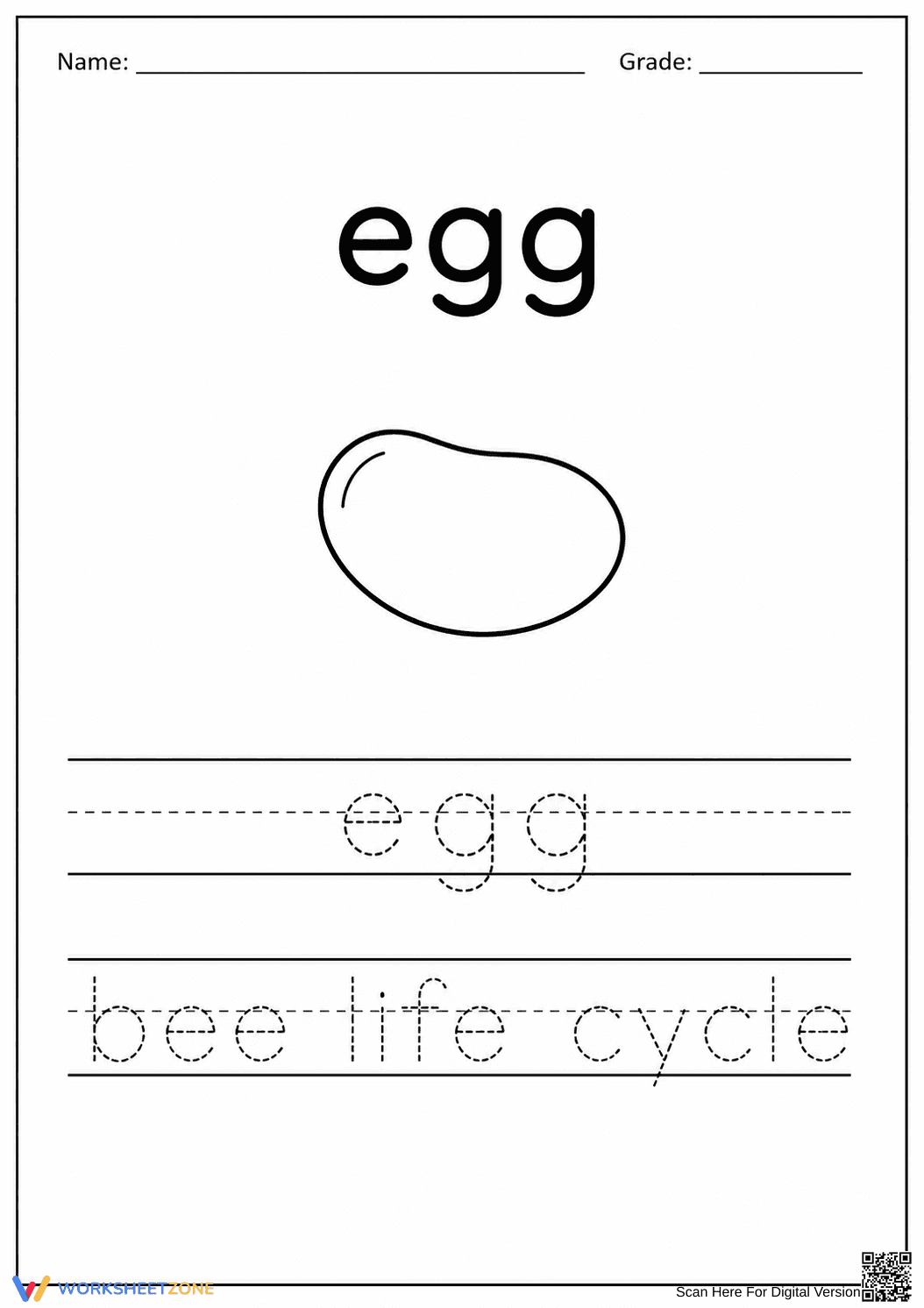
This foundational handwriting worksheet helps early learners practice letter formation while introducing essential science vocabulary. Students trace the words "egg" and "bee life cycle" on primary-lined paper, reinforcing fine motor skills and early literacy concepts simultaneously. The simple layout keeps young students focused on proper pencil control and letter placement.
At a Glance
- Grade: K · Subject: Handwriting
- Standard:
CCSS.ELA-LITERACY.L.K.1.A— Print many upper- and lowercase letters accurately on primary lines- Skill Focus: Letter tracing and vocabulary
- Format: 1 page · 2 problems · No answer key · PDF
- Best For: Morning work or literacy centers
- Time: 5–10 minutes
This single-page resource features a clear design tailored for early childhood education. A simple illustration of a bee egg provides a coloring opportunity to engage visual learners. Below the image, students find two tracing tasks on standard primary dashed lines. The first line focuses on the word "egg," while the second line challenges them with the phrase "bee life cycle."
Zero-Prep Workflow
- Print (1 minute): Simply download the PDF and print the required number of copies. The black-and-white design is highly ink-efficient for classroom use.
- Distribute (1 minute): Hand out the worksheets along with pencils and crayons. No additional teacher setup or specialized materials are required.
- Review (1 minute): Quickly check student work for proper letter formation and spacing on the dashed lines.
With total teacher prep time under two minutes, this resource is an excellent addition to any sub plan or center activity.
Standards Alignment
This activity aligns with CCSS.ELA-LITERACY.L.K.1.A, requiring students to print many upper- and lowercase letters accurately. By integrating science vocabulary, it also supports early cross-curricular connections. Both standard codes can be copied directly into lesson plans, IEP goals, or district curriculum mapping tools.
How to Use It
Deploy this worksheet during morning work to establish a calm, focused routine at the start of the school day. It also functions perfectly as an independent literacy center activity while the teacher conducts small group reading instruction. As a formative assessment tip, observe students while they trace to ensure they are starting their letters from the top line.
Who It's For
This resource is designed primarily for Kindergarten and early first-grade students who are developing their handwriting and fine motor skills. For differentiation, teachers can provide a highlighter for students who need extra visual support. It pairs naturally with a read-aloud book about insects or a direct instruction lesson on the stages of a bee's life.
Integrating handwriting practice with content-area vocabulary, such as the terms found in this bee life cycle activity, provides a dual benefit for early learners. According to a recent ScienceDirect TpT Analysis, cross-curricular resources that combine fine motor skill development with science concepts significantly increase student engagement and retention. By addressing CCSS.ELA-LITERACY.L.K.1.A, which requires students to print many upper- and lowercase letters, educators ensure that foundational literacy skills are practiced in a meaningful context. Tracing activities build the muscle memory necessary for fluent writing, reducing the cognitive load required for letter formation so students can eventually focus on content creation. This targeted practice supports early childhood development milestones while introducing essential biological concepts in an accessible, developmentally appropriate format. Consistent exposure to structured tracing tasks improves overall legibility and prepares students for more complex writing tasks in later grades.


