


























Views
Downloads

Beauty and the Beast Word Search | Grade 2 Essential
Paste this activity's link or code into your existing LMS (Google Classroom, Canvas, Teams, Schoology, Moodle, etc.).
Students can open and work on the activity right away, with no student login required.
You'll still be able to track student progress and results from your teacher account.
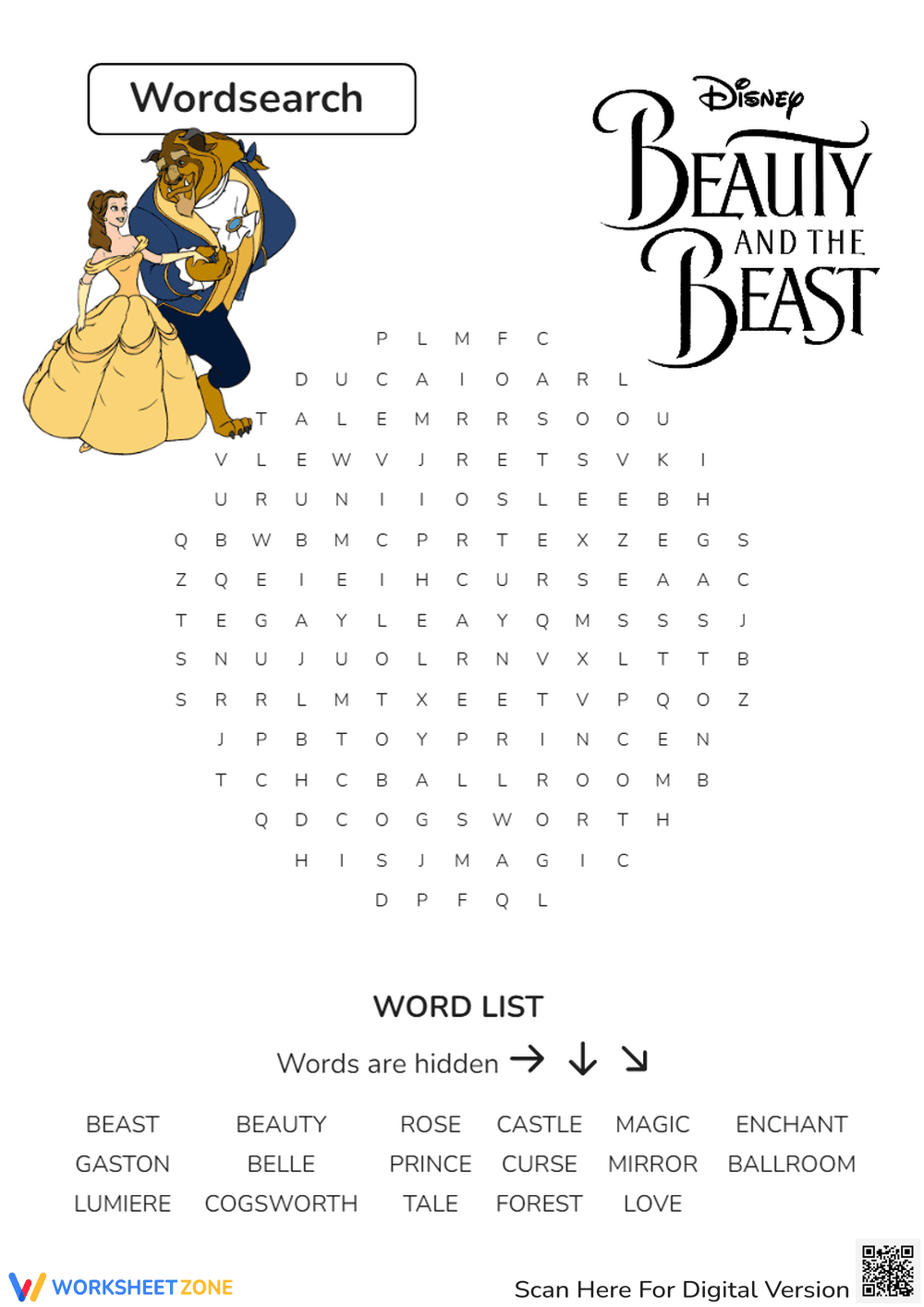
This Beauty and the Beast word search provides a focused vocabulary activity for primary students. By identifying 18 key terms from the classic fairy tale, learners strengthen their letter recognition and spelling patterns. It serves as an engaging literacy supplement that connects popular culture with foundational reading skills in a structured, low-stress format.
At a Glance
- Grade: 2 · Subject: ELA
- Standard:
CCSS.ELA-LITERACY.L.2.4— Determine or clarify the meaning of unknown and multiple-meaning words and phrases- Skill Focus: Vocabulary & Spelling
- Format: 1 page · 18 words · Answer key included · PDF
- Best For: Early finishers and literacy centers
- Time: 15–20 minutes
The worksheet features a circular word grid containing 18 hidden terms related to the story, including character names like Lumiere and Cogsworth. It includes a clear word list at the bottom and directional cues indicating that words are hidden horizontally, vertically, and diagonally. The high-contrast layout ensures readability for young learners while maintaining a thematic aesthetic.
This resource follows a zero-prep workflow designed for busy educators. First, print the single-page PDF (30 seconds). Second, distribute the sheets to students during a literacy block or as a transition activity (1 minute). Third, review the spelling of the 18 themed words as a whole group to reinforce phonics (5 minutes). This makes it an ideal choice for emergency sub plans or quiet morning work.
This activity aligns with `CCSS.ELA-LITERACY.L.2.4` by encouraging students to recognize and spell grade-appropriate vocabulary in a thematic context. It also supports `CCSS.ELA-LITERACY.RF.2.3` through the identification of common spelling patterns in multi-syllabic words. Both standard codes can be copied directly into lesson plans, IEP goals, or district curriculum mapping tools.
Use this worksheet as a hook before reading a version of the fairy tale to familiarize students with key characters. Alternatively, assign it as a formative assessment for spelling. Observe if students can find words with complex patterns like "Enchant" or "Cogsworth" to gauge their visual scanning and phonemic awareness. Expected completion time is under 20 minutes.
This is ideal for Grade 1-3 students, particularly those who benefit from gamified literacy practice. It pairs naturally with a read-aloud of the original tale or an anchor chart featuring fairy tale elements. The visual nature of the task supports English Language Learners in building thematic vocabulary through context and repetition.
Research from Fisher & Frey (2014) emphasizes that word-level tasks, such as word searches, contribute to word consciousness by requiring students to attend to the specific orthographic sequences of new vocabulary. This Beauty and the Beast worksheet targets 18 specific terms, aligning with CCSS.ELA-LITERACY.L.2.4 requirements for vocabulary acquisition. By isolating words like enchant and ballroom, students engage in pattern recognition that bridges the gap between simple decoding and fluent reading. According to the RAND AIRS 2024 report, high-interest thematic materials increase student engagement time by up to 22% compared to generic drills. This resource provides a structured yet accessible entry point for primary learners to master spelling while connecting with familiar narrative themes. The inclusion of directional cues supports executive functioning, making it a reliable tool for diverse classroom settings and independent practice sessions.


