


























Views
Downloads


Printable Base-10 Place Value Worksheet | Grade 2 Math
Paste this activity's link or code into your existing LMS (Google Classroom, Canvas, Teams, Schoology, Moodle, etc.).
Students can open and work on the activity right away, with no student login required.
You'll still be able to track student progress and results from your teacher account.
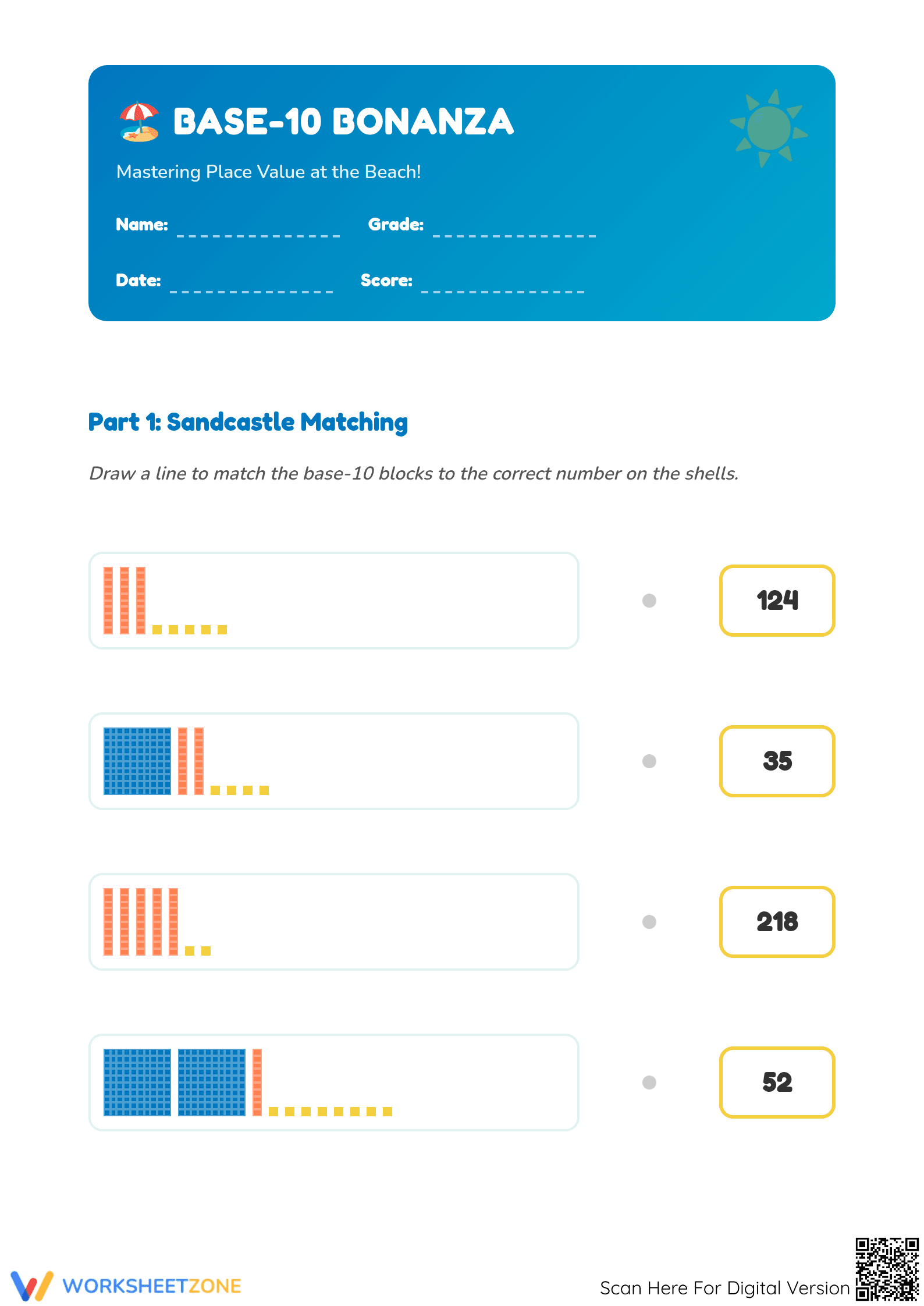
Help your second graders solidify their understanding of place value with this comprehensive base-10 blocks worksheet. By visualizing numbers as sets of hundreds, tens, and ones, students develop the conceptual foundation necessary for regrouping and multi-digit addition. This activity transforms abstract numerical values into concrete, manageable components using a beach-themed instructional design.
At a Glance
- Grade: 2 · Subject: Math
- Standard:
2.NBT.A.1— Understand that the three digits of a three-digit number represent hundreds, tens, and ones- Skill Focus: Base-10 Block Representation
- Format: 3 pages · 13 problems · Answer key included · PDF
- Best For: Small group instruction and independent practice
- Time: 20–30 minutes
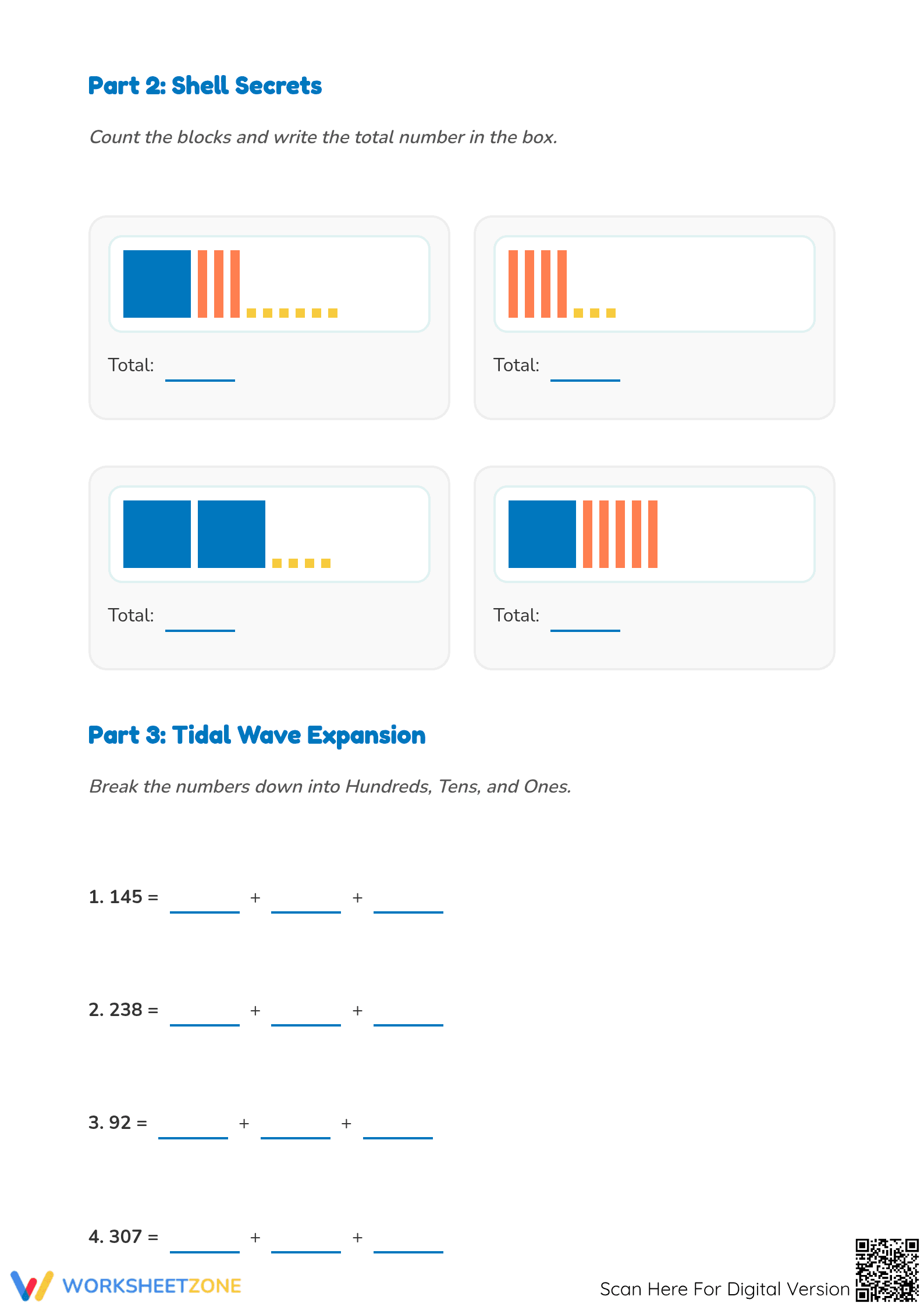
This three-page instructional packet contains thirteen targeted exercises across four distinct sections. The layout includes matching tasks, counting blocks to find totals, writing numbers in expanded form, and a creative drawing challenge. High-quality visuals of flats, rods, and units provide clear scaffolding, while the provided answer keys ensure efficient grading and self-correction opportunities for students.
Skill Progression
- Guided practice: Part 1 features matching exercises where students connect four sets of base-10 blocks to their numerical equivalents, reinforcing recognition of hundreds, tens, and ones.
- Supported practice: In Parts 2 and 3, students count four independent block sets and decompose four three-digit numbers into expanded form components to build writing fluency.
- Independent practice: The final Treasure Hunt Challenge requires students to draw a specific three-digit number using blocks from scratch, demonstrating complete conceptual mastery.
This sequence follows a gradual-release model to ensure students move from visual identification to independent construction of numerical models.
Standards Alignment: The primary focus is 2.NBT.A.1, which requires students to understand that the digits in a three-digit number represent amounts of hundreds, tens, and ones. Additionally, the expanded form section directly supports 2.NBT.A.3, focusing on reading and writing numbers to 1000 using various notations. Both standard codes can be copied directly into lesson plans, IEP goals, or district curriculum mapping tools.
How to Use It: Use this worksheet during the independent practice phase of a lesson on three-digit numbers. After demonstrating how to count flats and rods on an anchor chart, distribute page one for a quick check for understanding. For a formative assessment observation, watch for students who struggle to transition from counting by tens to counting by ones in Part 2. This resource typically takes 25 minutes to complete.
Who It's For: This resource is designed for Grade 2 students but is also suitable for Grade 3 intervention groups or Grade 1 students ready for enrichment. It pairs naturally with physical base-10 manipulatives, allowing students to build the numbers before recording them on paper. The clear visuals support English Language Learners by reducing the linguistic load of word-heavy problems.
Mastering the decimal system through base-10 block visualization is a critical milestone in early elementary mathematics. This Grade 2 worksheet, aligned to 2.NBT.A.1, facilitates the transition from concrete representation to abstract numerical understanding by requiring students to identify, compose, and decompose three-digit numbers. According to the RAND AIRS 2024 report on mathematical literacy, consistent exposure to multiple representations—including blocks and expanded form—significantly improves a student's ability to understand multi-digit operations. By engaging in these 13 structured tasks, learners build the spatial reasoning skills necessary for future success with decimals and larger place value systems. This resource provides a comprehensive instructional path from matching to independent construction, ensuring the base-10 concept is deeply internalized. It serves as a reliable tool for both primary instruction and targeted intervention for struggling learners.


