


























Views
Downloads

Essential Base Words Worksheet | Grade 2-4 Printable
Paste this activity's link or code into your existing LMS (Google Classroom, Canvas, Teams, Schoology, Moodle, etc.).
Students can open and work on the activity right away, with no student login required.
You'll still be able to track student progress and results from your teacher account.
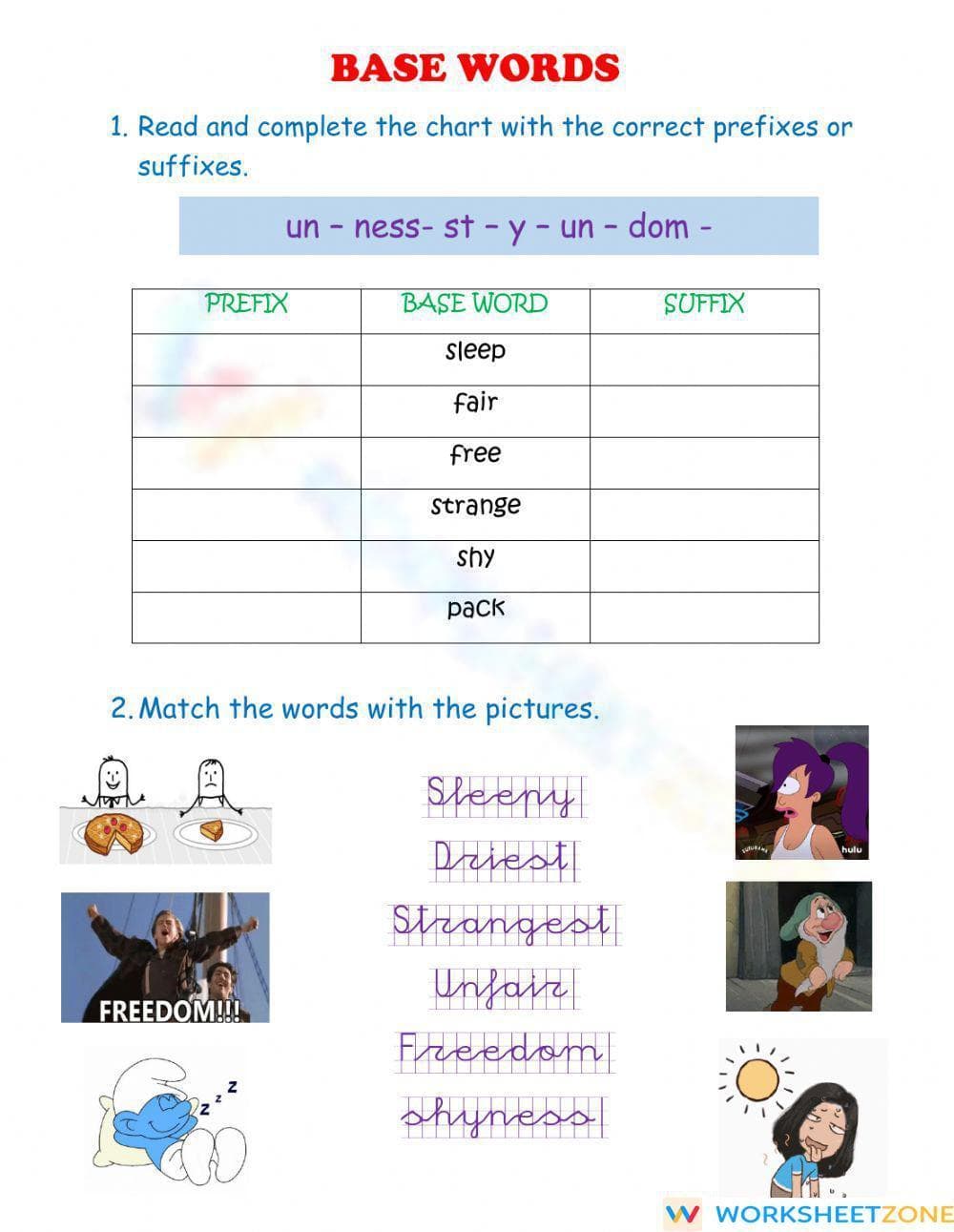
This printable Grade 3 base words worksheet helps students master word formation by identifying prefixes and suffixes attached to common root words. By analyzing how affixes change the meaning of base words like "sleep" or "fair," students develop essential morphological skills that improve their reading fluency and overall vocabulary acquisition in ELA.
At a Glance
- Grade: 3 · Subject: ELA
- Standard:
CCSS.ELA-LITERACY.L.3.4.B— Determine the meaning of words formed when affixes are added to roots- Skill Focus: Base words, prefixes, and suffixes
- Format: 1 page · 12 problems · Answer key included · PDF
- Best For: Morning work and morphology practice
- Time: 10–15 minutes
What's Inside
This single-page worksheet features two high-impact activities. The first task is a structured morphological chart where students must correctly place prefixes and suffixes to create new words from a provided list of six base words. The second task transitions to application, requiring students to match completed words such as "freedom" and "shyness" with corresponding visual illustrations. This layout includes a clear word bank and a comprehensive answer key for immediate feedback.
Zero-Prep Workflow
Implementing this resource into your daily routine requires minimal effort. First, print the single-page PDF for your entire class, which takes less than 30 seconds. Second, distribute the copies and allow students approximately 10 to 15 minutes of independent practice time. Finally, use the included answer key to conduct a quick 2-minute whole-class review. This streamlined workflow is ideal for busy mornings, emergency sub plans, or transitional periods between core ELA blocks.
Standards Alignment
This resource is directly aligned with CCSS.ELA-LITERACY.L.3.4.B, which focuses on determining the meaning of new words formed when a known affix is added to a known word. It also supports spelling standards by highlighting suffix interactions. Both standard codes can be copied directly into lesson plans, IEP goals, or district curriculum mapping tools to ensure instructional compliance.
How to Use It
Use this worksheet as a formative assessment during the "You Do" phase of a gradual release lesson on word parts. Observe students as they fill out the chart to identify who may be struggling with prefix placement versus suffix attachment. Additionally, it serves as an excellent morning work activity; students can complete the matching section independently to activate their prior knowledge of morphology before the start of a formal vocabulary lesson.
Who It's For
This resource is designed for Grade 3 students but is also appropriate for Grade 2 learners ready for a challenge or Grade 4 students requiring a quick review of basic affixes. It is particularly beneficial for English Language Learners (ELLs) who need visual aids to connect abstract vocabulary to concrete concepts. Pair with a root word anchor chart for a full literacy session.
According to the RAND AIRS 2024 report, morphological awareness is a significant predictor of reading comprehension success in the upper elementary grades. This base words worksheet specifically targets the CCSS.ELA-LITERACY.L.3.4.B standard by requiring students to determine the meaning of new words formed when known affixes are added to known roots. By engaging with both prefixes like 'un-' and suffixes like '-ness' or '-dom,' students build a mental library of word parts that aids in decoding unfamiliar vocabulary across various genres. The dual-task structure—first completing a structured chart and then applying that knowledge through a visual matching activity—reinforces the connection between abstract word formation and concrete semantic meaning. This zero-prep resource provides the focused practice necessary for students to master base word identification, which is a foundational skill for literacy development and academic language proficiency in ELA classrooms.


