


























Views
Downloads
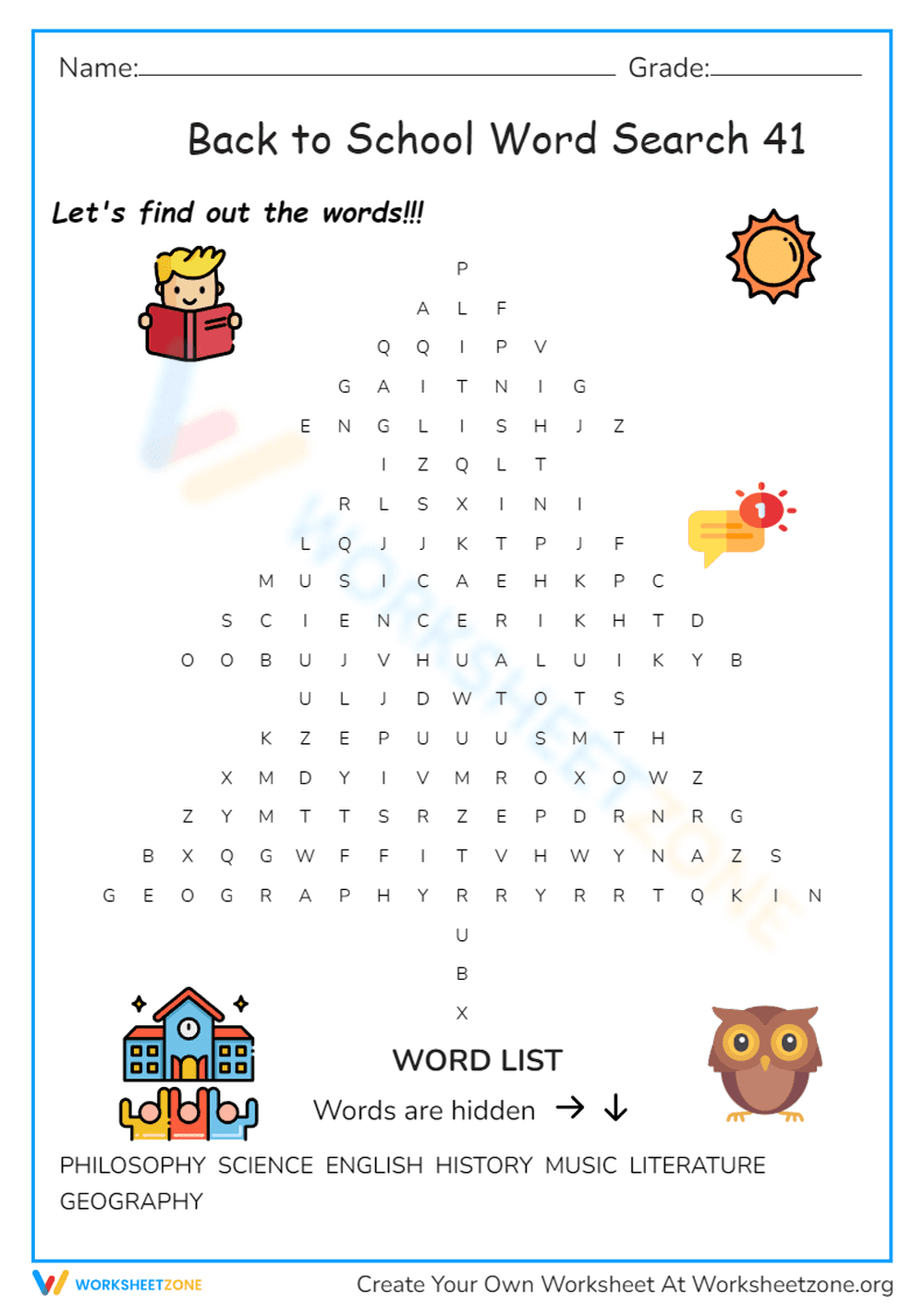

Printable Back to School Word Search | Grades 1-3
Paste this activity's link or code into your existing LMS (Google Classroom, Canvas, Teams, Schoology, Moodle, etc.).
Students can open and work on the activity right away, with no student login required.
You'll still be able to track student progress and results from your teacher account.
This printable word search helps elementary students identify and spell seven school-related academic subjects. By searching for key vocabulary words in the grid, learners reinforce their spelling recognition and build familiarity with school terminology. Use this activity to ease students back into classroom routines during the first week of school.
At a Glance
- Grade: Grades 1–3 · Subject: English Language Arts
- Standard:
CCSS.ELA-LITERACY.L.2.6— Use grade-appropriate general academic and domain-specific words- Skill Focus: Vocabulary recognition and spelling
- Format: 1 page · 7 words · No answer key · PDF
- Best For: Morning work or early finishers
- Time: 10–15 minutes
This single-page activity features a clean, school-themed layout with a word search grid shaped like a pencil. Below the puzzle, a clear word list displays seven academic subjects: philosophy, science, english, history, music, literature, and geography. Directional arrows indicate that words are hidden horizontally and vertically, providing a structured layout that supports young readers.
The zero-prep workflow saves valuable instructional planning time. First, print the single-page PDF, which takes less than 1 minute. Second, distribute the sheets to students at the start of class or during transitions, requiring about 30 seconds of teacher effort. Finally, review the completed puzzles individually or as a whole group in under 2 minutes. This rapid setup makes the activity an ideal choice for emergency sub plans or morning warm-ups.
Standards Alignment
This activity aligns directly with the Common Core State Standard CCSS.ELA-LITERACY.L.2.6, which requires students to acquire and use grade-appropriate conversational, general academic, and domain-specific words and phrases. By identifying terms like geography and literature, students connect visual word forms to academic concepts. Both standard codes can be copied directly into lesson plans, IEP goals, or district curriculum mapping tools.
How to Use It
Incorporate this puzzle during the first week of school as a low-stakes morning work activity to welcome students. Alternatively, use it as a transition task between direct instruction blocks. During the activity, walk around the room to observe which students locate words quickly and which struggle with letter tracking, providing a quick formative assessment of visual scanning skills. Expect completion within 10 to 15 minutes.
Who It's For
This worksheet is designed for students in grades 1, 2, and 3 who are developing foundational reading and spelling skills. It offers excellent vocabulary practice for English language learners who need visual reinforcement of school subject names. Pair this activity with a read-aloud book about starting school or a simple classroom map activity to build a cohesive introductory lesson plan.
Word searches and puzzle-based learning activities support orthographic mapping and vocabulary acquisition in early childhood education. According to research from EdReports 2024, structured vocabulary reinforcement activities that focus on domain-specific terms help young learners transition from basic phonics to fluent word recognition. This worksheet targets CCSS.ELA-LITERACY.L.2.6 by presenting academic vocabulary in a visually engaging format that encourages active scanning and letter-pattern recognition. By focusing on seven key school subjects, the puzzle reinforces spelling structures and word boundaries without overwhelming developing readers. Teachers can utilize this tool to gather quick observational data on student focus and visual processing speeds during the busy back-to-school transition period. The simple layout ensures that students can work independently, allowing educators to focus on classroom management during the critical first days of the academic year.


