


























Views
Downloads

Back to School Bingo Printable | Grade 1-5 ELA
Paste this activity's link or code into your existing LMS (Google Classroom, Canvas, Teams, Schoology, Moodle, etc.).
Students can open and work on the activity right away, with no student login required.
You'll still be able to track student progress and results from your teacher account.
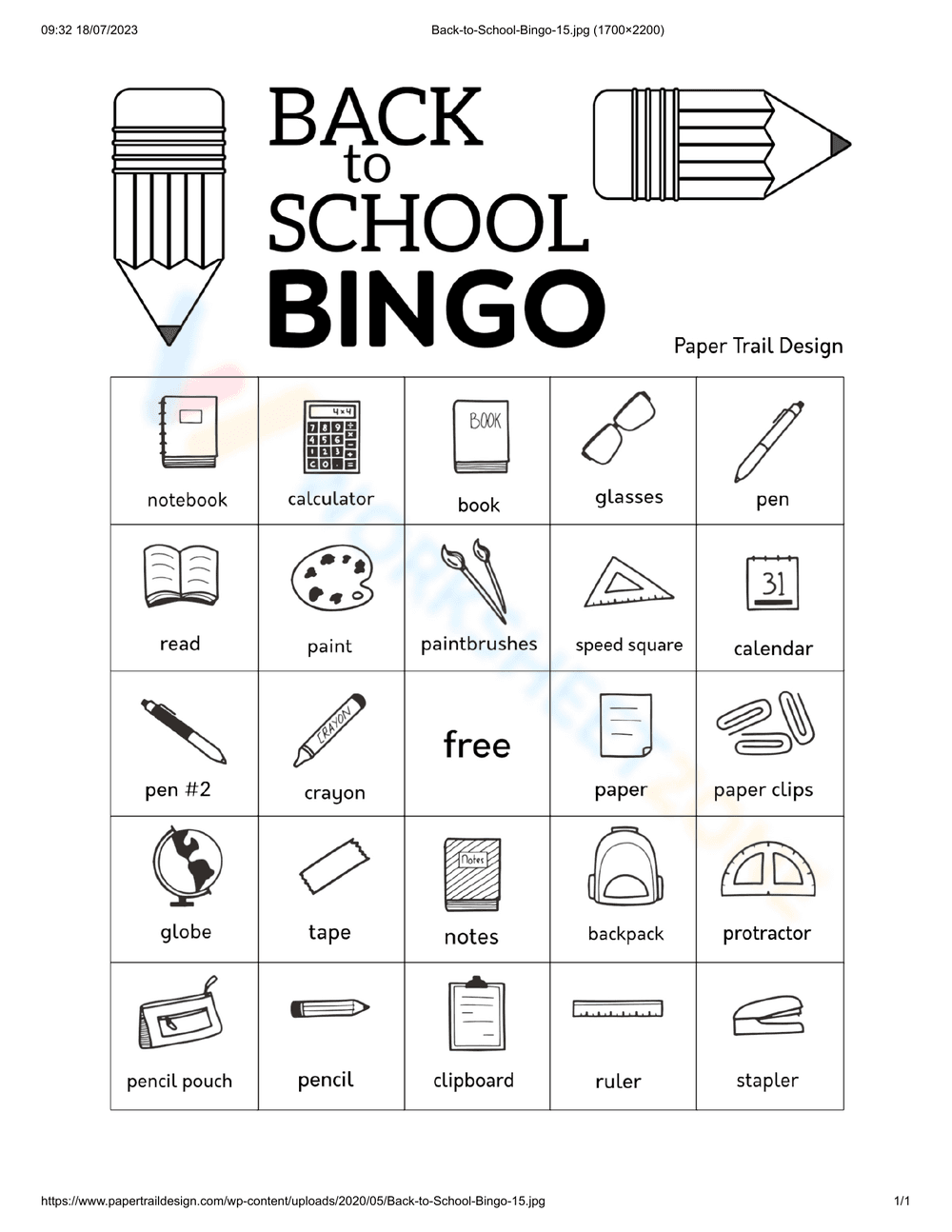
This Back to School Bingo card provides an engaging way for elementary students to familiarize themselves with common classroom supplies and academic vocabulary. By identifying 24 distinct school-themed icons, learners build essential listening and observation skills during the first week of school. It serves as a perfect icebreaker to foster a positive classroom environment.
At a Glance
- Grade: 1-5 · Subject: ELA / Seasonal
- Standard:
CCSS.ELA-LITERACY.SL.1.1— Participate in collaborative conversations with diverse partners about grade-level topics- Skill Focus: Vocabulary & Listening
- Format: 1 page · 24 items · No-prep · PDF
- Best For: First week icebreaker and community building
- Time: 15–20 minutes
This single-page PDF features a high-quality 5x5 grid containing 24 unique school-related illustrations and one central "free" space. Each square includes both a clear black-and-white icon and its corresponding printed word, such as "protractor," "clipboard," and "pencil pouch." The visual-text pairing supports early readers and English Language Learners while they search for items in their new learning environment.
Zero-Prep Workflow
- Print: Select the number of copies needed for your class and print in seconds (1 minute).
- Distribute: Hand out cards along with markers or small manipulatives like beans or buttons (1 minute).
- Review: Call out the items or have students find them in the room to complete their rows (15 minutes).
This activity requires zero teacher preparation and functions perfectly as a last-minute sub plan or a transition activity during the busy first days of the academic term.
The primary standard addressed is CCSS.ELA-LITERACY.SL.1.1, which focuses on participating in collaborative conversations and following agreed-upon rules for discussion. As students play, they practice active listening and turn-taking. Additionally, it supports CCSS.ELA-LITERACY.L.1.6 by reinforcing the acquisition of common nouns and academic vocabulary. Both standard codes can be copied directly into lesson plans, IEP goals, or district curriculum mapping tools.
Use this card during the first morning of school as a "Scavenger Hunt Bingo." Instead of calling out names, have students walk around the room to find the physical objects represented on their cards. Alternatively, use it as a traditional listening game where the teacher describes the function of an object (e.g., "Find the tool we use to measure lines") to challenge higher-grade students. This formative assessment allows you to observe which students can identify specific tools and follow multi-step directions.
This resource is designed for students in Grades 1 through 5, with specific utility for English Language Learners who benefit from the visual cues. It pairs naturally with a classroom tour or a "Meet the Teacher" presentation. The simple black-and-white design is printer-friendly and allows students to color the icons as they are called, extending the engagement time.
According to research by Fisher & Frey (2014) on the gradual release of responsibility, structured social interactions like educational games are vital for establishing classroom norms and academic language proficiency. This Back to School Bingo card aligns with CCSS.ELA-LITERACY.SL.1.1 by providing a low-stakes environment for students to practice collaborative listening and vocabulary recognition. By focusing on 24 essential school items, the worksheet reduces cognitive load while building the foundational school-readiness skills necessary for more complex ELA tasks. Data from NAEP suggests that students who feel a strong sense of classroom community and familiarity with their environment in the first weeks of school show higher levels of engagement throughout the semester. This printable resource offers a practical, evidence-based solution for teachers looking to integrate social-emotional learning with vocabulary development without increasing their administrative burden or preparation time.


