


























Views
Downloads

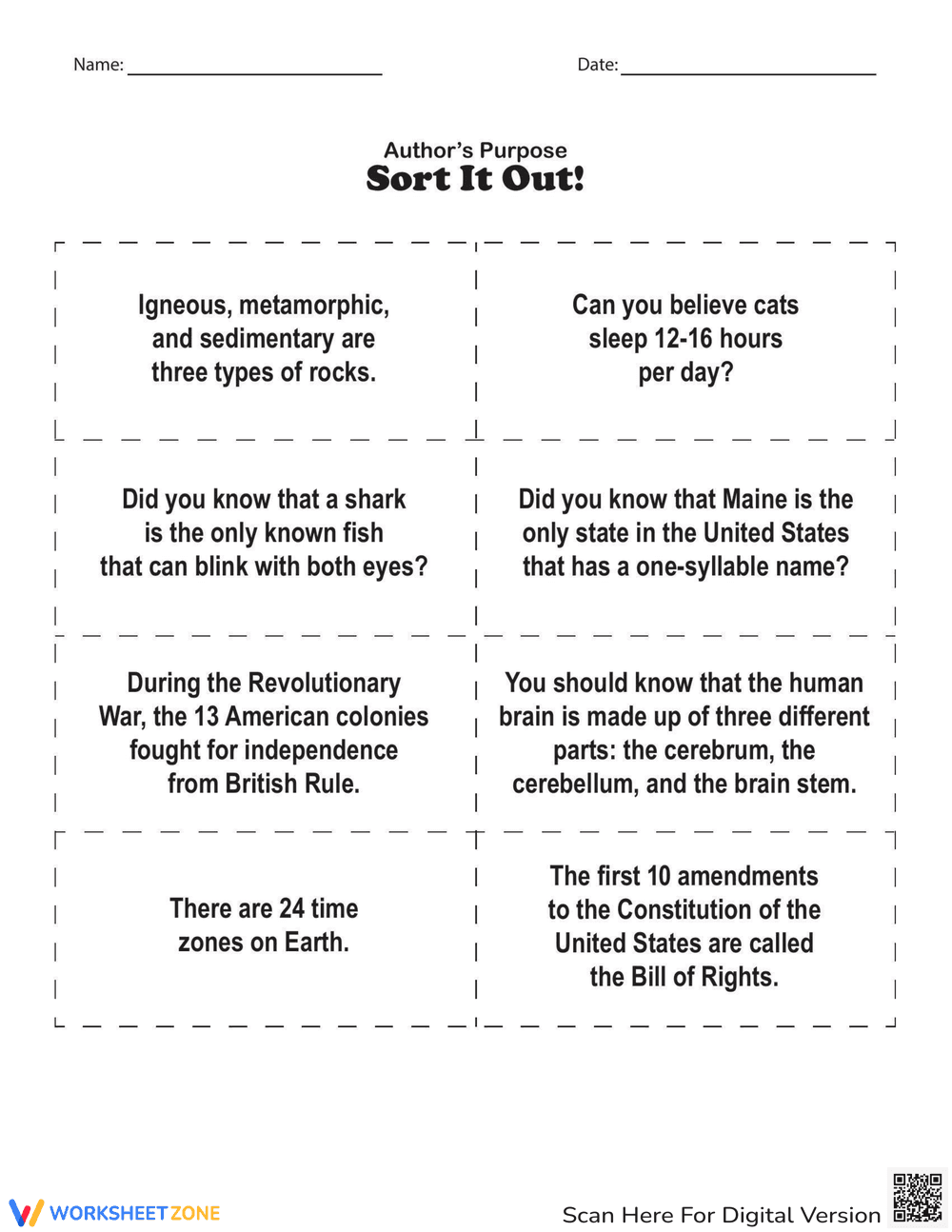


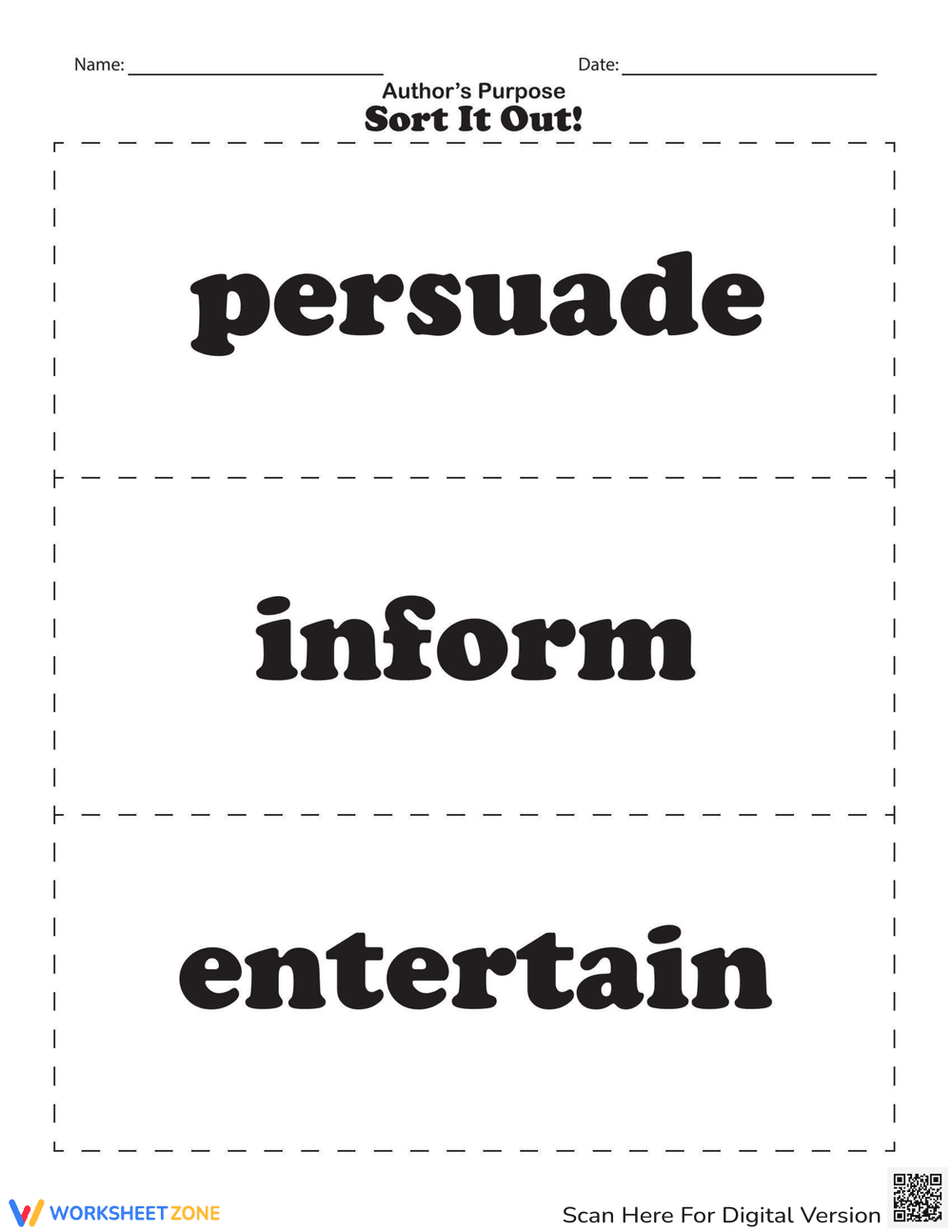

Author's Purpose Printable Worksheet | Grade 5 ELA
Paste this activity's link or code into your existing LMS (Google Classroom, Canvas, Teams, Schoology, Moodle, etc.).
Students can open and work on the activity right away, with no student login required.
You'll still be able to track student progress and results from your teacher account.
This Grade 5 author's purpose worksheet builds students' ability to classify short fiction passages as persuading, informing, or entertaining — using a cut-and-sort format that demands active text analysis, not passive reading. Students complete 12 sorting tasks across 3 pages, each requiring evidence-based categorization before placing text strips into labeled columns.
At a Glance
- Grade: 5 · Subject: ELA / Reading — Fiction
- Standard:
CCSS.ELA-LITERACY.RL.5.6— Describe how a narrator's or speaker's point of view influences how events are described- Skill Focus: Author's purpose identification — persuade, inform, entertain (PIE)
- Format: 3 pages · 12 problems · Answer key included · PDF
- Best For: Guided practice or small-group sorting activity
- Time: 20–30 minutes
Inside: 12 short fiction text strips, one sorting mat with three labeled columns (Persuade / Inform / Entertain), and a completed answer key. Text strips vary in length and genre signal strength — some passages use obvious persuasive language; others require students to read for subtle authorial intent. No word bank is provided, keeping cognitive demand at grade level.
- Guided practice (problems 1–4): High-signal passages with clear PIE markers. Scaffolded by bolded key phrases that flag authorial intent. Students sort with teacher modeling.
- Supported practice (problems 5–8): Mixed-signal passages. Students apply PIE criteria independently but may reference a posted anchor chart. Moderate cognitive load.
- Independent practice (problems 9–12): Low-signal passages requiring inference about purpose. No scaffolds. Students justify each sort in one sentence on the answer line.
Structure follows gradual release: I Do (teacher models strip 1), We Do (pairs sort strips 2–4), You Do (students complete strips 5–12 independently).
Standards Alignment
Primary standard: CCSS.ELA-LITERACY.RL.5.6 — Describe how a narrator's or speaker's point of view influences the way in which events are described. Author's purpose is the applied expression of this standard: students must recognize that word choice, tone, and structure reflect deliberate authorial decisions. Supporting standard CCSS.ELA-LITERACY.RL.5.1 applies when students cite textual evidence to justify each sort. Both standard codes can be copied directly into lesson plans, IEP goals, or district curriculum mapping tools.
How to Use It
Use during direct instruction as a formative check after introducing the PIE framework, or assign after a read-aloud as a consolidation task. Observation tip: watch for students who sort correctly but cannot articulate why — prompt with "What does the author want you to think or do?" Expected completion: 20–30 minutes.
Who It's For
Grade 5 readers working on fiction comprehension and point-of-view skills. Works well in small groups, literacy centers, or as a partner activity. Pairs naturally with a PIE anchor chart and any Grade 5 fiction read-aloud. Students who finish early can write a fourth text strip of their own, targeting a purpose of their choice.
This worksheet targets CCSS.ELA-LITERACY.RL.5.6, requiring Grade 5 students to identify how an author's purpose shapes a text. Fisher & Frey (2014) identify explicit purpose-setting and gradual-release task design as high-leverage moves in literacy instruction; this worksheet applies both. The cut-and-sort format increases engagement and produces a physical artifact teachers can review for formative data. Across 12 tasks spanning three scaffold levels, students move from teacher-modeled sorting to fully independent inference — building the analytical habit of asking why an author wrote a passage, not just what it says. Answer key supports immediate feedback and can inform small-group regrouping decisions.


