


























Views
Downloads

Grade 6 Salmon Life Cycle — Printable No-Prep Worksheet
Paste this activity's link or code into your existing LMS (Google Classroom, Canvas, Teams, Schoology, Moodle, etc.).
Students can open and work on the activity right away, with no student login required.
You'll still be able to track student progress and results from your teacher account.
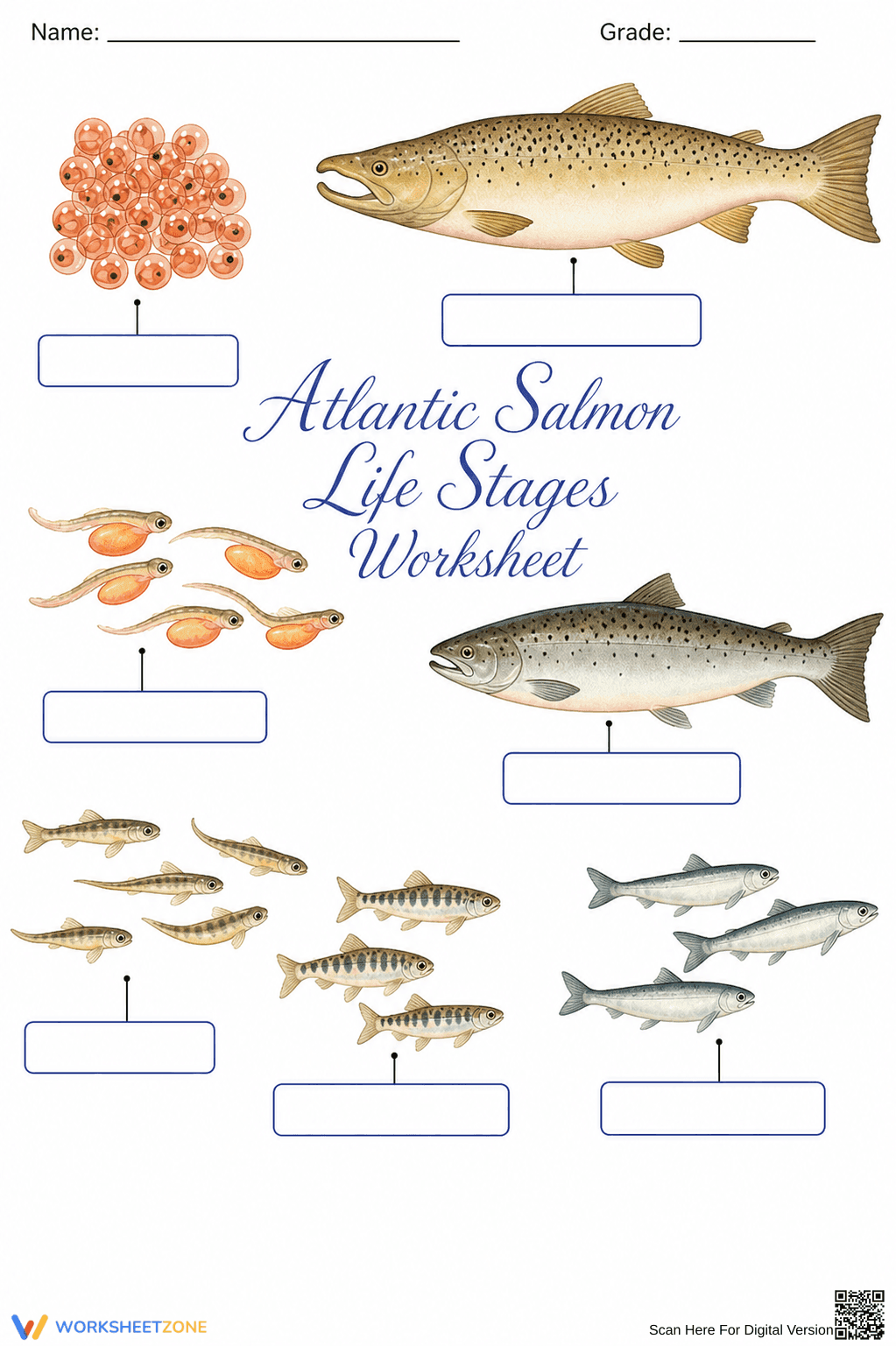
This Grade 6 science worksheet helps students visualize and identify the distinct developmental phases of the Atlantic salmon. By labeling detailed anatomical illustrations, learners connect scientific vocabulary to biological growth stages, reinforcing their understanding of how organisms develop from eggs to mature adults in aquatic ecosystems.
At a Glance
- Grade: 6 · Subject: Science
- Standard:
MS-LS1-5— Construct an explanation for how factors influence organism growth.- Skill Focus: Labeling animal life cycle stages
- Format: 1 page · 7 problems · Answer key included · PDF
- Best For: Independent practice and visual review
- Time: 10–15 minutes
This resource features a single, highly visual page containing seven distinct labeling tasks. Students are presented with scientifically accurate illustrations of the Atlantic salmon at various life stages, including eggs, alevin, fry, parr, smolt, and adult forms. Blank text boxes are strategically placed beneath each developmental stage for students to write the correct terminology. A complete answer key is provided to ensure accurate grading and immediate feedback.
Designed for maximum efficiency, this zero-prep resource follows a simple workflow:
- Print (1 minute): Download the PDF and print a class set.
- Distribute (1 minute): Hand out the worksheets alongside a textbook reference.
- Review (3 minutes): Quickly check answers using the provided key.
With total teacher prep time under two minutes, this activity is an excellent addition to any emergency sub plan.
This activity aligns with MS-LS1-5: Construct a scientific explanation based on evidence for how environmental and genetic factors influence the growth of organisms. By identifying specific developmental milestones, students build the foundational knowledge required to discuss how external factors impact each vulnerable life stage. Both standard codes can be copied directly into lesson plans, IEP goals, or district curriculum mapping tools.
Deploy this worksheet during direct instruction as a guided visual aid, allowing students to fill in labels as you introduce each stage. Alternatively, assign it as independent review to solidify vocabulary. As a formative assessment observation tip, note whether students can distinguish between the visually similar fry and parr stages. Expect completion within a 10 to 15-minute timeframe.
This material is primarily designed for middle school science students studying animal biology, ecology, or life cycles. To support diverse learners, teachers can provide a scrambled word bank on the board for students who struggle with spelling or recall. It pairs perfectly with a short documentary clip or reading passage detailing the challenging upstream migration of the Atlantic salmon, giving context to the adult breeding stages shown on the page.
Integrating visual models into biology instruction significantly improves student retention of complex developmental processes. According to a ScienceDirect TpT Analysis, students who engage with detailed anatomical diagrams demonstrate higher accuracy when recalling sequential biological events compared to text-only instruction. This resource directly supports MS-LS1-5 by requiring learners to construct an explanation for how factors influence organism growth through the identification of distinct life phases. By mapping specific vocabulary to accurate illustrations, educators provide a cognitive anchor that helps students transition from rote memorization to a deeper understanding of ecological adaptations. Recognizing the physical changes between alevin, smolt, and adult forms allows students to better grasp how organisms adapt to changing environments over time. This structured, visual approach ensures that foundational life science concepts are firmly established before moving on to more advanced environmental studies or complex ecosystem dynamics.


