


























Views
Downloads

AAPI Heritage Month Quiz | Grade 6-8 Essential Worksheet
Paste this activity's link or code into your existing LMS (Google Classroom, Canvas, Teams, Schoology, Moodle, etc.).
Students can open and work on the activity right away, with no student login required.
You'll still be able to track student progress and results from your teacher account.
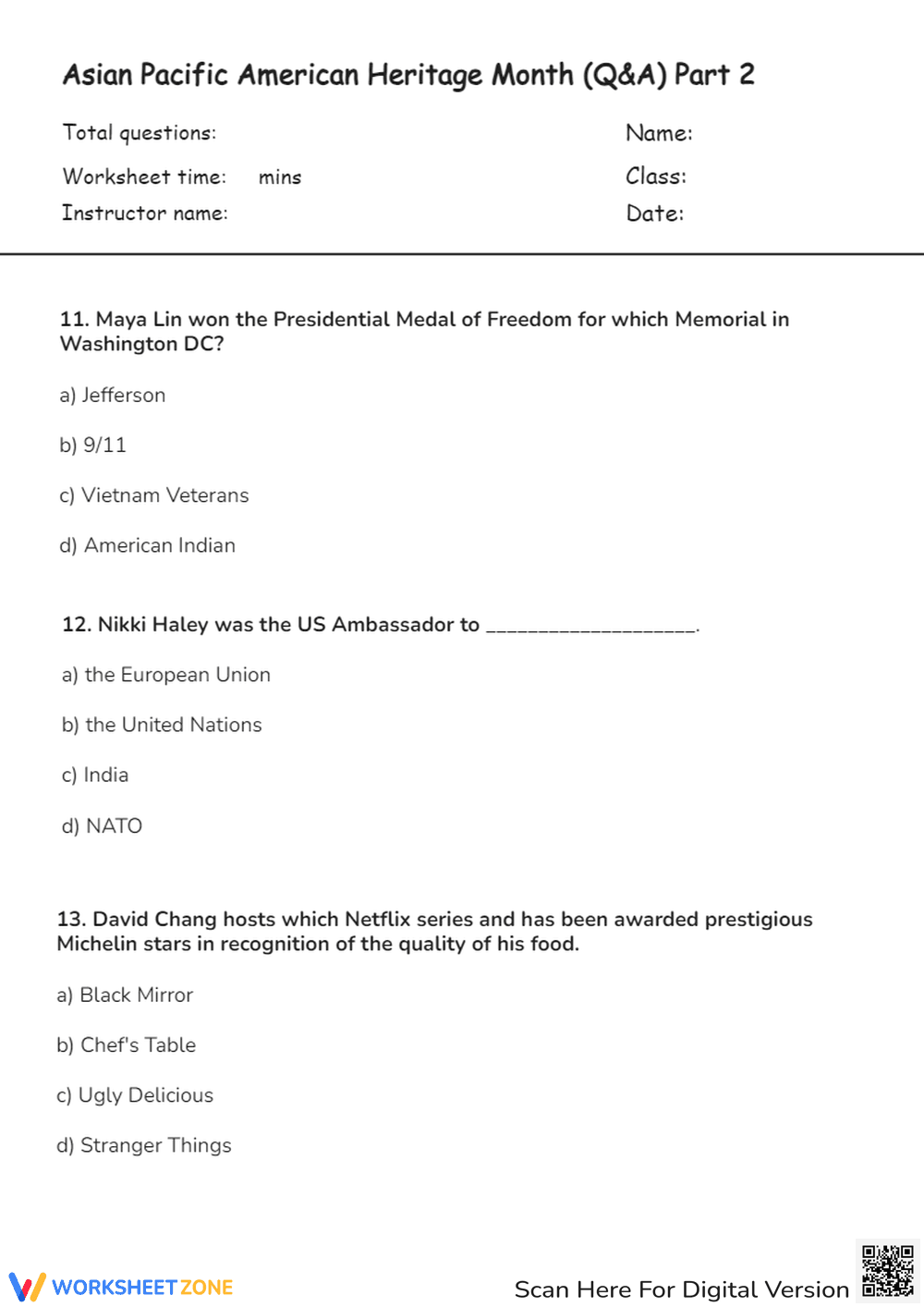
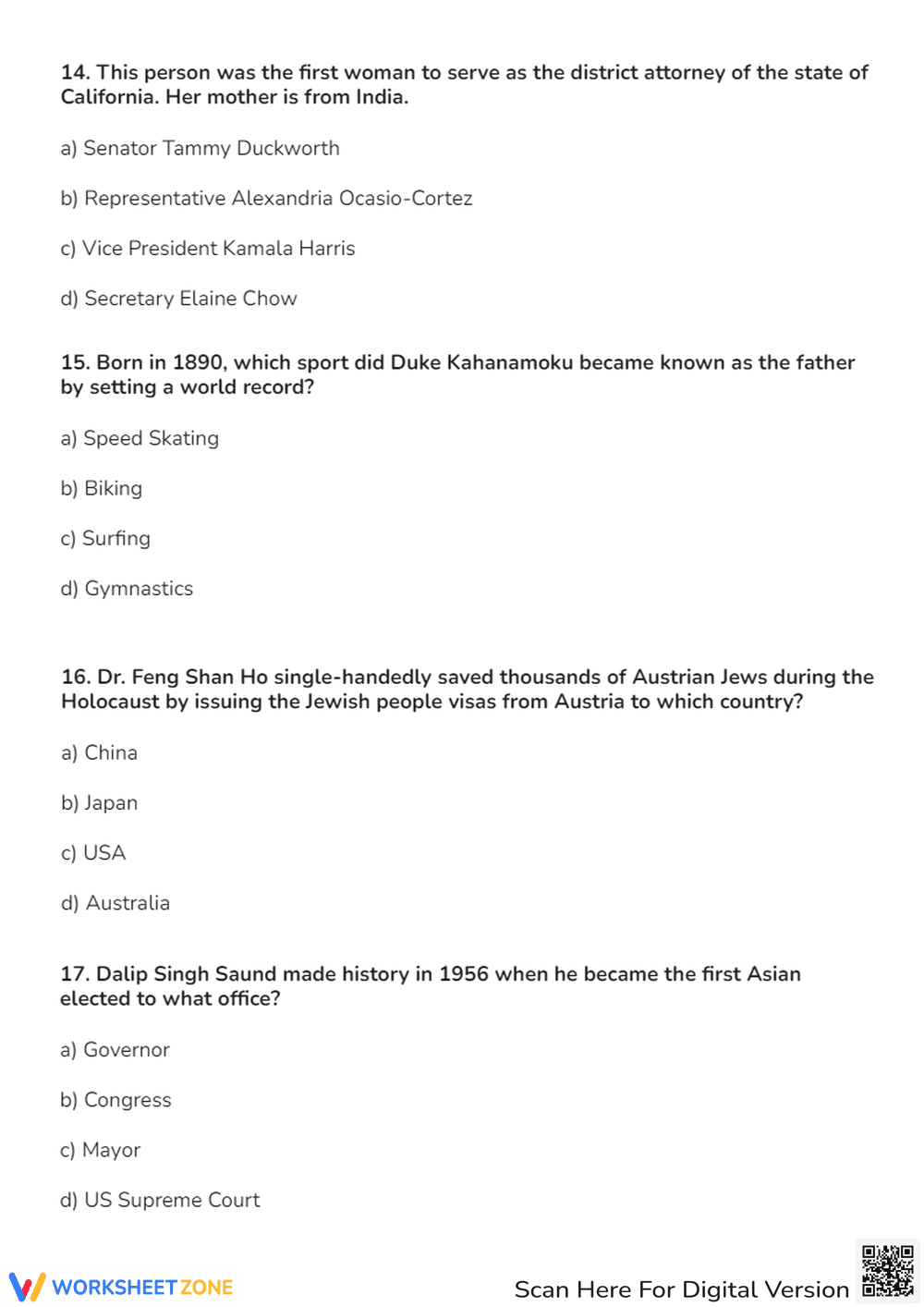
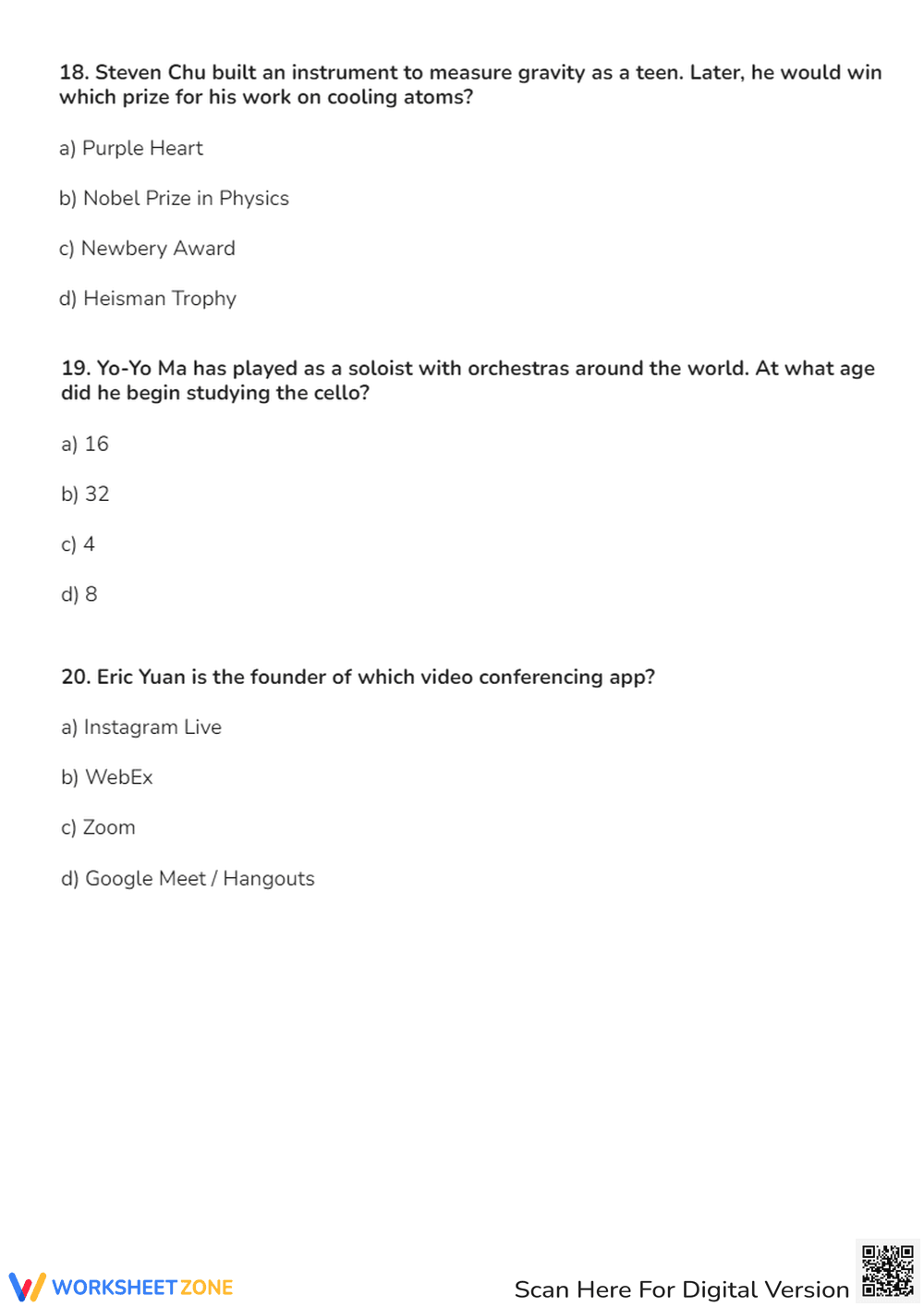
This Grade 5-8 Social Studies worksheet provides a comprehensive review of influential Asian American and Pacific Islander figures. Students engage with 10 multiple-choice questions that highlight significant contributions in politics, science, arts, and sports. By identifying key details about leaders like Kamala Harris and Maya Lin, learners strengthen their informational reading skills and cultural awareness.
At a Glance
- Grade: 6 · Subject: Social Studies
- Standard:
CCSS.ELA-LITERACY.RI.6.1— Cite textual evidence to support analysis of what the text says explicitly- Skill Focus: AAPI History & Notable Figures
- Format: 3 pages · 10 problems · Answer key included · PDF
- Best For: Heritage Month activities or bell ringers
- Time: 15–20 minutes
What's Inside
This resource contains three pages of structured multiple-choice questions. Each question focuses on a specific individual, such as Nobel Prize winner Steven Chu or surfing legend Duke Kahanamoku. The layout is clean and distraction-free, featuring clear headers for student names and completion times. A full answer key is provided to facilitate quick grading or student self-correction.
Zero-Prep Workflow
- Print: Open the 3-page PDF and print enough copies for your class in under 30 seconds.
- Distribute: Hand out the worksheets as a quiet bell-ringer or a focused independent research task.
- Review: Use the included answer key to provide instant feedback or have students peer-grade their work.
Total teacher preparation time is under 2 minutes, making it an ideal choice for substitute plans or busy instructional blocks.
Standards Alignment
The primary standard addressed is `CCSS.ELA-LITERACY.RI.6.1`, which requires students to cite textual evidence to support analysis of what the text says explicitly. While this worksheet functions as a quiz, it encourages students to recall or research specific facts about historical and contemporary figures. Both standard codes can be copied directly into lesson plans, IEP goals, or district curriculum mapping tools.
How to Use It
Use this worksheet as a formative assessment after a unit on AAPI history to gauge student retention of key facts. Alternatively, assign it as a "scavenger hunt" where students must use digital resources to find the correct answers, promoting research skills. During the activity, observe which figures students are least familiar with to guide future direct instruction. Completion typically takes 15 to 20 minutes.
Who It's For
This resource is tailored for middle school students in grades 5 through 8. It is particularly effective for general education classrooms, though the multiple-choice format provides excellent support for English Language Learners and students with IEPs. Pair this worksheet with a biographical anchor chart or a short video documentary on AAPI trailblazers to create a multi-modal learning experience.
The use of structured multiple-choice assessments to build cultural literacy is supported by the RAND AIRS 2024 report, which emphasizes the importance of diverse representation in curriculum materials to improve student engagement. This worksheet aligns with `CCSS.ELA-LITERACY.RI.6.1` by requiring students to identify specific, factual details about Asian American and Pacific Islander figures who have shaped modern history. By focusing on 10 distinct individuals across various fields—from the founder of Zoom to the first Asian American elected to Congress—the resource provides a broad yet manageable overview of AAPI contributions. Research indicates that integrating heritage-specific content into standard ELA or Social Studies blocks helps students develop a more nuanced understanding of American identity. This printable PDF serves as a reliable tool for teachers seeking to meet rigorous standards while fostering an inclusive classroom environment through evidence-based instructional design and clear, measurable student outcomes.


