


























Views
Plays


Valentine's Day Argumentative Writing | Grade 3 Ready
Paste this activity's link or code into your existing LMS (Google Classroom, Canvas, Teams, Schoology, Moodle, etc.).
Students can open and work on the activity right away, with no student login required.
You'll still be able to track student progress and results from your teacher account.
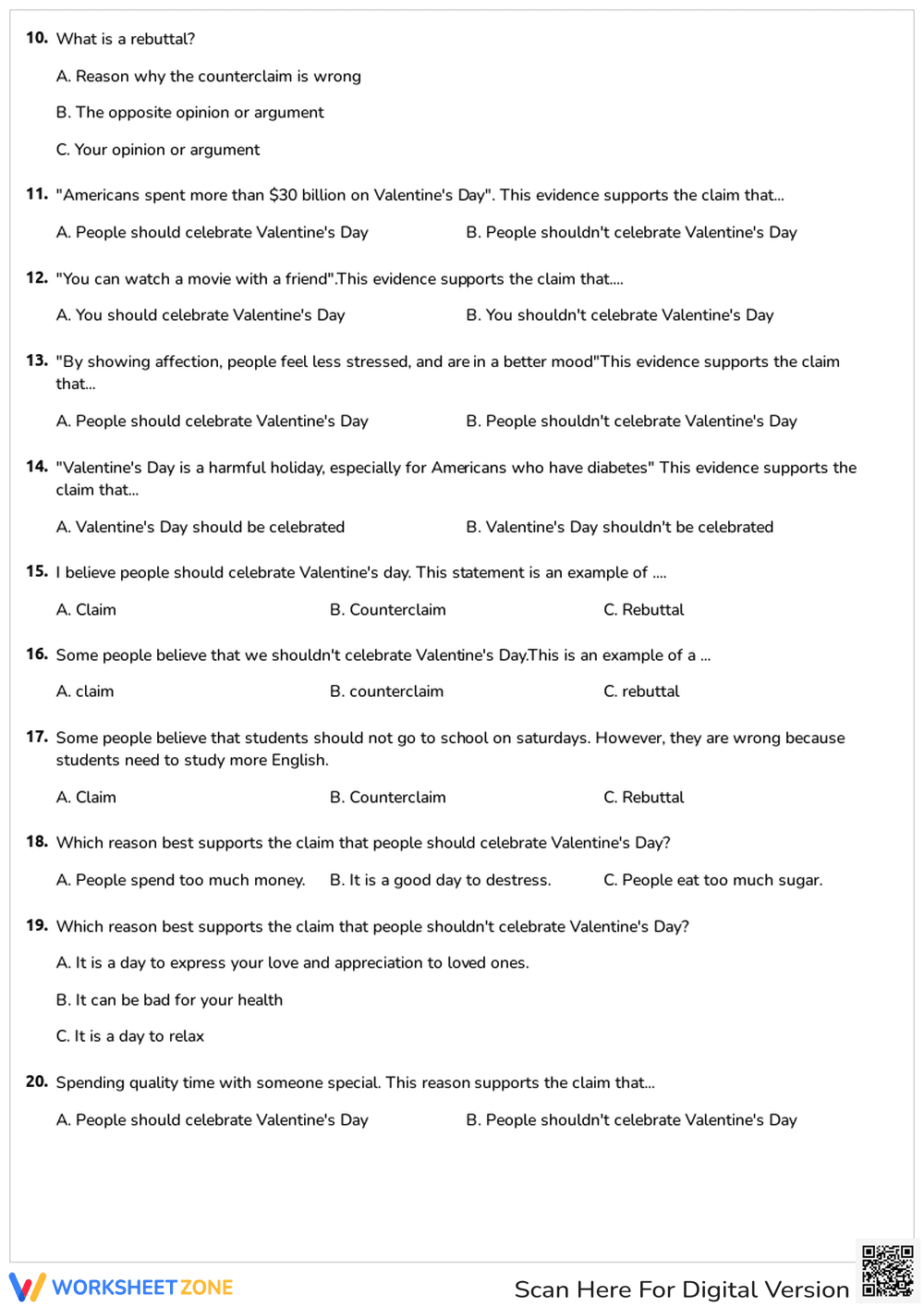
This Grade 3 argumentative writing worksheet helps students master the essential components of persuasion through the engaging lens of Valentine's Day. By analyzing 20 structured problems, learners practice identifying claims, counterclaims, and rebuttals while evaluating which evidence best supports a specific point of view. This resource ensures students can distinguish between opinions and logical reasons effectively.
At a Glance
- Grade: 3 · Subject: ELA Writing
- Standard:
CCSS.ELA-LITERACY.W.3.1— Write opinion pieces on topics, supporting a point of view with reasons.- Skill Focus: Claims, Counterclaims, and Rebuttals
- Format: 2 pages · 20 problems · Answer key included · PDF
- Best For: Holiday-themed argumentative writing practice
- Time: 20–30 minutes
This resource contains 20 multiple-choice questions designed to test both vocabulary and application. The first section defines key terms like "affection" and "tradition," while the subsequent sections challenge students to categorize statements as claims or counterclaims. The worksheet also includes specific scenarios where students must choose the most effective rebuttal or identify which claim a piece of evidence supports, such as spending statistics or health considerations.
The zero-prep design ensures that teachers can integrate high-level writing concepts into their schedule without extensive planning. First, print the two-page PDF (30 seconds). Second, distribute the worksheet to students as a bell-ringer or independent practice activity (1 minute). Finally, use the included answer key to review responses as a whole group, facilitating a discussion on why specific evidence supports or refutes a claim. This streamlined workflow makes it an ideal choice for substitute lesson plans.
This resource is primarily aligned with `CCSS.ELA-LITERACY.W.3.1`, which focuses on writing opinion pieces where students support a point of view with reasons. It specifically addresses the sub-skill of organizing ideas to support the writer's purpose. Additionally, it supports CCSS.ELA-LITERACY.RI.3.8 by asking students to describe logical connections between sentences. Both standard codes can be copied directly into lesson plans, IEP goals, or district curriculum mapping tools.
Use this worksheet as a formative assessment after an introductory lesson on argumentative structures. It works exceptionally well during the "You Do" phase of a gradual release lesson. Teachers should observe if students struggle to differentiate between a counterclaim and a rebuttal, as this indicates a need for further modeling. Expect students to complete the full 20-question set within 25 minutes, making it a perfect mid-week check for understanding.
This worksheet is designed for third-grade students but is also highly effective for older English Language Learners (ELLs) who need clear, scaffolded examples of argumentative academic language. It pairs naturally with an anchor chart on "Persuasive Parts" or a short informational passage about the history of Valentine's Day. The multiple-choice format provides the necessary support for students who are still developing their writing stamina.
This instructional resource aligns with CCSS.ELA-LITERACY.W.3.1 by requiring students to distinguish between claims, counterclaims, and supporting evidence within a thematic context. According to Fisher & Frey (2014), the ability to evaluate the strength of a reason in support of a claim is a foundational component of the gradual release of responsibility model in argumentative literacy. By utilizing a familiar holiday like Valentine's Day, the worksheet lowers the cognitive load associated with content knowledge, allowing students to focus exclusively on the structural mechanics of persuasion and logical reasoning. Research from EdReports 2024 emphasizes that high-quality instructional materials must provide explicit practice in identifying rebuttals to build rhetorical stamina. This 20-question assessment provides the necessary repetition for students to internalize these complex ELA concepts, ensuring they can transition from identifying arguments to constructing their own evidence-based opinion pieces in later writing units.


