


























Views
Downloads


Area of Rectangles and Squares: Essential Grade 4 Worksheet
Paste this activity's link or code into your existing LMS (Google Classroom, Canvas, Teams, Schoology, Moodle, etc.).
Students can open and work on the activity right away, with no student login required.
You'll still be able to track student progress and results from your teacher account.
Mastering Area: Rectangles and Squares Practice
Students often struggle to bridge the gap between concrete counting and abstract formulas when learning about area. This comprehensive worksheet provides a structured path for Grade 4 learners to master the concept of area for rectangles and squares. By progressing from visual models to word problems, students build a deep mathematical understanding of spatial measurement.
At a Glance
- Grade: Grade 4 · Subject: Math
- Standard:
4.MD.A.3— Apply area and perimeter formulas for rectangles in real world and mathematical problems- Skill Focus: Area of Rectangles and Squares
- Format: 3 pages · 15 problems · Answer key included · PDF
- Best For: Independent practice and formal skill assessment
- Time: 30–45 minutes
This 3-page resource transitions students through different levels of cognitive demand. It begins with counting unit squares to establish the foundational concept of area before moving into the standard formula. The document includes 15 tasks, concluding with complex word problems and a challenge section. A full answer key is provided for rapid grading.
Skill Progression and Scaffolding
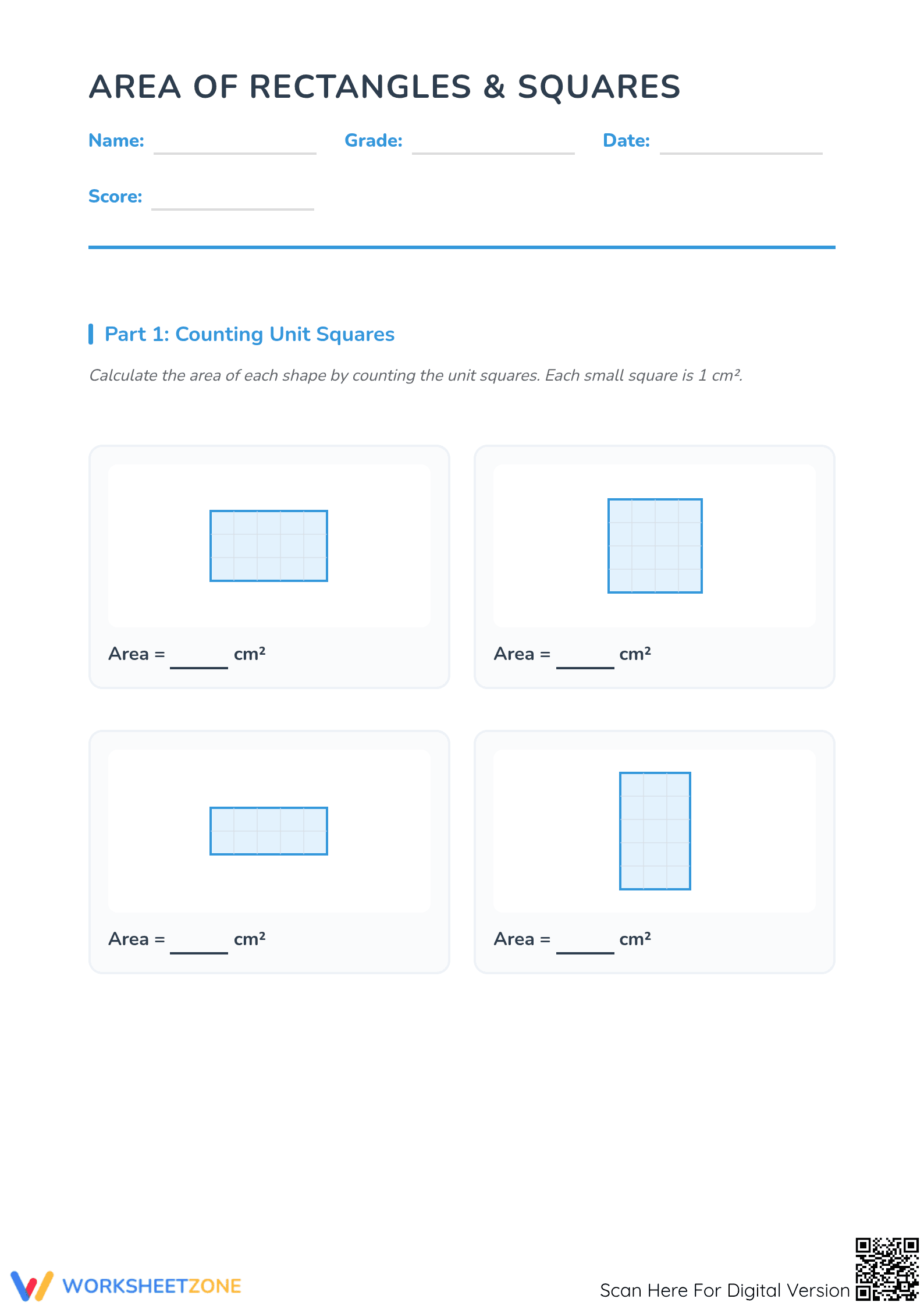
- Guided Practice (4 Tasks): Students count unit squares within grid-lined shapes to visualize area as the amount of space covered, reinforcing the square unit concept.
- Supported Practice (4 Tasks): The grid is removed, and students apply the formula (Length × Width) to labeled rectangles and squares, transitioning to symbolic calculation.
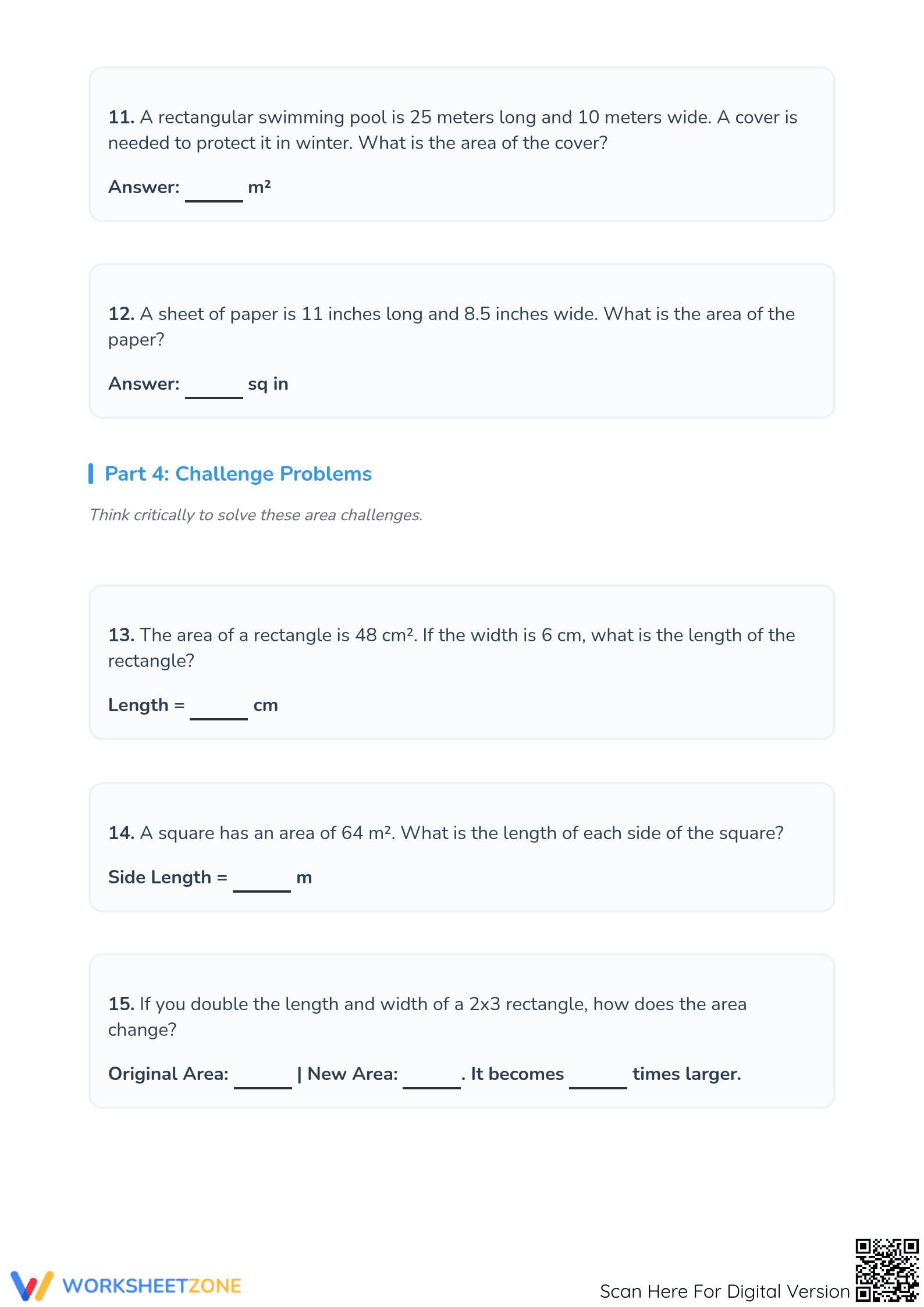
- Independent Practice (7 Tasks): Learners tackle word problems and multi-step challenges, such as finding missing side lengths or analyzing how doubling dimensions affects total area.
This sequence follows the gradual-release model, ensuring students have the confidence to solve abstract problems by first anchoring their knowledge in visual representations.
Standards Alignment
This worksheet is strictly aligned to the Primary Standard `4.MD.A.3`, which requires students to apply area formulas for rectangles in mathematical contexts. It also supports `3.MD.C.7` by establishing the relationship between area and multiplication. Both standard codes can be copied directly into lesson plans, IEP goals, or district curriculum mapping tools.
Effective Instructional Use
This resource works best as independent practice following a direct instruction lesson on multiplication-based area. Teachers can use the first page during a collaborative phase to check for misconceptions about square units. During independent work, observe how students handle the transition to word problems. A completion time of 35 minutes is typical for most learners.
Who It's For
This material is tailored for Grade 4 students, though it serves as an excellent extension for Grade 3 or a remedial review for Grade 5. The inclusion of clear units in the word problem sections provides support for diverse learners. It pairs naturally with a math passage about construction or a set of physical tiles.
The 4.MD.A.3 standard represents a critical shift in elementary mathematics where students move from additive to multiplicative reasoning regarding space. This worksheet facilitates that transition by providing 15 tasks that align with the recommendations from the RAND AIRS 2024 report on effective math instruction. The report emphasizes that high-quality practice must include varied problem types, including visual models and situational applications, to ensure long-term retention of geometric principles. By requiring students to calculate area using both unit squares and formulas, the resource addresses common misconceptions about spatial measurement identified in NAEP data. Teachers can utilize these problems to evaluate student mastery of the fundamental area concept, which serves as a prerequisite for more advanced topics like volume in middle school. The structured progression and included answer key make this an essential component of any rigorous Grade 4 math curriculum focused on standards-aligned achievement.


