


























Views
Downloads
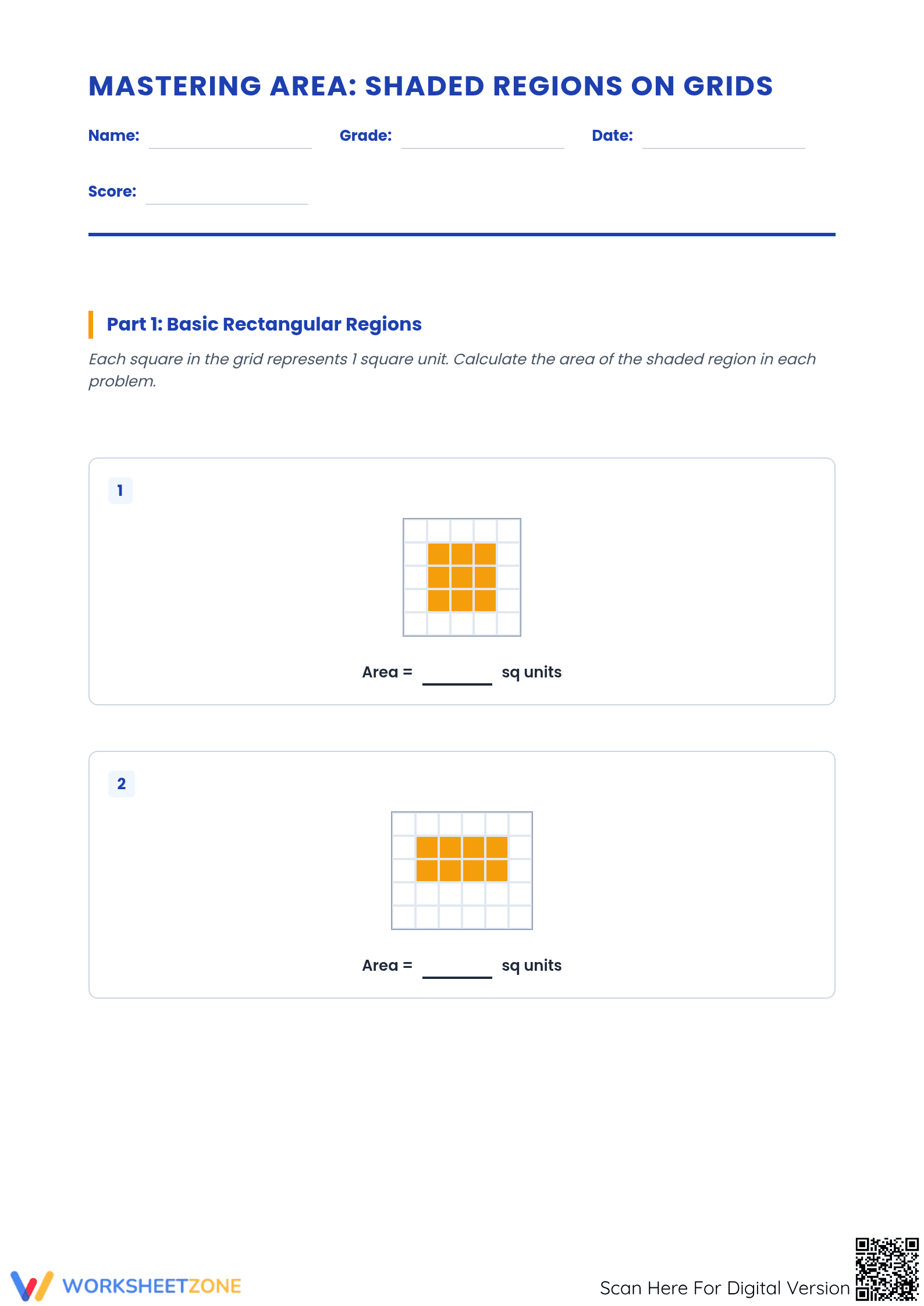
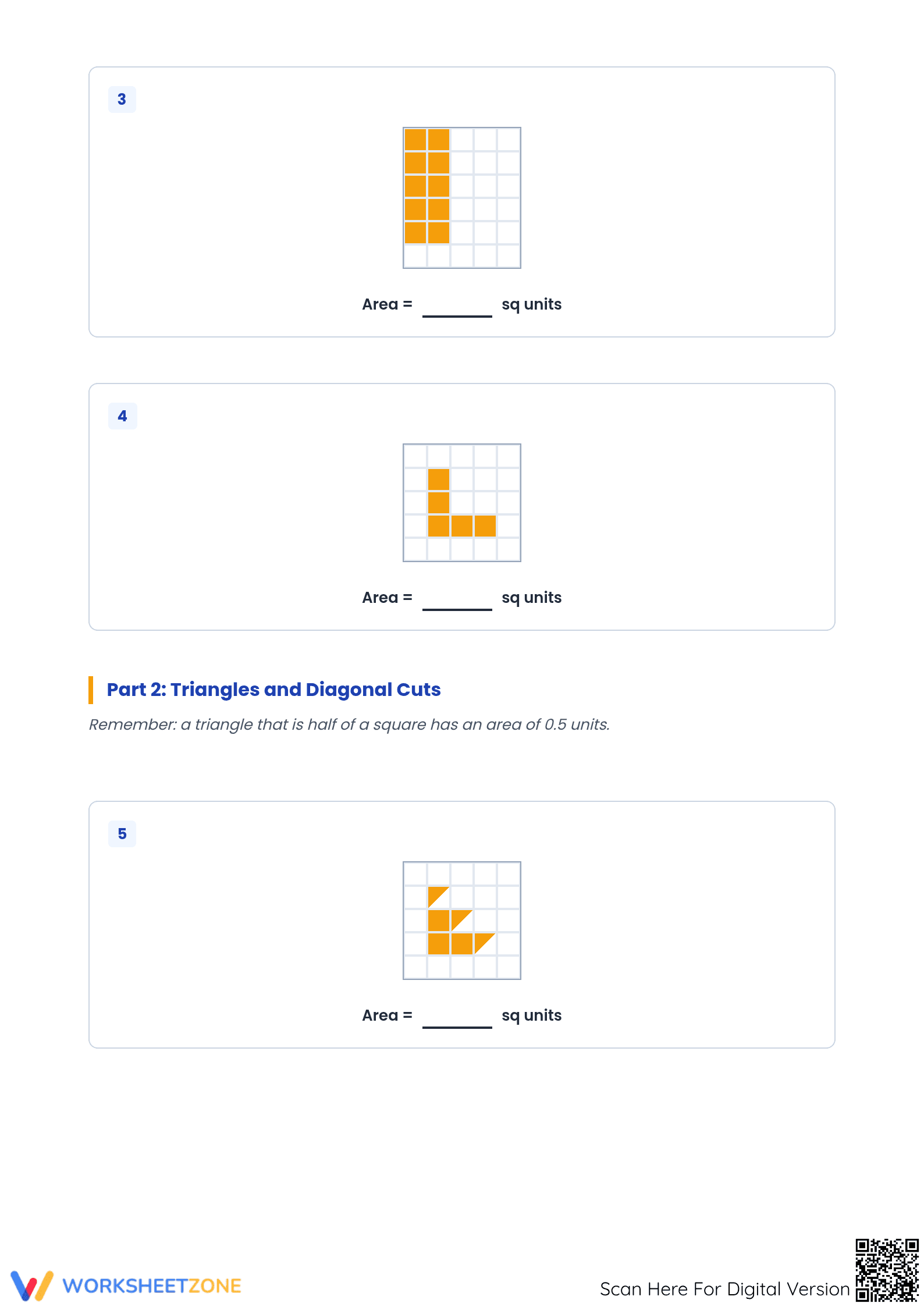
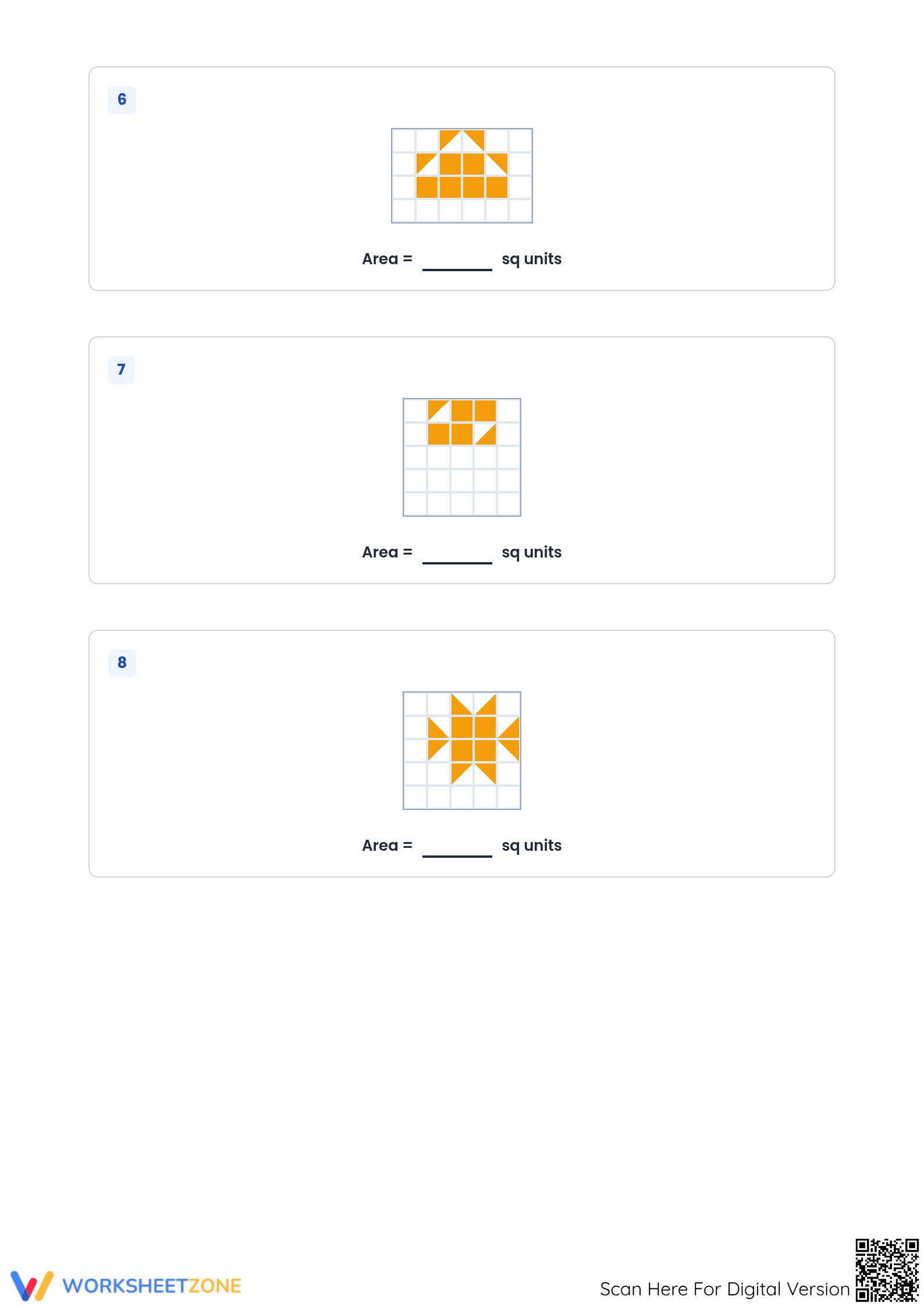
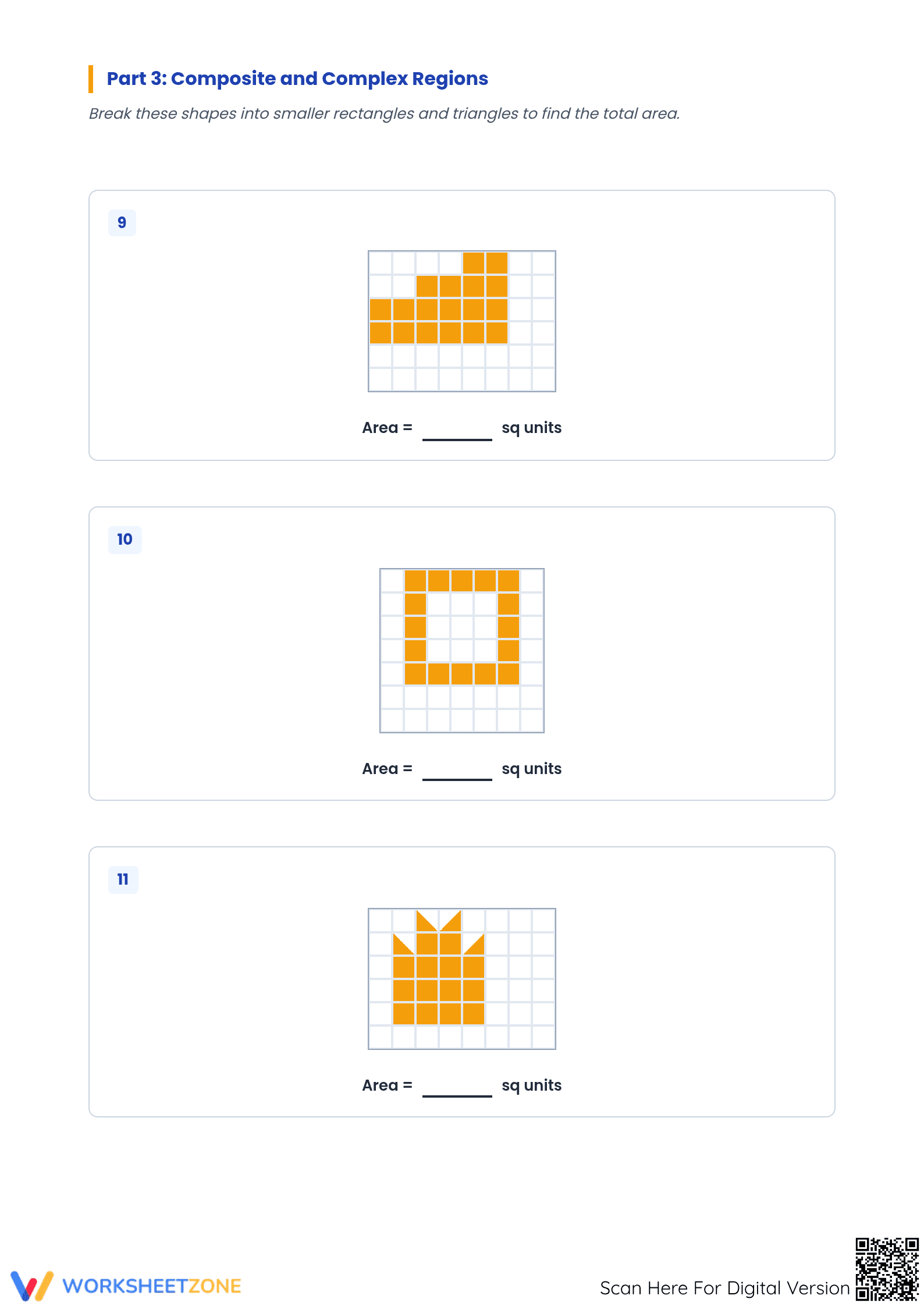

Printable Area on Grids Worksheet | Grade 7-8 Math
Paste this activity's link or code into your existing LMS (Google Classroom, Canvas, Teams, Schoology, Moodle, etc.).
Students can open and work on the activity right away, with no student login required.
You'll still be able to track student progress and results from your teacher account.
This worksheet provides comprehensive practice for determining the area of various shapes using a grid system. By counting shaded units and calculating composite regions, learners develop a concrete understanding of spatial measurement. Determining the area of both simple and complex polygons is a vital precursor to applying abstract algebraic formulas in higher-level geometry courses.
At a Glance
- Grade: 7-8 · Subject: Math
- Standard:
CCSS.MATH.CONTENT.6.G.A.1— Find the area of polygons by composing into rectangles or decomposing into triangles- Skill Focus: Grid-based area calculation
- Format: 5 pages · 13 problems · Answer key included · PDF
- Best For: Reinforcing geometry and measurement fundamentals
- Time: 30–45 minutes
What's Inside
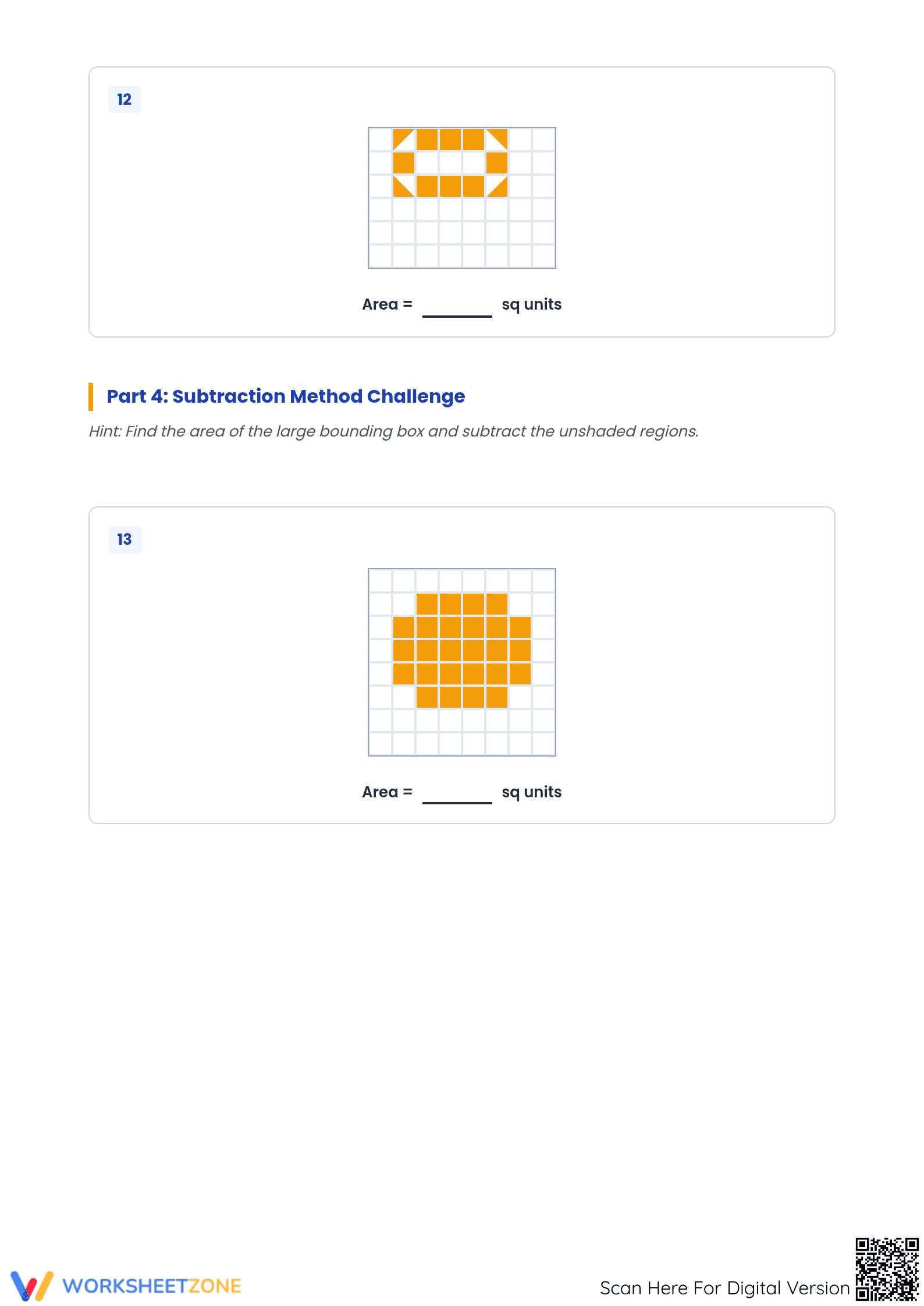
This 5-page PDF contains 13 unique problems organized into four distinct parts. Students encounter basic rectangular regions, triangles with diagonal cuts, composite shapes, and a subtraction method challenge. The layout features clear grids where each square represents one unit, and a full answer key is provided for immediate feedback and grading efficiency.
Skill Progression
- Guided practice: The first two problems focus on simple rectangles, allowing students to establish the baseline counting method with 4 to 12 square units.
- Supported practice: Problems 3 through 8 introduce vertical orientations and diagonal cuts, requiring students to identify half-units and combine them into whole areas.
- Independent practice: The final five problems present composite regions and subtraction challenges where students calculate a bounding box and remove unshaded parts.
The worksheet follows a gradual-release model, moving from direct counting to strategic decomposition of complex polygons.
Standards Alignment
The primary focus is CCSS.MATH.CONTENT.6.G.A.1, which requires students to find the area of right triangles, other triangles, special quadrilaterals, and polygons by composing into rectangles or decomposing into triangles and other shapes. It also supports Grade 7 standards regarding area and surface area. Both standard codes can be copied directly into lesson plans, IEP goals, or district curriculum mapping tools.
How to Use It
Assign this worksheet as a mid-unit practice session after students have mastered basic counting but before they are introduced to complex area formulas. During the activity, observe how students handle diagonal lines in Part 2; those who struggle to see two half-squares as a whole may need a brief review of triangle-rectangle relationships. Expect completion in approximately 40 minutes.
Who It's For
This resource is designed for Grade 7 and 8 students who need to solidify their geometric reasoning. It is particularly effective for visual learners and can be paired with a physical grid-paper activity or a direct instruction lesson on polygon decomposition. The progressive difficulty makes it suitable for mixed-ability classrooms and small-group interventions.
Determining the area of polygons through grid decomposition is a foundational skill that bridges the gap between concrete counting and abstract algebraic application in geometry. According to the NAEP (2024) framework, spatial visualization and the ability to decompose complex shapes are critical indicators of mathematical proficiency in the middle school grades. Research from Fisher & Frey (2014) highlights the effectiveness of a gradual-release approach—moving from simple rectangles to composite regions—in building student confidence and reducing cognitive load during problem-solving. By using the CCSS.MATH.CONTENT.6.G.A.1 standard, this worksheet ensures that students develop the necessary conceptual scaffolding to master higher-level surface area and volume calculations. The inclusion of the subtraction method challenge specifically targets higher-order thinking skills, as students must shift their perspective from additive to subtractive logic. This evidence-based design promotes long-term retention of geometric principles across middle school curricula.


