


























Views
Downloads




Essential Ratios and Proportions Worksheet | Grade 7 Aligned
Paste this activity's link or code into your existing LMS (Google Classroom, Canvas, Teams, Schoology, Moodle, etc.).
Students can open and work on the activity right away, with no student login required.
You'll still be able to track student progress and results from your teacher account.
This comprehensive ratios and proportions worksheet helps middle school students master the fundamental concepts of proportional relationships. Students will progress through identifying equivalent ratios, solving for unknown variables, and applying logic to real-world word problems. By completing these structured exercises, learners develop the analytical skills necessary for success in higher-level algebra and proportional reasoning.
At a Glance
- Grade: 7 · Subject: Math
- Standard:
CCSS.MATH.CONTENT.7.RP.A.2— Recognize and represent proportional relationships between quantities in mathematical and real-world contexts- Skill Focus: Proportionality & Solving Ratios
- Format: 4 pages · 31 problems · Answer key included · PDF
- Best For: Independent practice, homework, or formative assessment
- Time: 40–50 minutes
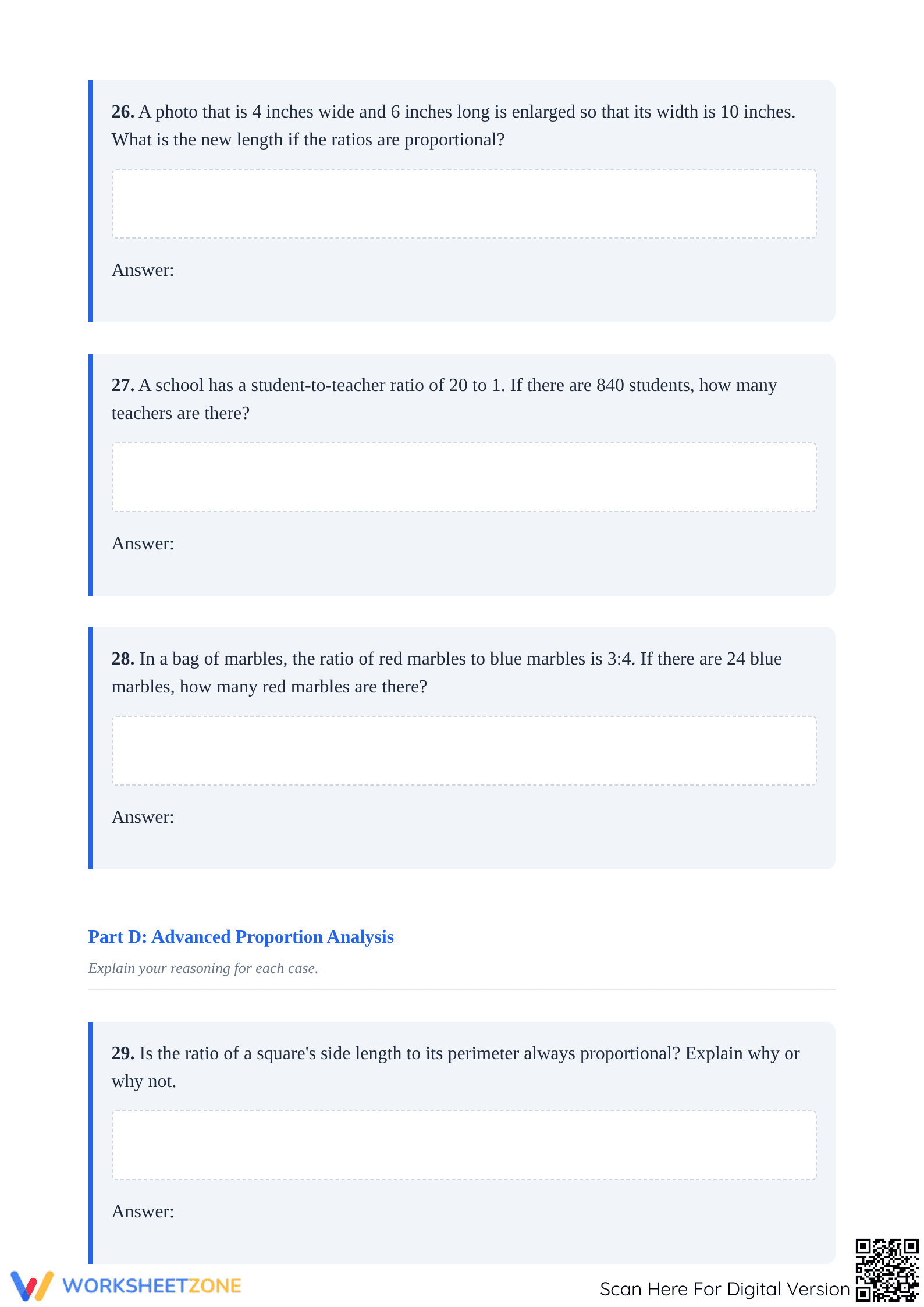
This 4-page practice packet contains 31 carefully sequenced tasks designed to build mastery. It includes 14 identification problems where students compare ratio pairs, 8 algebraic solving tasks to find missing values in proportions, and 6 multi-step word problems involving real-world scenarios like recipes and travel. The final section features 3 advanced analysis questions that challenge students to explain their mathematical reasoning. A full answer key is included.
Skill Progression
- Guided Practice (14 tasks): Students begin by identifying if ratios are proportional using cross-multiplication or simplification, with clear visual boxes provided for 'yes' or 'no' responses.
- Supported Practice (8 tasks): The worksheet transitions to solving for missing variables ('x') in proportion equations, requiring students to apply their understanding of equivalent ratios in an algebraic format.
- Independent Practice (9 tasks): Students apply skills to word problems and conceptual analysis, moving from concrete calculations to abstract reasoning and written explanations of proportional properties.
This packet utilizes a gradual-release model, shifting from basic recognition to complex application to ensure deep conceptual understanding.
Standards Alignment
This worksheet focuses on CCSS.MATH.CONTENT.7.RP.A.2, which requires students to recognize and represent proportional relationships between quantities. This includes deciding whether two quantities are in a proportional relationship by testing for equivalent ratios. Additionally, it supports CCSS.MATH.CONTENT.6.RP.A.3 by using ratio and rate reasoning to solve real-world problems. Both standard codes can be copied directly into lesson plans, IEP goals, or district curriculum mapping tools.
How to Use It
This worksheet is ideal for use during the "We Do" or "You Do" phases of a lesson on proportional relationships. Teachers can assign the first page as a quick check for understanding before moving into the word problem sections. It also serves as an excellent formative assessment tool; observing how students approach the "Advanced Analysis" section can provide insights into their conceptual grasp. Expected completion time is 45 minutes.
Who It's For
This resource is designed for Grade 7 students, but is effective for Grade 6 acceleration or Grade 8 remediation. The clear layout supports diverse learners, including those needing scaffolded practice with algebraic proportions. It pairs naturally with a lesson on unit rates or a Ratios and Proportions anchor chart for student reference during independent work.
Proportional reasoning is a critical milestone in middle school mathematics, a gateway to algebra. This worksheet utilizes a gradual-release framework, moving students from identification to application, fostering deep internalization of ratios. Aligned with CCSS.7.RP.A.2, it requires students to calculate values and explain proportionality logic. With 31 diverse tasks, this resource balances procedural fluency with conceptual understanding, reinforcing the connection between simple ratios and complex proportional relationships found in science and engineering. This structured approach builds stamina for standardized assessments and fosters genuine mastery.


