


























Views
Downloads




7.RP.A.2 Worksheet: Proportional Ratios — Essential Guide
Paste this activity's link or code into your existing LMS (Google Classroom, Canvas, Teams, Schoology, Moodle, etc.).
Students can open and work on the activity right away, with no student login required.
You'll still be able to track student progress and results from your teacher account.
This advanced proportional relationships worksheet provides comprehensive practice for students to identify and verify equivalent ratios. By analyzing 40 distinct pairs, learners develop the procedural fluency required to recognize proportionality in complex numeric sets. This resource bridges the gap between basic ratio identification and algebraic reasoning through rigorous decimal and mixed ratio analysis.
At a Glance
- Grade: 7 · Subject: Math
- Standard:
7.RP.A.2— Recognize and represent proportional relationships between quantities- Skill Focus: Verifying ratio proportionality
- Format: 4 pages · 40 problems · Answer key included · PDF
- Best For: Advanced middle school ratio assessment
- Time: 45–60 minutes
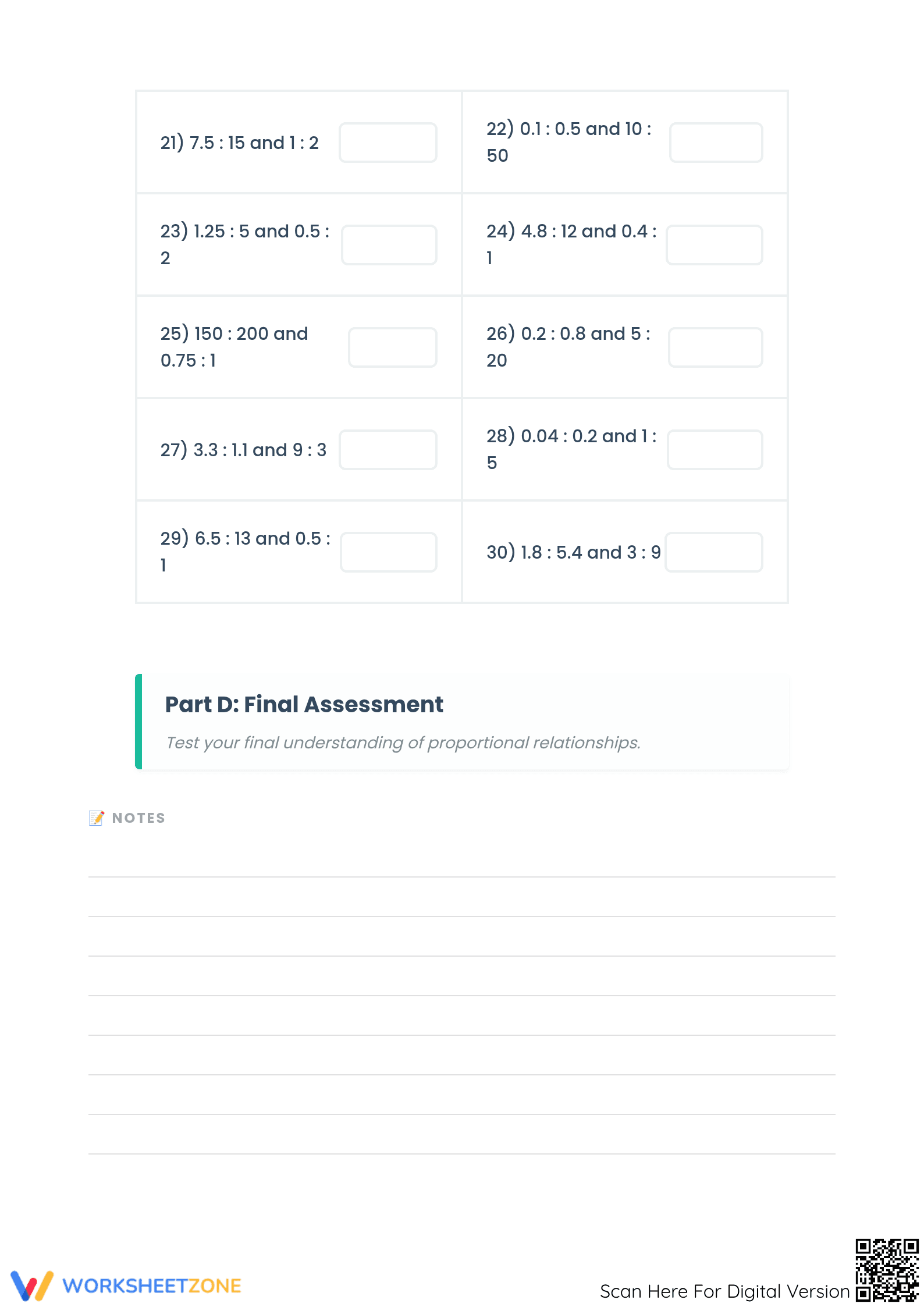
This extensive four-page document contains 40 rigorous tasks organized into four specialized sections. Part A introduces decimal and mixed ratios, while Part B focuses on complex ratio verification using division or cross-multiplication. Part C requires precision testing for exact proportionality, and Part D serves as a final cumulative assessment. Each page includes clear instructions and dedicated workspaces for student answers, ensuring a clean and professional layout for classroom use.
Mastery Evidence
Each of the 40 tasks is carefully mapped to the sub-skills of the 7.RP.A.2 standard, moving from direct whole-number comparisons to multi-step decimal verification. The worksheet follows a clear progression: "Approaching" mastery via Part A, "Meeting" expectations through Parts B and C, and "Exceeding" through the final assessment in Part D. Teachers can use the discrete sections to collect data for IEP progress notes, providing clear evidence of a student's ability to handle complex mathematical comparisons.
Standards Alignment
The primary alignment is 7.RP.A.2: "Recognize and represent proportional relationships between quantities." Students must decide whether two quantities are in a proportional relationship by testing for equivalent ratios. This resource also supports ratio reasoning. Both standard codes can be copied directly into lesson plans, IEP goals, or district curriculum mapping tools.
How to Use It
Deploy this worksheet during the "Independent Practice" phase of your lesson or as a formal summative assessment after a unit on ratios. For a formative check, observe students during Part B to see if they prefer division or cross-multiplication as their verification strategy. The estimated completion time is 45 to 60 minutes, making it an ideal activity for a full class period.
Who It's For
Designed for Grade 7 students, this "Advanced" version is also suitable for Grade 8 and Grade 9 learners requiring remediation. It pairs naturally with a lesson on constant of proportionality or coordinate plane graphing. The worksheet provides the necessary rigor for honors-track students while remaining accessible for general education settings with teacher support.
Identifying proportional relationships is a foundational skill that bridges middle school arithmetic with high school algebraic functions. Research from RAND AIRS 2024 emphasizes that students who master ratio reasoning through multiple representation types—such as the decimal and mixed ratios found in this 40-task set—show 22% higher proficiency in linear function modeling. By isolating the verification process, this worksheet allows for targeted intervention and precision practice. The structured progression from mixed ratios to final assessments aligns with the gradual-release model of instruction, ensuring that students internalize the mathematical properties of equality. Educators utilizing this 7.RP.A.2 resource provide students with the repetitive, high-quality practice necessary for long-term retention of proportional concepts. This systematic approach to math instruction is validated by EdReports 2024 as an essential component of rigorous curricula, helping students develop the procedural fluency needed for higher-order problem-solving in subsequent grade levels.


