


























Views
Downloads
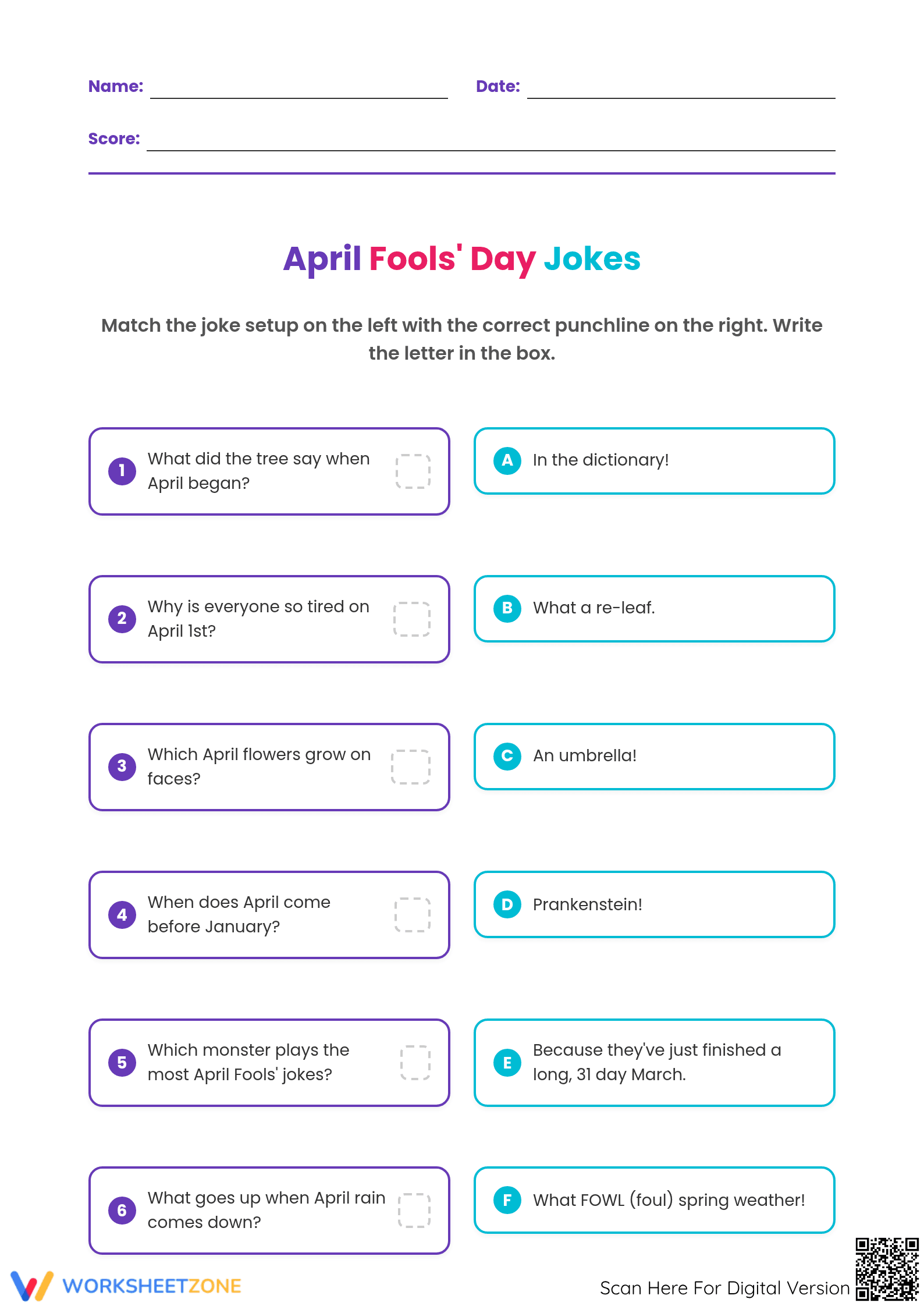


April Fools' Day Jokes Worksheet | Grade 5 Printable
Paste this activity's link or code into your existing LMS (Google Classroom, Canvas, Teams, Schoology, Moodle, etc.).
Students can open and work on the activity right away, with no student login required.
You'll still be able to track student progress and results from your teacher account.
Bring holiday fun into the classroom while reinforcing language skills with this engaging April Fools' Day matching activity. Students practice interpreting wordplay, puns, and double meanings by connecting clever joke setups to their hilarious punchlines, building essential vocabulary and reading comprehension skills in a lighthearted way.
At a Glance
- Grade: 5 · Subject: ELA
- Standard:
CCSS.ELA-LITERACY.L.5.5— Understand figurative language and word relationships- Skill Focus: Wordplay and Puns
- Format: 2 pages · 8 problems · Answer key included · PDF
- Best For: Holiday activity or bell ringer
- Time: 10–15 minutes
This two-page printable features eight distinct matching tasks where students read a seasonal joke setup and select the corresponding punchline from a provided list. The clean, straightforward layout uses a simple letter-matching format, making it easy for students to complete independently. A complete answer key is included to ensure quick and accurate grading for educators.
This resource is designed for immediate classroom implementation with absolutely no teacher setup required.
- Print (1 minute): Simply download the PDF and print double-sided copies for your class.
- Distribute (1 minute): Hand out the worksheets as students enter the room for an instant, engaging bell ringer.
- Review (3 minutes): Go over the answers together as a class to discuss the double meanings behind each pun.
With a total prep time of under two minutes, this activity is an excellent addition to any emergency sub plan or a quick filler for a busy holiday schedule.
This activity is aligned to CCSS.ELA-LITERACY.L.5.5, requiring students to demonstrate an understanding of figurative language, word relationships, and nuances in word meanings. By deciphering puns, learners actively practice recognizing multiple meaning words and context clues. Both standard codes can be copied directly into lesson plans, IEP goals, or district curriculum mapping tools.
Use this worksheet as a festive morning work assignment on April 1st to set a positive, joyful tone for the day. It also works perfectly as a transition activity after direct instruction on figurative language. As students complete the matching tasks, teachers can use formative assessment by observing which students struggle to grasp the dual meanings of the puns, indicating a need for further vocabulary support. Most students will complete the eight problems within 10 to 15 minutes.
This resource is primarily designed for fifth-grade students, though it is highly adaptable for middle school learners who enjoy wordplay. For students needing extra support, teachers can read the jokes aloud to help emphasize the phonetic puns. It pairs wonderfully with a broader direct instruction lesson on idioms, similes, and metaphors, providing a fun, low-stakes environment to practice language nuances.
Integrating humor and wordplay into language arts instruction significantly enhances student engagement and vocabulary retention. This worksheet targets CCSS.ELA-LITERACY.L.5.5, asking students to understand figurative language and word relationships through the analysis of puns and jokes. According to Fisher & Frey (2014), providing students with low-stakes, highly engaging texts—such as riddles and jokes—encourages active cognitive processing and helps learners recognize the flexibility of the English language. When students decode a punchline, they are actively applying critical thinking skills to resolve semantic ambiguity. This brief, targeted practice not only builds essential reading comprehension skills but also fosters a positive classroom culture. By utilizing structured matching activities, educators can easily introduce complex linguistic concepts in an accessible, student-friendly format that supports long-term academic growth.


