


























Views
Downloads

Mitosis Practice Worksheet | Grade 9-12 Essential
Paste this activity's link or code into your existing LMS (Google Classroom, Canvas, Teams, Schoology, Moodle, etc.).
Students can open and work on the activity right away, with no student login required.
You'll still be able to track student progress and results from your teacher account.
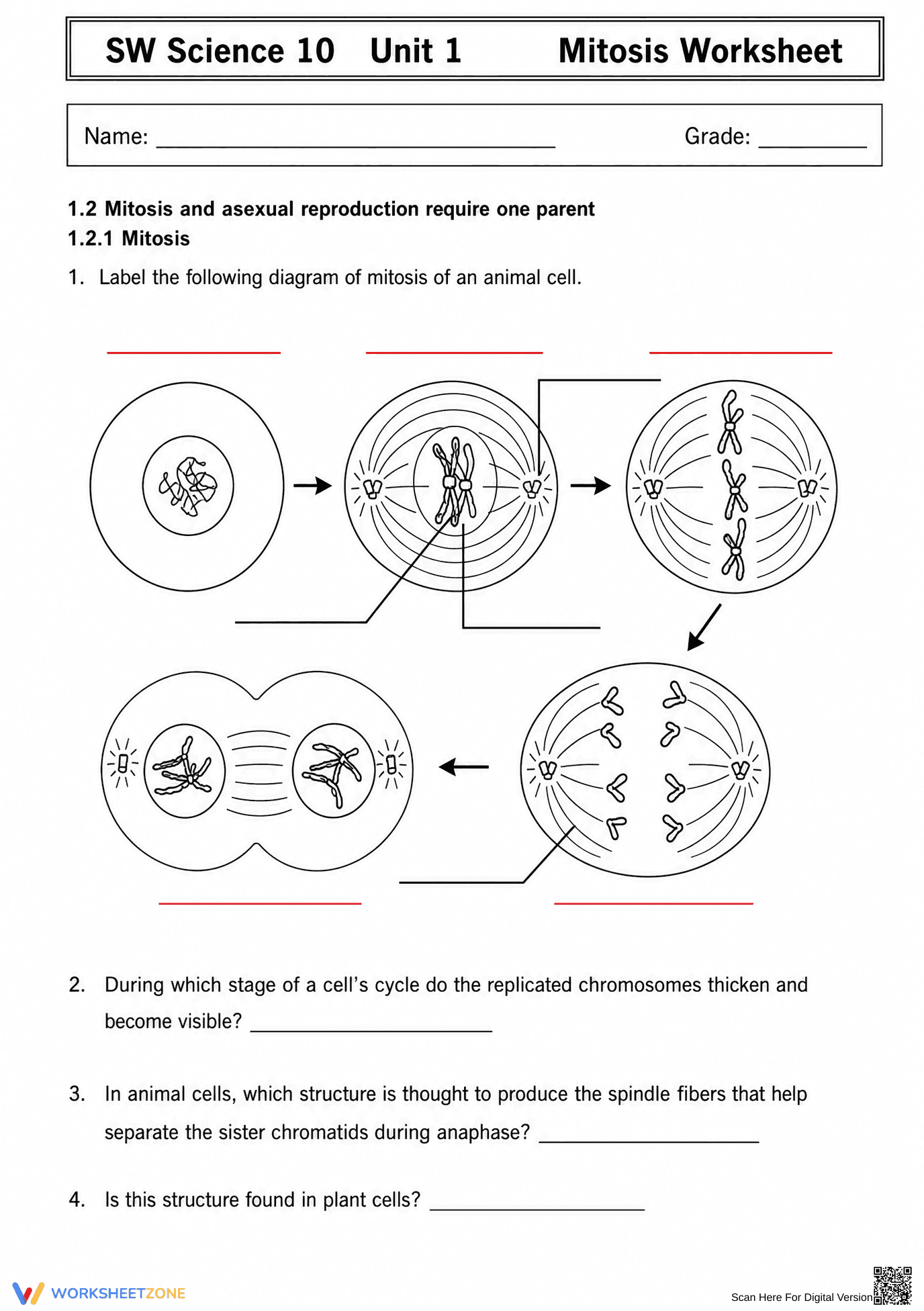
This Grade 9-12 mitosis worksheet provides a focused review of the cell cycle, enabling students to identify and sequence the phases of somatic cell division. By labeling diagrams and answering targeted questions, learners solidify their understanding of how animal cells replicate. It is an ideal resource for reinforcing biological vocabulary and visual recognition of cellular structures.
At a Glance
- Grade: 9-12 · Subject: Biology
- Standard:
HS-LS1-4— Use a model to illustrate the role of cellular division in maintaining complex organisms- Skill Focus: Mitosis stages and cellular structures
- Format: 1 page · 8 tasks · Full answer key included · PDF
- Best For: Quick formative assessment, homework, or sub plans
- Time: 15–20 minutes
The worksheet features a clear, sequential diagram of an animal cell undergoing mitosis, with five distinct labeling lines for the major phases. Below the visual model, three critical-thinking questions address chromosome visibility, spindle fiber production, and the differences between animal and plant cell structures. The layout is clean and optimized for black-and-white printing, ensuring all diagrams remain legible for students.
This resource is designed for immediate classroom implementation. Teachers can print the single-page PDF in under 1 minute, distribute it to students for a 15-minute independent session, and review the answers using the provided key in less than 5 minutes. It serves as a perfect "plug-and-play" activity for substitute plans or end-of-unit reviews where teacher preparation time must be kept to a minimum.
The primary focus is HS-LS1-4: "Use a model to illustrate the role of cellular division (mitosis) and differentiation in producing and maintaining complex organisms." This worksheet specifically addresses the modeling aspect by requiring students to interpret and label a visual representation of the process. Both standard codes can be copied directly into lesson plans, IEP goals, or district curriculum mapping tools.
Use this as a formative assessment immediately following a lecture on the cell cycle to check for misconceptions regarding anaphase and telophase. Alternatively, assign it as a pre-lab activity before students observe onion root tip slides under a microscope. Completion typically takes 15 to 20 minutes depending on prior knowledge, making it a versatile tool for bell-ringers or exit tickets.
This is tailored for high school biology students in grades 9 through 12, including those in introductory or honors-level courses. It provides necessary scaffolding for visual learners and can be paired with a digital animation of mitosis or a textbook chapter on asexual reproduction. The clear diagrams help English Language Learners (ELL) connect scientific terminology to physical processes.
According to the RAND AIRS 2024 report on secondary science instruction, visual modeling of microscopic processes like mitosis significantly improves long-term retention of biological concepts. This worksheet aligns with HS-LS1-4 by requiring students to engage with a conceptual model of cell division, identifying the specific roles of centrioles and spindle fibers. Research from Fisher & Frey (2014) emphasizes that labeling diagrams serves as a critical bridge between vocabulary acquisition and conceptual mastery in the life sciences. By isolating the five stages of mitosis—Interphase, Prophase, Metaphase, Anaphase, and Telophase—this resource ensures students can distinguish between the subtle transitions of the cell cycle. The inclusion of an answer key facilitates immediate feedback, a practice proven to reduce the formation of scientific misconceptions in high school learners. This structured approach supports the gradual release of responsibility in complex biological units.


