


























Views
Downloads

Printable Animal Offspring Matching Worksheet | Grade 1
Paste this activity's link or code into your existing LMS (Google Classroom, Canvas, Teams, Schoology, Moodle, etc.).
Students can open and work on the activity right away, with no student login required.
You'll still be able to track student progress and results from your teacher account.
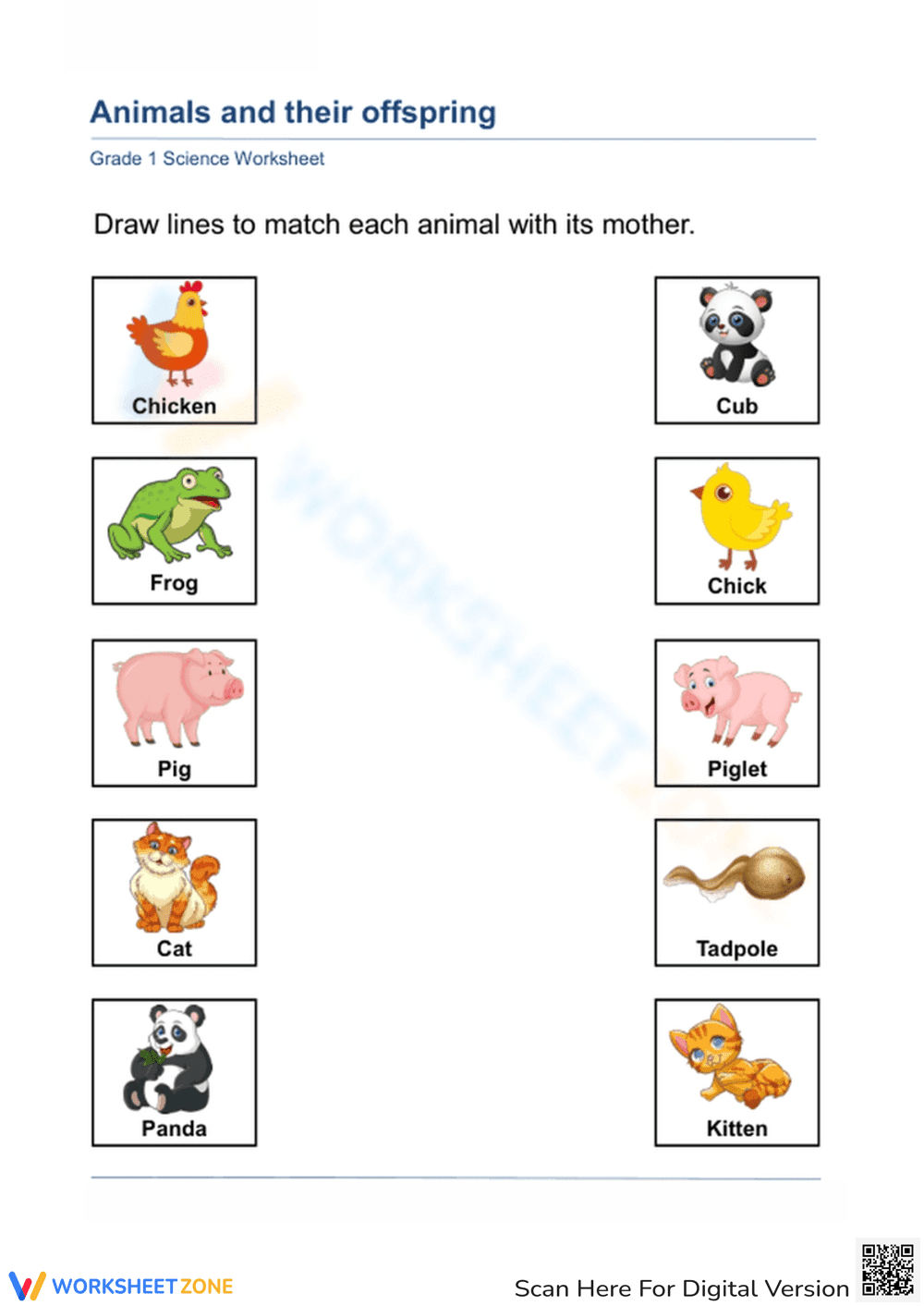
This Grade 1 science worksheet helps students identify the relationship between animals and their offspring through an engaging matching activity. By connecting parents with their young, learners observe structural similarities and differences, building a foundational understanding of heredity and life cycles. It provides a clear, visual way to reinforce vocabulary and biological concepts.
At a Glance
- Grade: 1 · Subject: Science
- Standard:
1-LS3-1— Observe how young animals are like, but not exactly like, their parents- Skill Focus: Animal and offspring identification
- Format: 1 page · 5 problems · Answer key included · PDF
- Best For: Kindergarten or First Grade science centers
- Time: 10–15 minutes
What's Inside
This resource features five distinct animal pairs—chicken, frog, pig, cat, and panda—with their corresponding offspring. The worksheet uses colorful illustrations and labels to support early readers. Students draw lines to connect the mother animal to its baby, such as matching a pig to a piglet or a frog to a tadpole. A full answer key is provided.
Zero-Prep Workflow
- Print: Generate copies for your class in seconds using standard settings.
- Distribute: Hand out sheets during a life sciences block with zero teacher setup.
- Review: Check work using the included key in under 2 minutes.
Total teacher preparation time is well under 2 minutes, making it ideal for emergency sub plans or last-minute lesson extensions.
Standards Alignment
The primary focus is 1-LS3-1, requiring students to "make observations to construct an evidence-based account that young plants and animals are like, but not exactly like, their parents." This worksheet provides the visual evidence needed for these observations. The standard code can be copied directly into lesson plans, IEP goals, or district curriculum mapping tools.
How to Use It
Use this as a formative assessment during your life cycles unit. After reading about baby animals, have students complete the matching task to verify understanding of parent-offspring pairs. It also works as a quiet station activity. Expected completion time is roughly 10 minutes.
Who It's For
Designed for Grade 1 and 2 students, this is also suitable for advanced Kindergarteners. It serves English Language Learners well through clear visual cues and labels. Pair this with an anchor chart showing animal families for a complete experience.
This Grade 1 science resource is specifically aligned with the 1-LS3-1 NGSS standard, focusing on the observable traits and relationships between animals and their offspring. Research from Fisher & Frey (2014) emphasizes the importance of visual literacy and scaffolded matching tasks in developing conceptual frameworks for early learners. By identifying 5 distinct animal pairs, students build the cognitive patterns necessary to understand biological heredity and life cycle progression. The inclusion of labels like "piglet" and "tadpole" supports specific domain vocabulary acquisition, which is a critical predictor of later scientific literacy. This activity serves as an essential bridge between simple observation and the construction of evidence-based accounts required by modern educational frameworks. It is designed to be a high-impact, low-barrier entry point into the life sciences for diverse classroom populations.


