


























Views
Downloads

Printable Animal Coverings Worksheet | Grade 2 Science
Paste this activity's link or code into your existing LMS (Google Classroom, Canvas, Teams, Schoology, Moodle, etc.).
Students can open and work on the activity right away, with no student login required.
You'll still be able to track student progress and results from your teacher account.
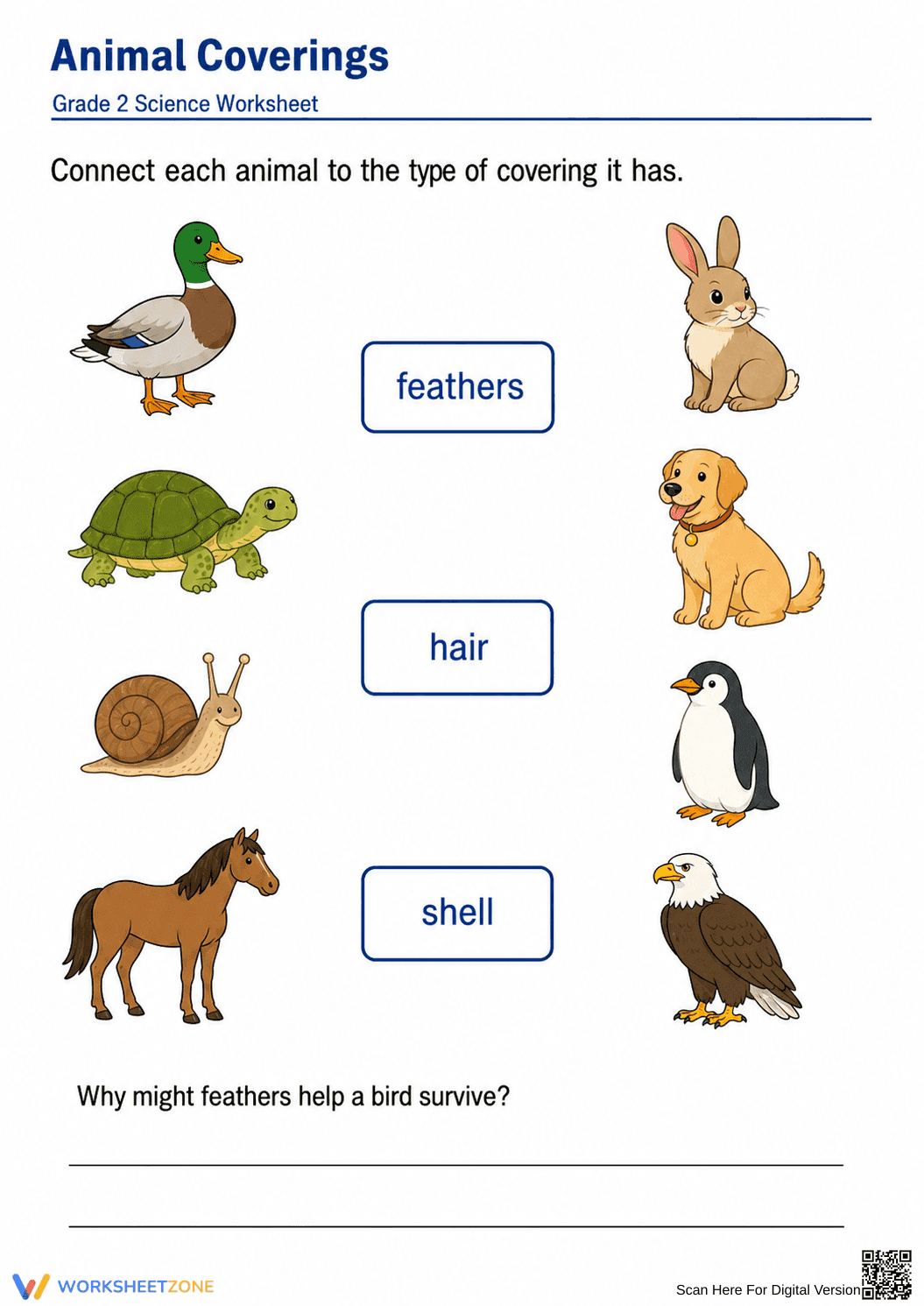
This Grade 2 science worksheet helps students identify and categorize animal body coverings, specifically feathers, hair, and shells. By matching various animals to their physical traits, learners develop a foundational understanding of how different species adapt to their environments. The final critical thinking prompt encourages students to analyze the functional relationship between body structure and survival.
At a Glance
At a Glance
- Grade: 2 · Subject: Science
- Standard:
2-LS4-1— Make observations of animals to compare the diversity of life in habitats- Skill Focus: Animal body coverings (hair, feathers, shells)
- Format: 1 page · 9 tasks · Answer key included · PDF
- Best For: Science centers or quick formative assessments
- Time: 10–15 minutes
What's Inside
This single-page PDF features 8 animal illustrations centered around three clearly labeled trait boxes. Students draw lines to connect the animal to its specific covering: feathers, hair, or a shell. The layout is clean, followed by a short-answer question prompting higher-order thinking about bird anatomy. A full answer key is provided for quick grading.
Zero-Prep Workflow
This resource is designed for immediate classroom integration with zero teacher setup. 1. Print (30 seconds): Output the single-page PDF for your entire class. 2. Distribute (1 minute): Hand out the sheets for a silent starter or a guided science lesson. 3. Review (1 minute): Use the included answer key to check student work or facilitate a whole-class discussion about biological diversity.
Standards Alignment
Aligned to `2-LS4-1`, this activity supports the requirement for students to make observations of animals to compare the diversity of life in different habitats. By focusing on physical characteristics like body coverings, students learn to distinguish between major animal groups. This standard code can be copied directly into lesson plans, IEP goals, or district curriculum mapping tools.
How to Use It
Use this worksheet as a formative assessment during a unit on animal traits. It is ideal for the "Explore" or "Explain" phase of a 5E lesson model. Completion typically takes 10 to 15 minutes, making it a perfect transition activity for busy elementary classrooms.
Who It's For
Designed for second-grade students, this worksheet is also appropriate for first-grade extension or third-grade review. The visual nature of the matching task makes it highly accessible for English Language Learners and students requiring visual support. It pairs naturally with an anchor chart displaying different animal habitats or a non-fiction text about animal adaptations.
According to the RAND AIRS 2024 report on elementary science literacy, structured visual categorization tasks like matching animal body coverings are essential for developing early taxonomic reasoning. This worksheet focuses on standard 2-LS4-1, requiring students to identify observable physical traits such as hair, feathers, and shells. Research by Fisher & Frey (2014) emphasizes that combining visual matching with a critical thinking prompt—like the bird anatomy question included here—facilitates the transition from identification to conceptual understanding. By engaging with nine distinct tasks, Grade 2 learners build the schema necessary to analyze how physical structures serve functional purposes. This evidence-based approach ensures that students are developing the inquiry skills prioritized in modern science frameworks. Educators can confidently implement this resource knowing it aligns with best practices for early childhood science instruction and standards-based mastery.


