


























Views
Downloads
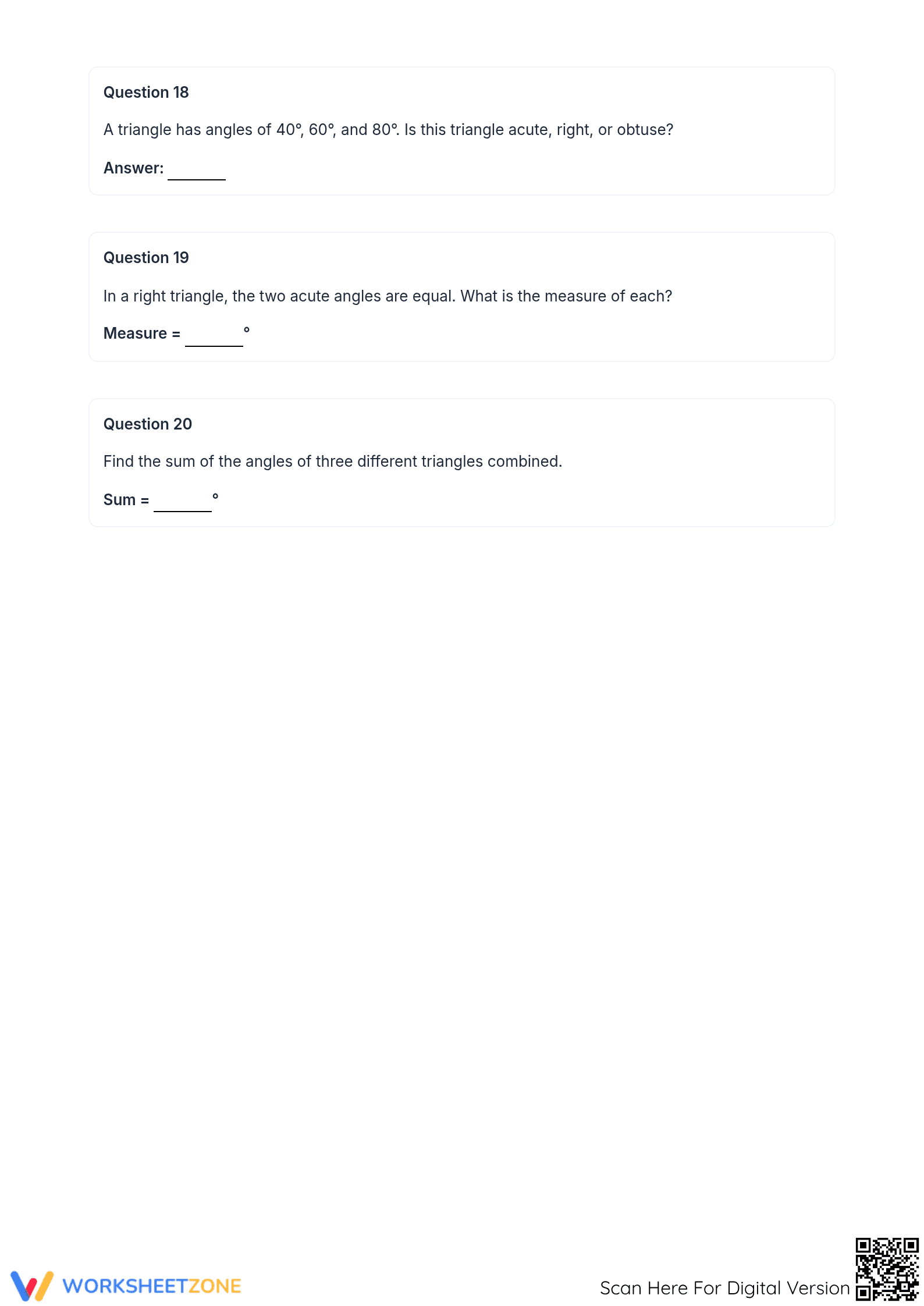

Grade 8 Angles in a Triangle — Printable No-Prep Worksheet
Paste this activity's link or code into your existing LMS (Google Classroom, Canvas, Teams, Schoology, Moodle, etc.).
Students can open and work on the activity right away, with no student login required.
You'll still be able to track student progress and results from your teacher account.
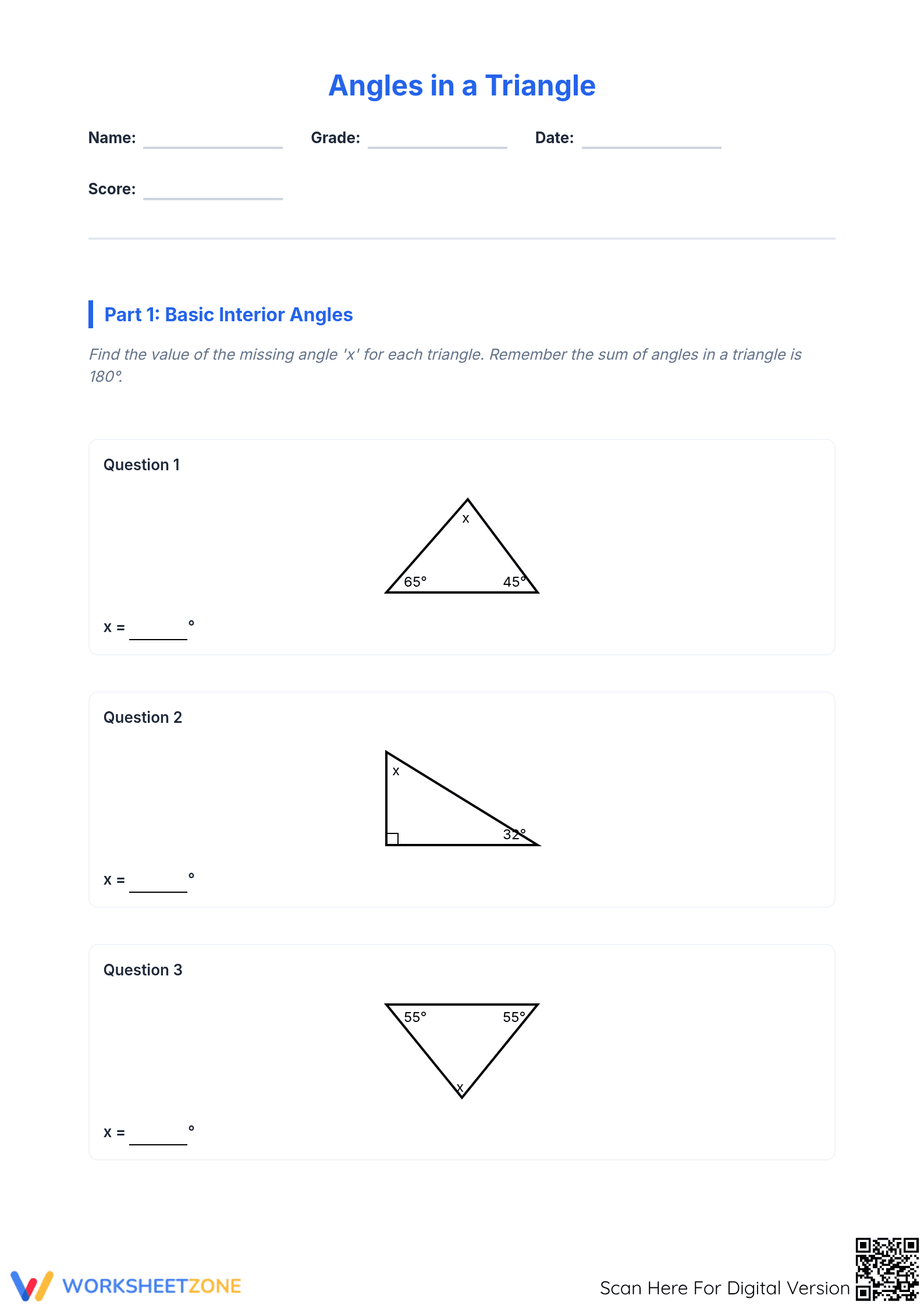
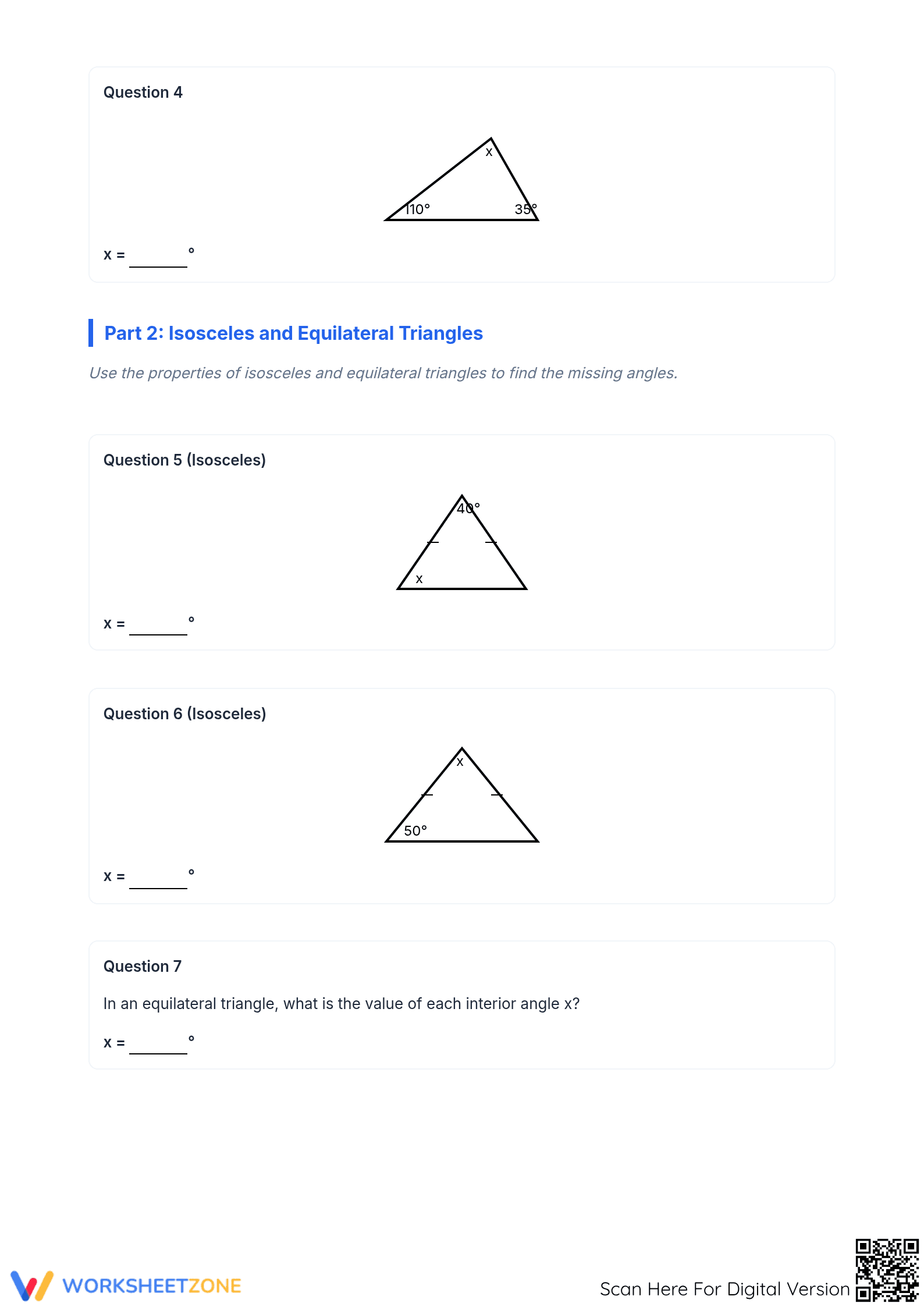
This comprehensive worksheet helps Grade 8 and 9 students master interior angle relationships within triangles. By progressing from basic arithmetic calculations to complex algebraic expressions and real-world word problems, learners develop a robust understanding of the 180-degree sum theorem. Students will successfully identify missing angles across diverse triangle types, including right, isosceles, and equilateral variants.
At a Glance
- Grade: 8 · Subject: Math
- Standard:
8.G.A.5— Use informal arguments to establish facts about the angle sum of triangles.- Skill Focus: Triangle Angle Sum Theorem
- Format: 5 pages · 20 problems · Answer key included · PDF
- Best For: Comprehensive unit review or homework
- Time: 45–60 minutes
What's Inside
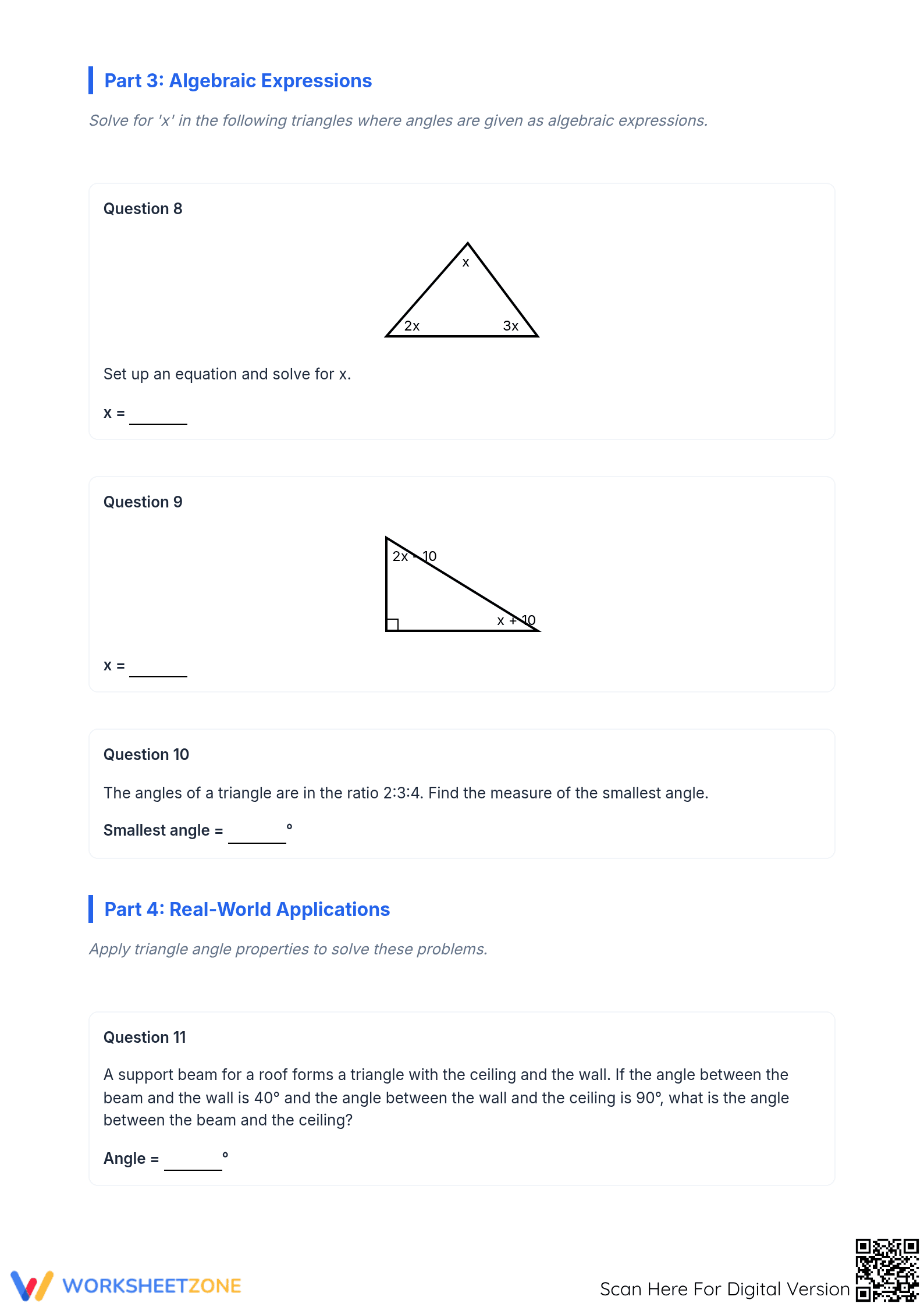
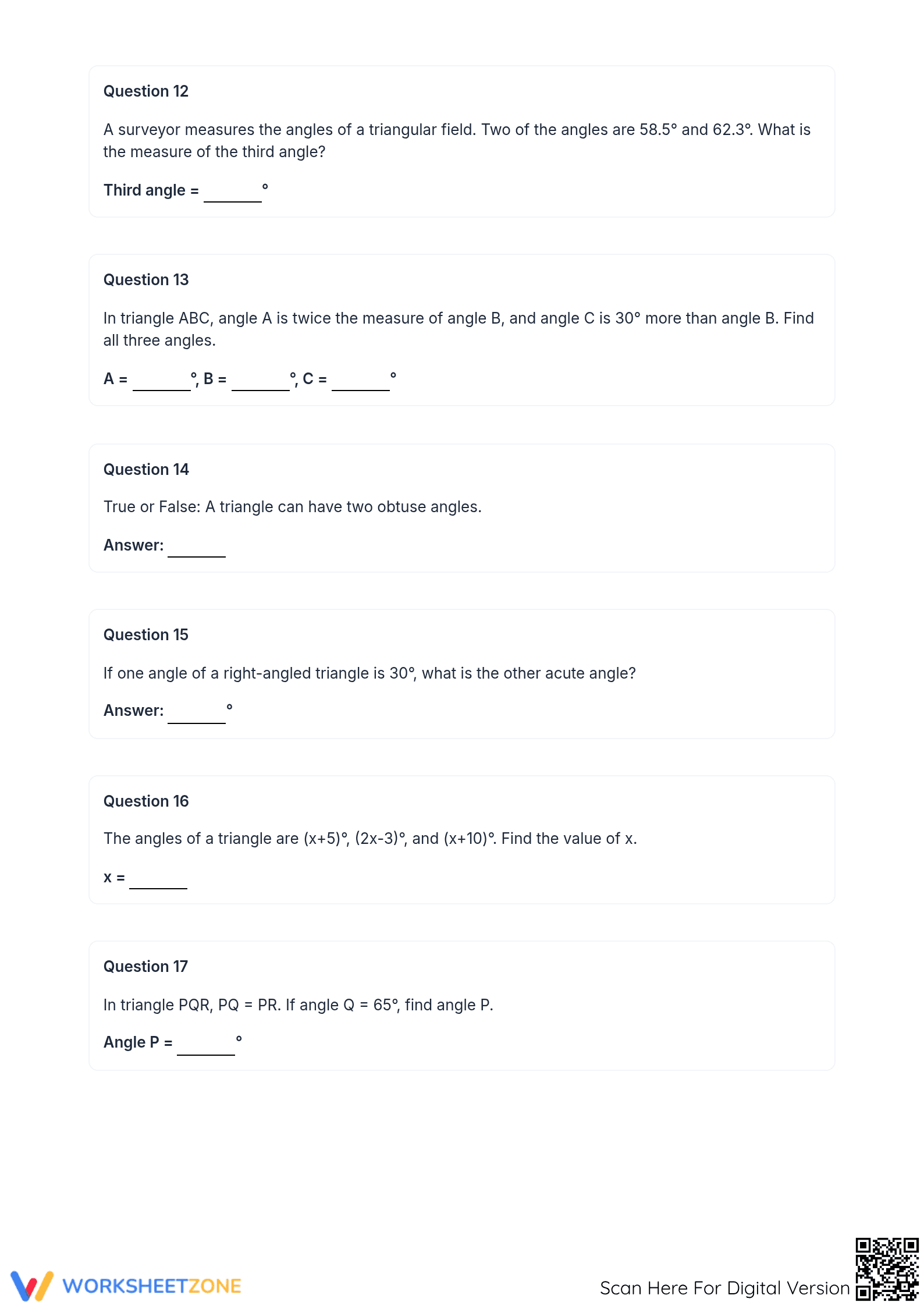
This five-page resource contains twenty structured problems divided into four distinct sections. It starts with basic interior angle calculations, moves into the specific properties of isosceles and equilateral triangles, introduces algebraic expressions for angle measures, and concludes with a series of real-world application word problems. A full answer key is provided for all five pages to facilitate quick grading and immediate feedback for learners.
Zero-Prep Workflow
This resource is designed for immediate classroom implementation with a three-step workflow. First, print the five-page PDF (less than 1 minute). Second, distribute the packets to students for independent or small-group practice (2 minutes). Finally, review the solutions using the included answer key during the last ten minutes of class. Total teacher preparation time is under two minutes, making it an ideal emergency sub plan or "print-and-go" assessment.
Standards Alignment
This worksheet is primarily aligned to 8.G.A.5, focusing on the fundamental geometric principle that the sum of interior angles in any triangle is exactly 180 degrees. It also supports higher-level algebraic reasoning as students must set up and solve linear equations to find unknown values based on geometric constraints. Both standard codes can be copied directly into lesson plans, IEP goals, or district curriculum mapping tools.
How to Use It
Use this packet as a summative assessment at the end of a geometry unit to verify student mastery of angle relationships. Alternatively, assign the real-world application section as a collaborative challenge for students to complete in pairs. During instruction, observe how students handle the algebraic expressions in Part 3 to identify those who need additional support bridging the gap between geometry and algebra. Completion typically takes 45 to 60 minutes.
Who It's For
This resource is tailored for Grade 8 and 9 students enrolled in Pre-Algebra or Algebra 1 courses. It provides natural differentiation through its tiered structure, allowing teachers to assign only the first two sections to struggling learners while challenging advanced students with the multi-step word problems. It pairs naturally with a geometry anchor chart displaying triangle classification and the 180-degree sum theorem for constant visual reference.
According to the RAND AIRS 2024 report on mathematics instructional materials, the integration of algebraic reasoning within geometric contexts is essential for preparing middle school students for secondary success. This worksheet directly addresses this need by requiring students to apply the 8.G.A.5 standard through various lenses, including literal angle measures, geometric properties of isosceles triangles, and algebraic expressions. By solving 20 distinct tasks that range from simple subtraction to complex multi-step equations, students build a deep conceptual understanding of the triangle angle sum theorem. Research from Fisher & Frey (2014) highlights that such structured, cumulative practice sets are critical for the gradual release of responsibility, moving students from guided calculation to independent problem-solving in real-world scenarios. This printable resource ensures that learners not only memorize the 180-degree rule but can also apply it across different mathematical domains, ensuring alignment with rigorous state and national standards.


