


























Views
Plays

Printable Word Meanings Worksheet | Grade 5 ELA
Paste this activity's link or code into your existing LMS (Google Classroom, Canvas, Teams, Schoology, Moodle, etc.).
Students can open and work on the activity right away, with no student login required.
You'll still be able to track student progress and results from your teacher account.
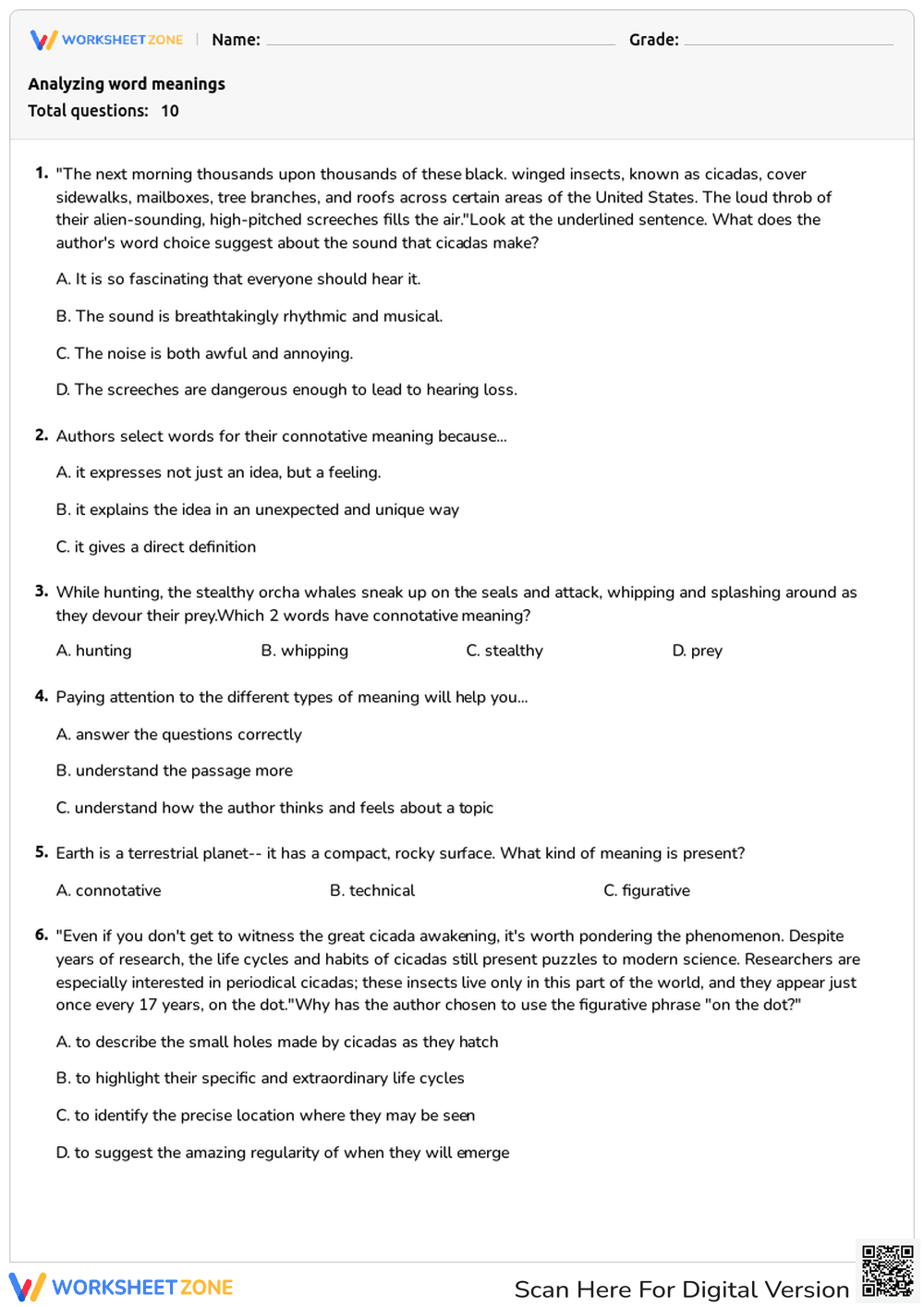
This focused worksheet helps fifth-grade students master the nuances of language by analyzing connotative, figurative, and technical word meanings in context. By evaluating short passages and sentences, learners will develop a stronger grasp of how author word choice impacts tone, feeling, and overall text comprehension.
At a Glance
- Grade: 5 · Subject: ELA
- Standard:
CCSS.ELA-LITERACY.L.5.5— Understand figurative language and nuances in word meanings- Skill Focus: Connotative and Figurative Meanings
- Format: 2 pages · 10 problems · Answer key included · PDF
- Best For: Independent practice or assessment
- Time: 15–20 minutes
What's Inside
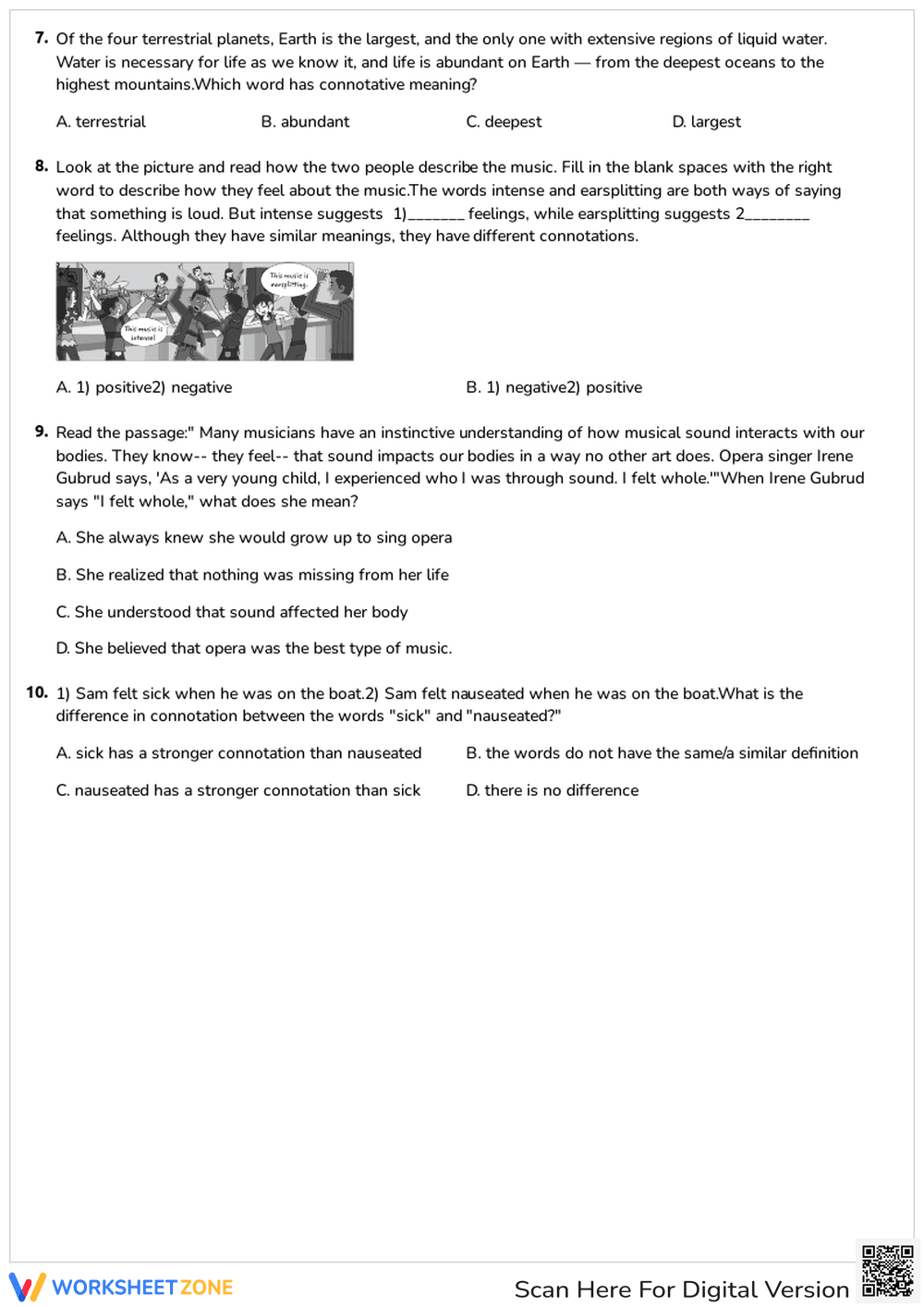
This two-page resource features 10 multiple-choice questions that challenge students to identify and interpret different types of word meanings. The task types include reading short cross-curricular excerpts—ranging from science facts about cicadas to descriptions of music—and determining why an author chose specific figurative phrases or connotative words. A complete answer key is included for quick grading.
Skill Progression
- Guided practice: The initial questions introduce the concept of connotative meaning, asking students to define why authors use it to express feelings rather than just ideas.
- Supported practice: Middle questions provide short, engaging context clues (like a passage about orca whales or cicadas) where students must identify which specific words carry connotative weight.
- Independent practice: The final questions require students to compare the nuances of similar words (e.g., "sick" versus "nauseated") to determine differences in intensity.
This structure follows a gradual-release model, ensuring students build confidence as they progress through the I Do, We Do, You Do framework.
Standards Alignment
Aligned to primary standard CCSS.ELA-LITERACY.L.5.5: Demonstrate understanding of figurative language, word relationships, and nuances in word meanings. It also supports reading comprehension standards by asking students to determine the meaning of words as they are used in a text. Both standard codes can be copied directly into lesson plans, IEP goals, or district curriculum mapping tools.
How to Use It
This worksheet is highly versatile for classroom instruction. Use it as a formative assessment after direct instruction on connotations and denotations to gauge student understanding. Alternatively, assign it as focused independent practice during literacy centers. As an observation tip, watch to see if students can articulate why a word has a positive or negative connotation before they select their multiple-choice answer. Expected completion time is 15 to 20 minutes.
Who It's For
This resource is designed for fifth-grade general education students, but it serves as excellent review material for sixth graders needing extra support with language nuances. For differentiation, teachers can read the longer passages aloud to support struggling readers while still assessing their vocabulary comprehension. It pairs perfectly with an anchor chart on positive and negative connotations.
Explicit instruction in vocabulary nuances, such as those covered by CCSS.ELA-LITERACY.L.5.5 (Understand figurative language and nuances in word meanings), is critical for advanced reading comprehension. According to Fisher & Frey (2014), students who actively analyze author word choice and connotative meanings develop significantly stronger critical thinking skills and deeper emotional intelligence regarding text tone. When learners move beyond simple denotations to understand how words like "intense" versus "earsplitting" shape a reader's perception, they transition from passive decoders to active analytical readers. This targeted practice ensures students can navigate complex texts across various subjects, recognizing that vocabulary is not just about definitions, but about the subtle shades of meaning that authors use to persuade, inform, or entertain their audience.


