


























Views
Downloads
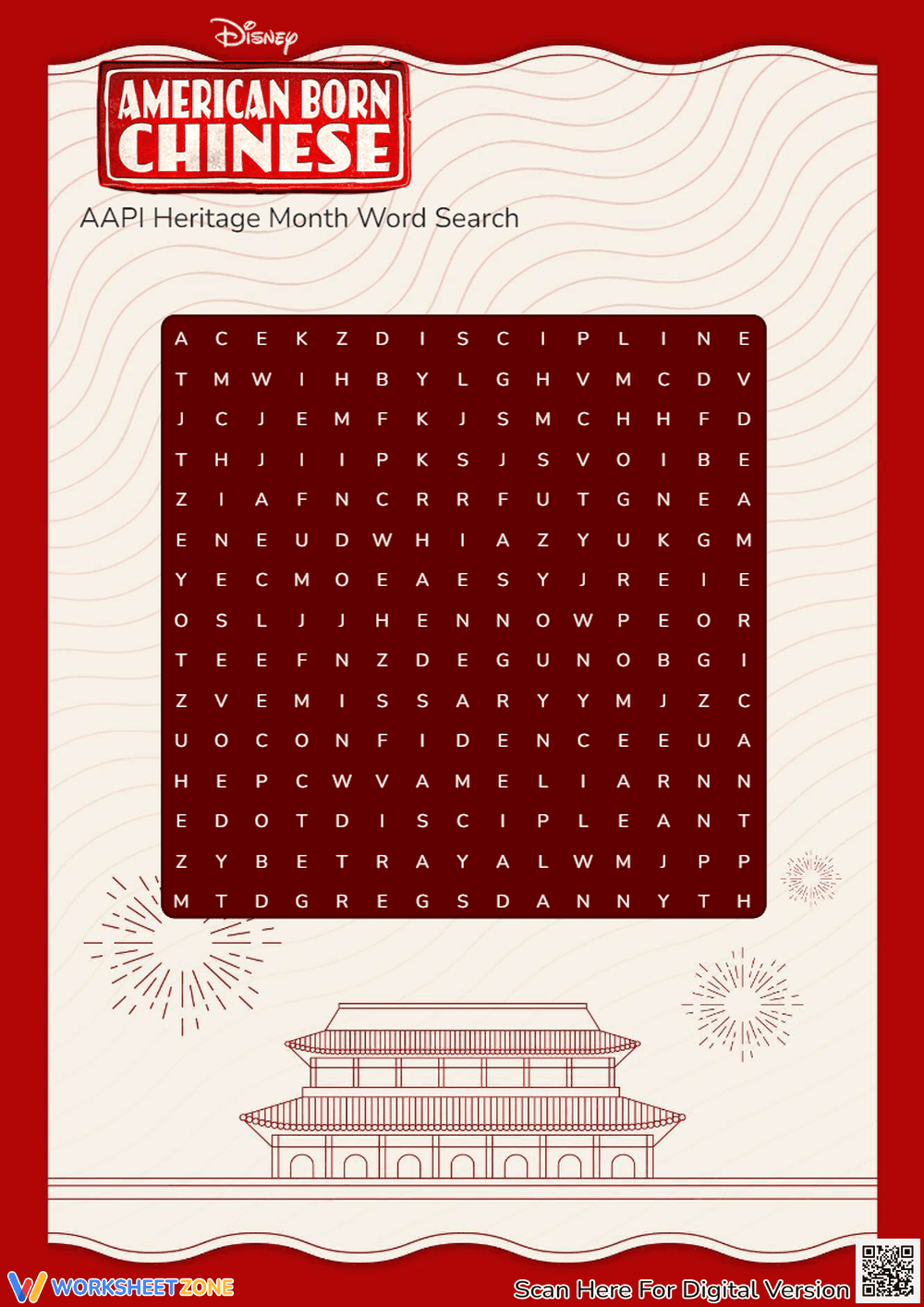

American Born Chinese Word Search | Essential AAPI Worksheet
Paste this activity's link or code into your existing LMS (Google Classroom, Canvas, Teams, Schoology, Moodle, etc.).
Students can open and work on the activity right away, with no student login required.
You'll still be able to track student progress and results from your teacher account.
This Grade 3-5 American Born Chinese word search provides a focused vocabulary activity to celebrate AAPI Heritage Month. Students identify key terms from the narrative, reinforcing word recognition and thematic understanding. It serves as a perfect supplemental resource for literature circles or cultural heritage lessons, ensuring students engage with meaningful content while building literacy skills.
At a Glance
- Grade: 3-5 · Subject: ELA / Social Studies
- Standard:
CCSS.ELA-LITERACY.L.4.6— Acquire and use grade-appropriate general academic and domain-specific words- Skill Focus: Vocabulary & Word Recognition
- Format: 1 page · 15 words · Answer key included · PDF
- Best For: AAPI Heritage Month morning work
- Time: 15–20 minutes
This single-page PDF features a high-density word search grid containing 15 vocabulary words and character names related to the American Born Chinese narrative. The layout is clean and visually engaging, featuring thematic borders that honor Asian Pacific American Heritage Month. A comprehensive answer key is provided to facilitate quick grading or student self-correction, making it a complete instructional tool for busy classrooms.
Zero-Prep Workflow:
- Print: Select the single-page PDF and print enough copies for your class in under 30 seconds.
- Distribute: Hand out the worksheets as a bell-ringer or transition activity; no additional materials or teacher setup are required.
- Review: Use the included answer key to check student progress or display it on a projector for a 2-minute whole-class review. Total teacher preparation time is less than 2 minutes.
The primary standard addressed is CCSS.ELA-LITERACY.L.4.6, which requires students to acquire and use accurately grade-appropriate general academic and domain-specific words and phrases. By identifying terms like discipline, emissary, and betrayal, students strengthen their lexical flexibility within a specific cultural and literary context. This standard code can be copied directly into lesson plans, IEP goals, or district curriculum mapping tools.
Assign this worksheet during the first 15 minutes of class as a Do Now activity to settle students and introduce the day's cultural theme. It also functions effectively as a formative assessment tool; observe which students struggle with word orientation to identify needs for visual-spatial support. This activity typically takes 15 to 20 minutes to complete.
This resource is designed for students in Grades 3, 4, and 5, particularly those studying AAPI history or reading graphic novels. It is an excellent pairing for a classroom anchor chart on character traits or a direct instruction lesson on the themes of identity and heritage.
Vocabulary acquisition through word-search puzzles is supported by research indicating that gamified word recognition tasks improve orthographic processing and lexical retrieval. According to Fisher & Frey (2014), providing students with multiple exposures to domain-specific vocabulary within a thematic context—such as AAPI Heritage Month—enhances long-term retention and comprehension of complex narratives. This worksheet aligns with CCSS.ELA-LITERACY.L.4.6 by focusing on academic terms like discipline and confidence found in the American Born Chinese text. By integrating these terms into a low-stakes, high-engagement format, educators can bridge the gap between simple word recognition and deep conceptual understanding. Research from the NAEP suggests that students who engage with diverse cultural content in literacy tasks show higher levels of engagement and improved performance in cross-disciplinary reading assessments. This resource provides a structured, evidence-based approach to celebrating heritage while meeting rigorous ELA standards.


