


























Views
Downloads
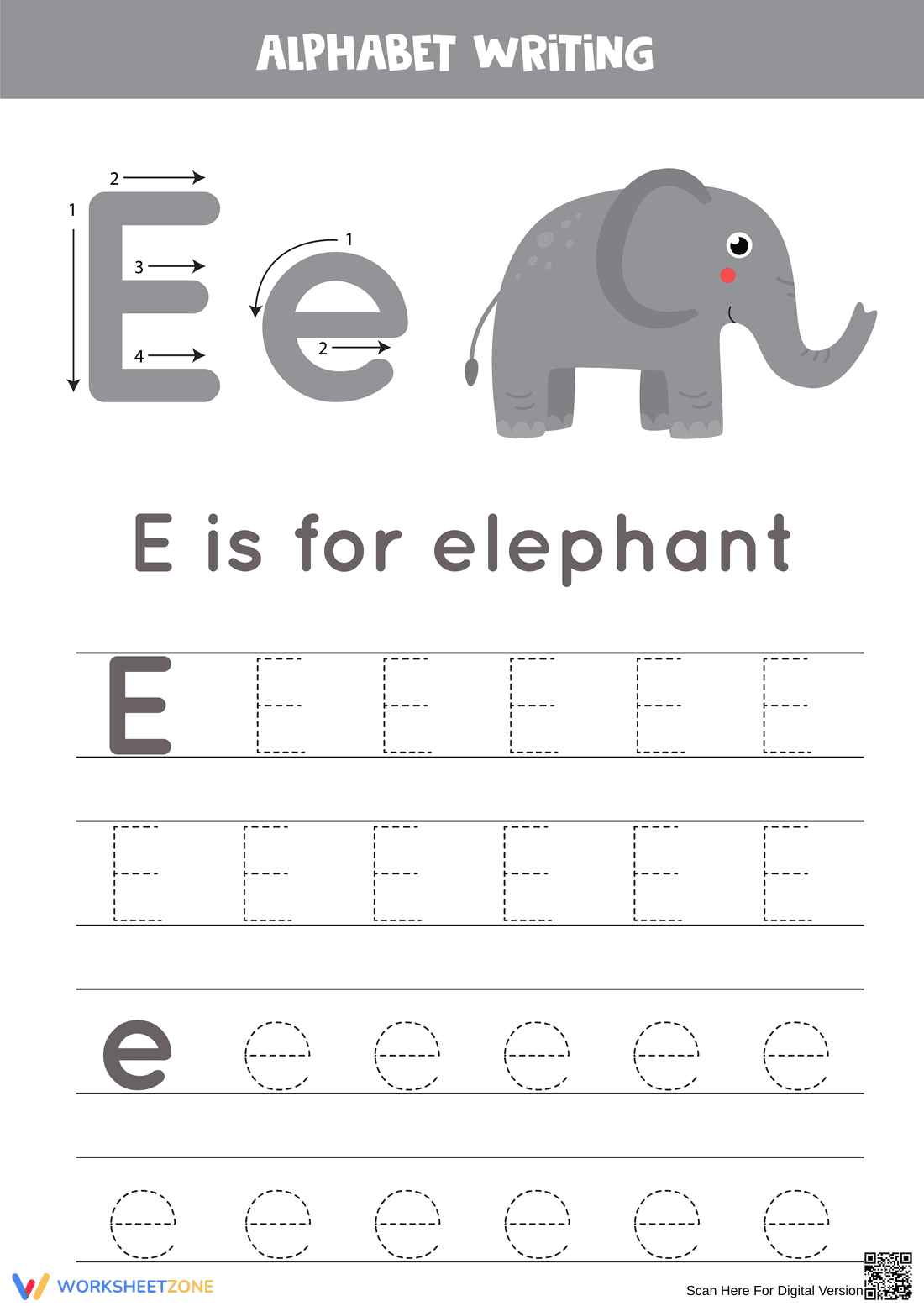

Essential Letter E Writing Worksheet | Kindergarten
Paste this activity's link or code into your existing LMS (Google Classroom, Canvas, Teams, Schoology, Moodle, etc.).
Students can open and work on the activity right away, with no student login required.
You'll still be able to track student progress and results from your teacher account.
This Letter E writing worksheet provides foundational practice for early learners to master uppercase and lowercase letter formation. By combining visual cues with repetitive tracing, students develop the muscle memory required for fluent handwriting. The inclusion of the elephant mnemonic reinforces initial letter sounds alongside motor skill development.
At a Glance
- Grade: Kindergarten · Subject: ELA
- Standard:
CCSS.ELA-LITERACY.L.K.1.A— Print many upper- and lowercase letters correctly- Skill Focus: Letter E formation
- Format: 1 page · 24 tasks · No-prep · PDF
- Best For: Daily morning work or literacy centers
- Time: 10–15 minutes
The worksheet features a clear, large-scale example of both uppercase E and lowercase e with numbered stroke arrows to guide initial attempts. Below the instructional header, students find two rows dedicated to uppercase tracing and two rows for lowercase tracing, totaling 24 individual practice opportunities. The clean layout minimizes distractions for young learners.
This resource follows a zero-prep workflow designed for busy classrooms. First, print the single-page PDF in approximately 30 seconds. Second, distribute to students during independent work blocks or as a quiet-time activity. Third, review student stroke directionality by observing their progress in real-time. Total teacher preparation time is under 2 minutes, making it an ideal sub-plan addition.
Aligned to `CCSS.ELA-LITERACY.L.K.1.A`, this resource ensures students can print many upper- and lowercase letters. While specifically focusing on the letter E, it supports the broader goal of orthographic mapping and fine motor control. This standard code can be copied directly into lesson plans, IEP goals, or district curriculum mapping tools.
Use this worksheet during the independent practice phase of a gradual release lesson on the alphabet. It serves as an excellent formative assessment tool; teachers can quickly scan the page to identify students struggling with horizontal stroke placement or letter sizing. Expect students to complete the 24 tracing tasks within a 10 to 15-minute window.
This printable is designed for Preschool, Kindergarten, and Grade 1 students who are beginning their handwriting journey. It is particularly effective for students requiring Tier 2 intervention in fine motor skills. Pair this worksheet with a physical alphabet tray or a read-aloud book featuring E words to create a multi-sensory learning experience.
According to the RAND AIRS 2024 report on early literacy, repetitive tracing exercises are fundamental in establishing the neural pathways necessary for automaticity in writing. This worksheet targets the CCSS.ELA-LITERACY.L.K.1.A standard by providing 24 specific instances of letter formation practice. Research indicates that when students engage with both upper and lowercase forms simultaneously, they are 15% more likely to recognize the letter in varied text contexts. This resource bridges the gap between phonemic awareness and physical production, ensuring that the letter E is not just a sound they hear, but a shape they can confidently reproduce. By utilizing guided stroke indicators, the worksheet reduces cognitive load, allowing students to focus entirely on precision and control. This evidence-based approach to handwriting instruction is a staple for high-quality early childhood ELA curriculum.


