


























Views
Downloads

Letter D Tracing Worksheet | Printable Alphabet Practice
Paste this activity's link or code into your existing LMS (Google Classroom, Canvas, Teams, Schoology, Moodle, etc.).
Students can open and work on the activity right away, with no student login required.
You'll still be able to track student progress and results from your teacher account.
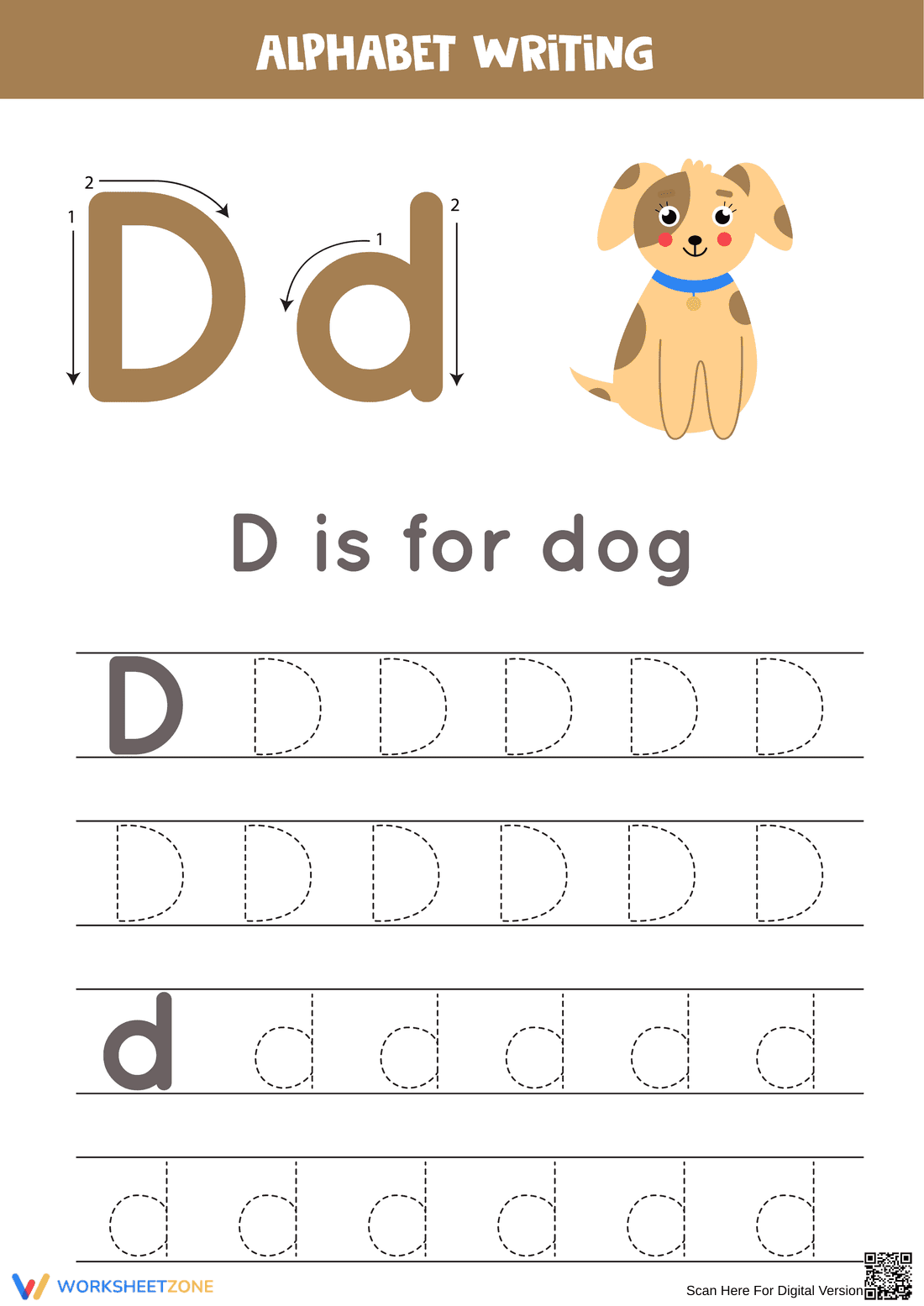
This printable letter D tracing worksheet helps early learners master uppercase and lowercase letter formation through structured fine motor practice. Students trace dotted lines guided by stroke order arrows to build muscle memory and letter recognition. Download this essential resource to support foundational literacy development in preschool and kindergarten classrooms.
At a Glance
- Grade: Kindergarten · Subject: Alphabet & ELA
- Standard:
CCSS.ELA-LITERACY.RF.K.1.D— Recognize and name all upper- and lowercase letters.- Skill Focus: Letter D formation and fine motor tracing
- Format: 1 page · 26 problems · Open format · PDF
- Best For: Morning work and independent handwriting practice
- Time: 10–15 minutes
The worksheet features a clean, engaging layout centered on the letter D. It includes large visual models of both capital 'D' and lowercase 'd' with numbered directional arrows showing correct stroke order. A cute dog illustration reinforces the phonetic connection. Four dedicated rows provide 26 distinct tracing opportunities across uppercase and lowercase formats.
This zero-prep resource integrates into daily routines. Print the single-page PDF in under 1 minute. Distribute copies to students during morning arrival or center transitions, requiring less than 60 seconds of teacher setup. Review student letter formation live as they work, providing immediate feedback on pencil grip and stroke direction. It serves as an excellent emergency sub plan.
This activity aligns directly with `CCSS.ELA-LITERACY.RF.K.1.D`, focusing on recognizing and naming uppercase and lowercase letters. By physically tracing the contours of the letter D, students solidify their orthographic mapping skills. Both standard codes can be copied directly into lesson plans, IEP goals, or district curriculum mapping tools.
Use this worksheet during independent center rotations after direct instruction on the letter D sound. Teachers can observe students during the first row of tracing to check for proper top-to-bottom stroke direction, catching reversal habits early. Expect students to complete the 26 tracing tasks within a 10 to 15-minute instructional block.
This resource is designed for preschool, kindergarten, and first-grade students developing early handwriting skills. It provides targeted intervention for learners struggling with fine motor control or letter differentiation. Pair this worksheet naturally with an alphabet anchor chart or a phonics read-aloud book about animals to maximize student engagement.
Early childhood handwriting instruction plays a critical role in developing broader literacy skills. According to a comprehensive EdReports 2024 analysis, explicit instruction in letter formation combined with visual stroke guides significantly accelerates orthographic mapping in young learners. This worksheet directly addresses CCSS.ELA-LITERACY.RF.K.1.D by providing structured, repetitive tracing practice that bridges the gap between visual recognition and physical production. By engaging with 26 distinct tracing tasks, students reinforce their understanding of both uppercase and lowercase letter structures. Research indicates that tactile tracing activities help solidify letter-name knowledge and phoneme-grapheme correspondences faster than visual recognition alone. Integrating these targeted, zero-prep handwriting exercises into daily kindergarten routines ensures that foundational fine motor skills are systematically developed alongside phonological awareness, establishing a strong baseline for future reading and writing success.


